Overvoltage Fault in VFD (Variable Frequency Drive)
Causes of Overvoltage Fault
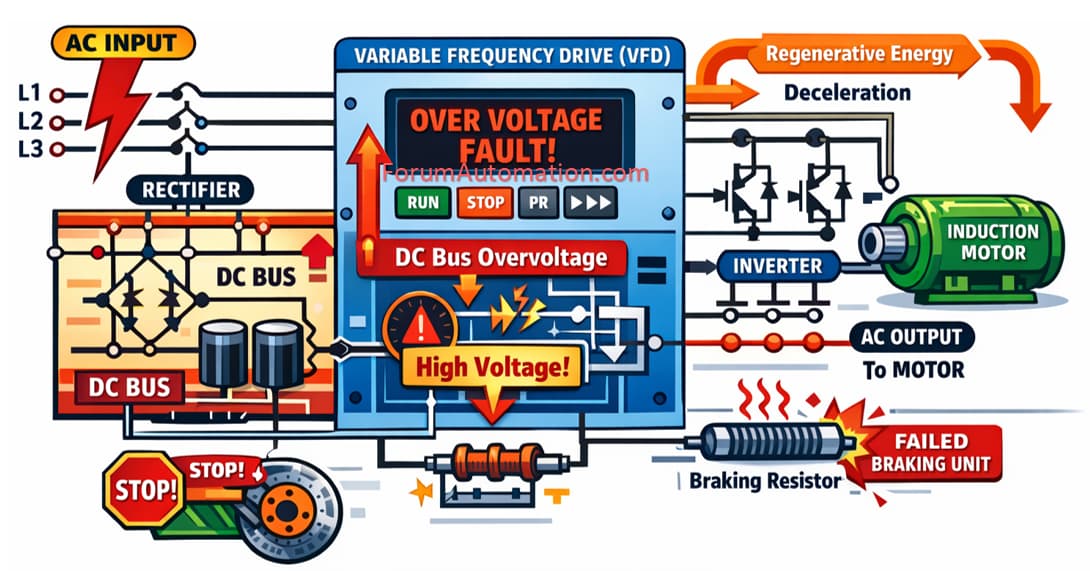
Regenerative Energy
During motor deceleration, energy flows back to the Variable Frequency Drive (VFD).
This increases DC bus voltage → trips on overvoltage.
Fast Deceleration Time
Sudden stopping → high energy return → voltage spike.
High Input Supply Voltage
Supply voltage higher than rated → DC bus exceeds limit.
Faulty Braking Resistor / Unit
Braking system fails → excess energy not dissipated.
Load Inertia (Heavy Loads)
High inertia loads (fans, conveyors) generate more regenerative energy.
Voltage Spikes / Surges
Lightning or switching surges increase input voltage.
How to prevent Overvoltage Fault?
1). Increase Deceleration Time
Slower stopping reduces regenerative energy.
2). Install Braking Resistor
Dissipates excess energy as heat.
3). Use Dynamic Braking Unit
Controls DC bus voltage effectively.
4). Use Regenerative VFD
Sends excess energy back to supply instead of tripping.
5). Check Input Supply Voltage
Ensure voltage is within limits.
6). Install Line Reactor / Surge Protection
Reduces spikes and harmonics.
7). Proper Load Selection
Avoid sudden stopping of high inertia loads.
Overvoltage in a VFD occurs mainly due to regenerative energy during the motor deceleration, high input voltage (or) braking system failure.
It can be prevented by increasing deceleration time, using braking resistors or regenerative drives and ensuring proper supply voltage and surge protection.
You can also follow us on AutomationForum.co, Facebook and Linkedin to receive daily Instrumentation updates.
You can also follow us on ForumElectrical.com , Facebook and Linkedin to receive daily Electrical updates.