What are the two types of Modbus?
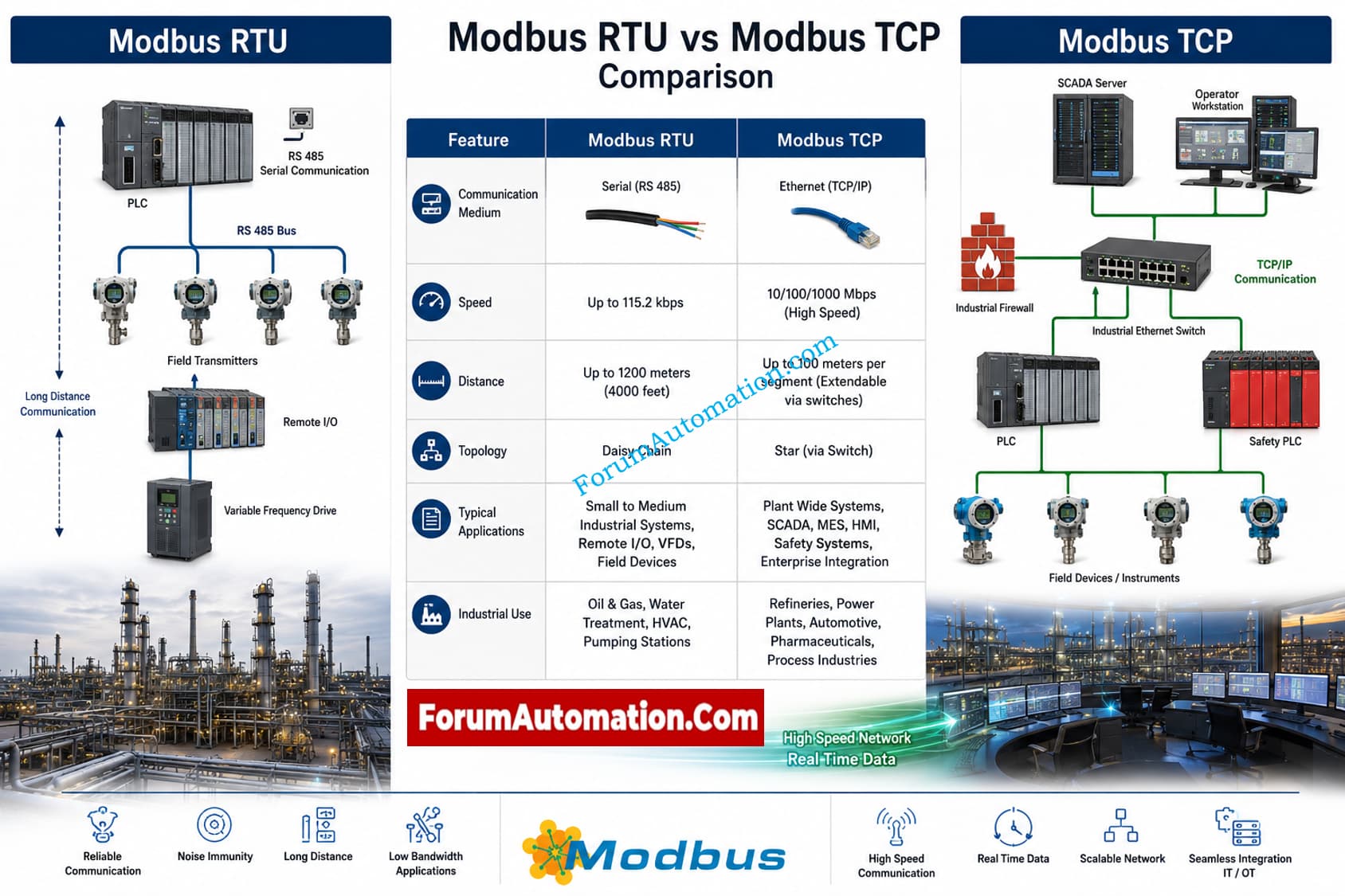
What are the two types of Modbus?
Two Main Types of Modbus
There are two major Modbus communication protocols that are utilized in industrial automation . These are Modbus RTU and Modbus TCP. Both are used for the interchange of process data between controllers and field equipment, although they use distinct means for communication.
Modbus RTU
Modbus RTU is a serial communication protocol that typically uses RS 485 networks.
Key characteristics include:
- Serial communication
- Multi drop architecture
- Lower installation cost
- Long communication distance
- Common for field instruments and remote I O devices
It is commonly utilized in process facilities because to its simplicity and durability in industrial applications.
Modbus TCP
Modbus TCP operates over standard Ethernet networks using TCP IP communication.
Key characteristics include:
- High communication speed
- Ethernet connectivity
- Easy network expansion
- Integration with PLC, SCADA, and industrial servers
- Suitable for modern digital automation systems
Modbus TCP is often chosen for larger facilities when data interchange needs to be speedier and monitored from a central location.
Selection Considerations
Instrumentation engineers select the protocol based on:
- Communication distance
- Required speed
- Existing infrastructure
- Number of connected devices
- Network architecture
- Maintenance requirements
Practical Comparison
For example , a wastewater treatment plant may employ Modbus RTU for distant flow transmitters and Modbus TCP for communication between PLCs , SCADA servers and operator workstations . This is a mix for reliable field connectivity with high speed plant level networking.
Understanding Modbus RTU and Modbus TCP enables engineers to create robust industrial communication systems, facilitate commissioning and enhance troubleshooting efficiency throughout process automation projects.