What are the requirements for intrinsically safe?
What are the requirements for intrinsically safe?
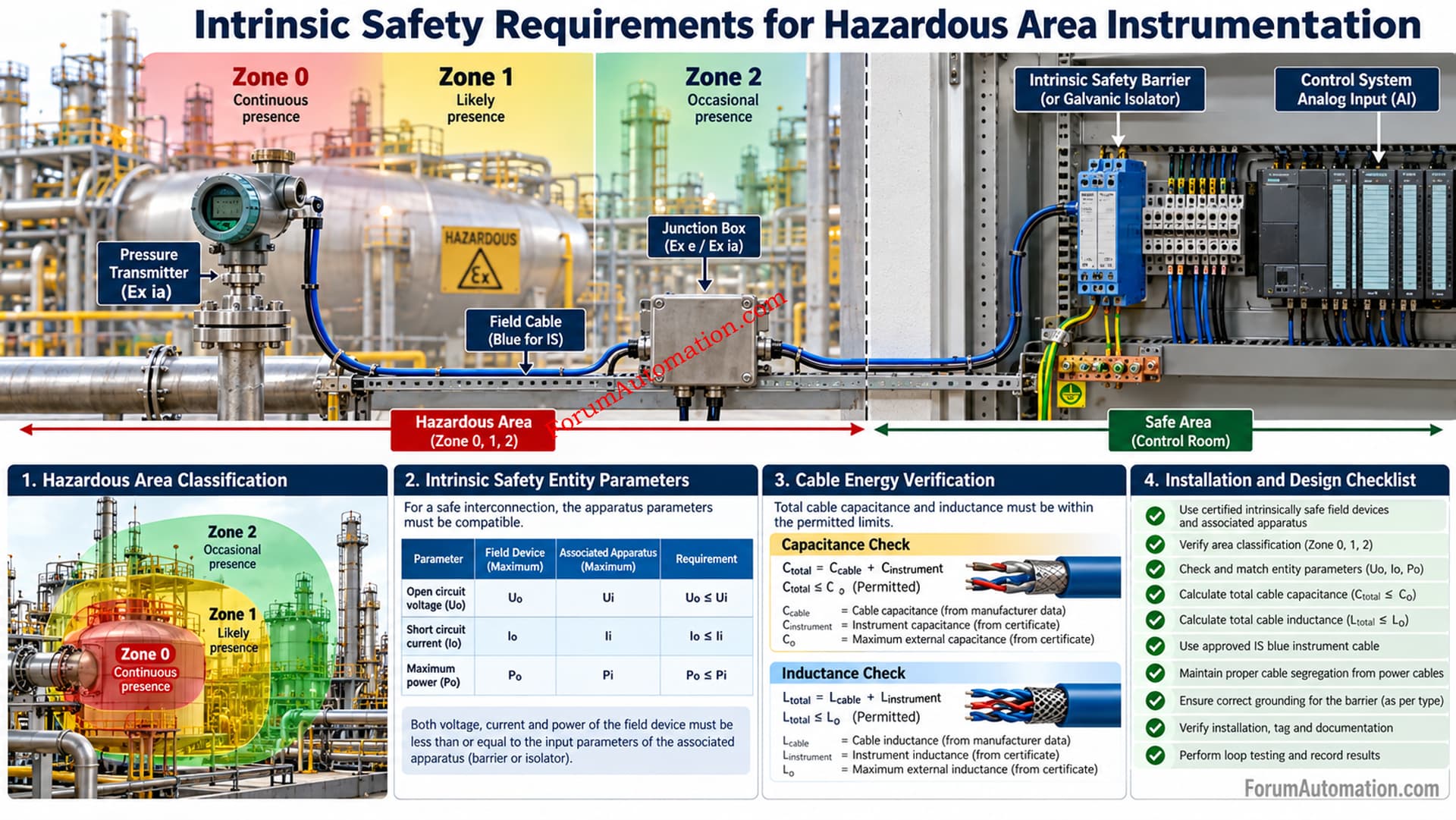
Intrinsic safety controls electrical and thermal energy such that a circuit cannot cause ignition in an explosive atmosphere. Don’t just check the transmitter, check the whole instrument loop.
1. Confirm area classification
Identify the zone, gas or dust group, temperature class and equipment protection level from hazardous area documentation. Choose equipment with appropriate certification. Comply with rules and IEC 60079 criteria, including IEC 60079 11 for intrinsic safety and IEC 60079 14 for installation.
2. Match barrier and instrument
Use a certified intrinsically safe field device with either a barrier or galvanic isolator. Verify under the entity idea :
- Barrier Uo is less than or equal to device Ui.
- Barrier Io is less than or equal to device Ii.
- Barrier Po is less than or equal to device Pi.
Check also stored energy. Total cable and instrument capacitance shall be within barrier Co and inductance shall be within Lo, subject to certifications.
3. Verify installation
Separate the intrinsically safe wiring from non IS circuits as required. Terminals, cable identification, enclosure entrances and separation. Check grounding and bonding, particularly for Zener barriers which rely on a high integrity earth. Grounding may be simplified with galvanic isolators, but they still need to be chosen and installed.
4. Document and inspect
Keep certificates, control drawings, loop calculations, cable data and the descriptive system paper. Verify polarity, continuity, segregation and equipment markings prior to energization.
Field reminder: 4 to 20 mA transmitter is not intrinsically safe by default. The certified loop must meet the site categorization and installation standards.