What Are the Four Types of SCADA Systems?
What Are the Four Types of SCADA Systems?
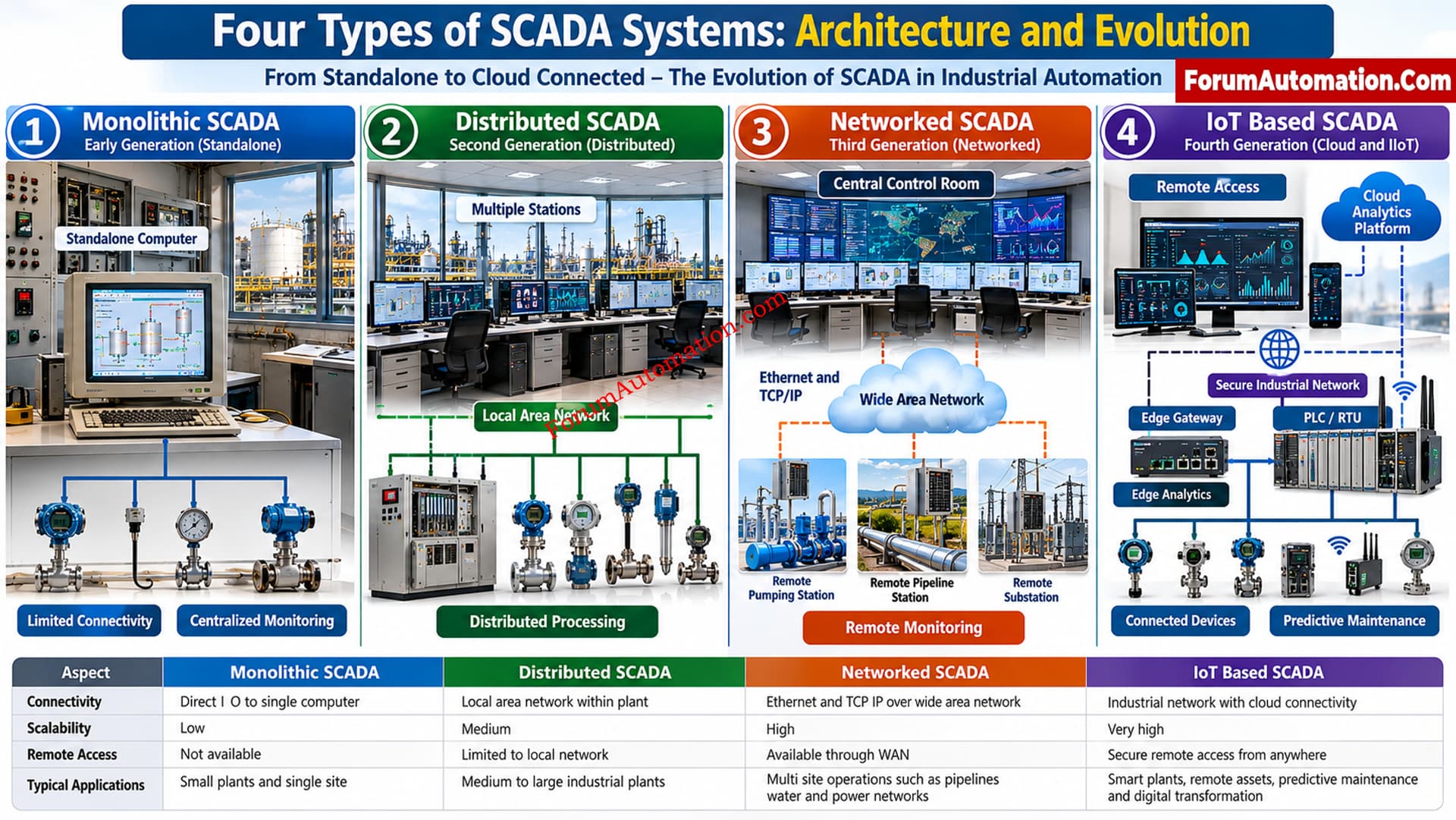
There are four classic versions of SCADA systems: monolithic SCADA, distributed SCADA, networked SCADA, and Internet of Things (IoT) based SCADA. Each generation is a progression of computation, communication, scalability and remote monitoring capabilities.
1. Monolithic SCADA System
The original architecture was the monolithic SCADA system. They were usually single computers with proprietary hardware and little ability to communicate.
They were mostly used for gathering process data, showing equipment condition, and triggering alarms. It was harder to expand and integrate with other systems compared to modern architectures.
2. Distributed SCADA System
Distributed SCADA was the addition of numerous computers networked on a LAN. Different stations could handle communication, data processing, operator displays, and alarm handling.
The architecture increased scalability and resource sharing. However, older implementations used proprietary communication methods.
3. Networked SCADA System
Networked SCADA systems provide communication networks that connect controllers, remote stations, operator workstations, and central servers in industrial facilities or geographically dispersed locations.
Ethernet, TCP/IP and industrial communication protocols provide centralized management of pipelines, electrical substations and water distribution networks.
Network availability, redundancy, latency, and cyber security must be considered in design.
4. IoT Based SCADA System
IoT enabled SCADA merges the industrial data with connected devices, remote analytics and possibly cloud services. Depending on the architecture, experts can remotely monitor equipment and analyze past data for predictive maintenance.
But cloud connectivity should not be a replacement for reliable local control or important safety features.
How Should Engineers Select a SCADA Architecture?
The selection is based on plant size, communication infrastructure, response requirements, integration, maintenance capability and cybersecurity risk.
EPC design, verification of network segmentation, server redundancy, alert management, data preservation and remote control of access.
Note: These four categories represent historical generations of SCADA architecture. Modern systems may be a mixture of distributed, networked, edge and cloud technologies rather than one or the other solely.