What are the different types of intrinsically safe barriers?
What are the different types of intrinsically safe barriers?
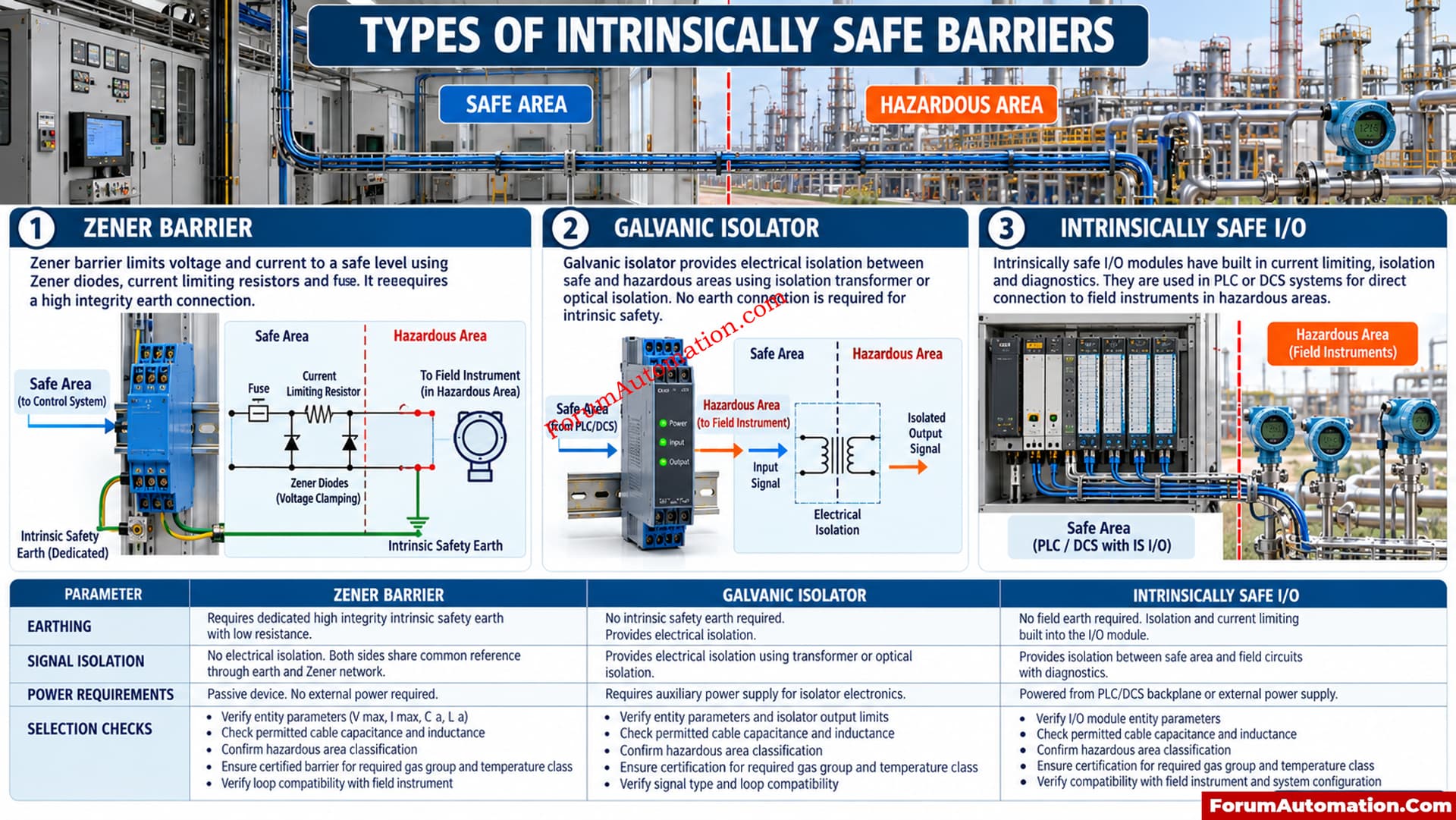
Intrinsic safe barriers limit the amount of electrical energy that can reach a hazardous region, therefore minimizing the possibility that a defect could ignite flammable gas or vapor. The principal types are Zener barriers and galvanic isolators. Selection will be based on the instrument certificate, hazardous area categorization and appropriate standards.
1. Zener barriers
Zener barriers use current limiting resistors, Zener diodes, and fuses to restrict voltage and current during specified faults. They are compact and economical, but require an engineered intrinsic safety earth. Grounding quality and voltage drop are important design considerations.
2. Galvanic isolators
Galvanic isolators transfer signals across an isolation barrier while limiting energy to the hazardous area. They generally avoid dependence on the same dedicated IS earth arrangement as Zener barriers. Depending on the model, they provide loop power, signal conversion, relay switching, or HART transmission. They simplify grounding but need power and cabinet space.
3. Intrinsically safe I/O
IS I/O modules combine control system I/O and energy limiting. Confirm module and field device approvals.
How should engineers select one?
Check the parameters of gas group, zone, protection level, certificate and entity. Make sure barrier output voltage, current and power restrictions of field device are not exceeded. Check cable inductance and capacitance against allowed values including cable length. Check earth configuration and voltage drop for Zener barriers as described. Check isolators for supply, signal type, channel isolation and diagnostics. Match channel type and fault response to application requirements. Document the loop design before installation or commissioning.