What are the 5 elements of control system?
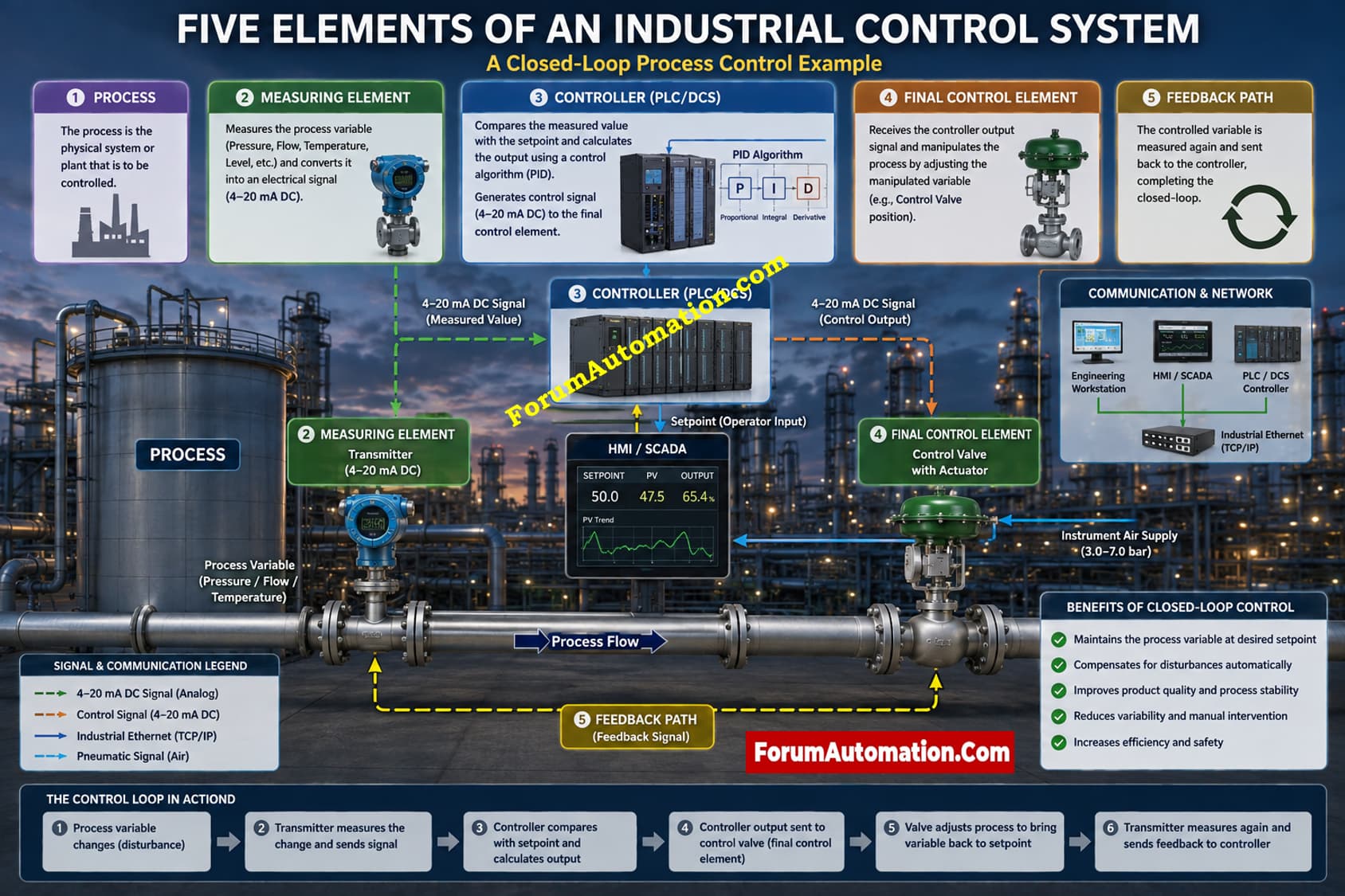
What are the 5 Elements of Control System?
The five elements of a control system all work together to keep a process variable at its target value. These components are the building blocks of industrial automation utilized in refineries, power generation plants, chemical plants, water treatment facilities and manufacturing industries.
The Five Elements
- Process: The equipment or operation being regulated. Examples of processes are a tank, furnace, boiler, or reactor.
- Measuring Element: Sensors or transmitters that constantly monitor process variables like pressure, temperature, flow, or level.
- Controller: The measured value is taken by a PLC, DCS or PID controller and compared to the setpoint and corrective action calculated.
- Final control element: The control valves, variable frequency motors, dampers or actuators are the result of controller output and control the process.
- Feedback Path: Provides the process value back to the controller to create a closed loop control system.
Practical Example
In a steam pressure control loop the pressure transmitter measures the pressure. The PID controller compares it with the setpoint and provides an output signal to a control valve. The valve is used to control the flow of steam until the pressure is at the required value . Continuous feedback is used to ensure a steady operation .
Engineering Importance
A control system that is well designed will improve product quality, energy efficiency, process stability, equipment protection and operational safety.
Troubleshooting Perspective
If control performance gets worse, check sensor calibration, controller tuning, valve operation, communication signals, instrument air supply and feedback correctness before replacing equipment.
Instrumentation engineers who understand these five control system characteristics can build dependable automation systems, quickly identify process problems, and boost plant efficiency with accurate and steady process control.