What are common vortex flow meter problems?
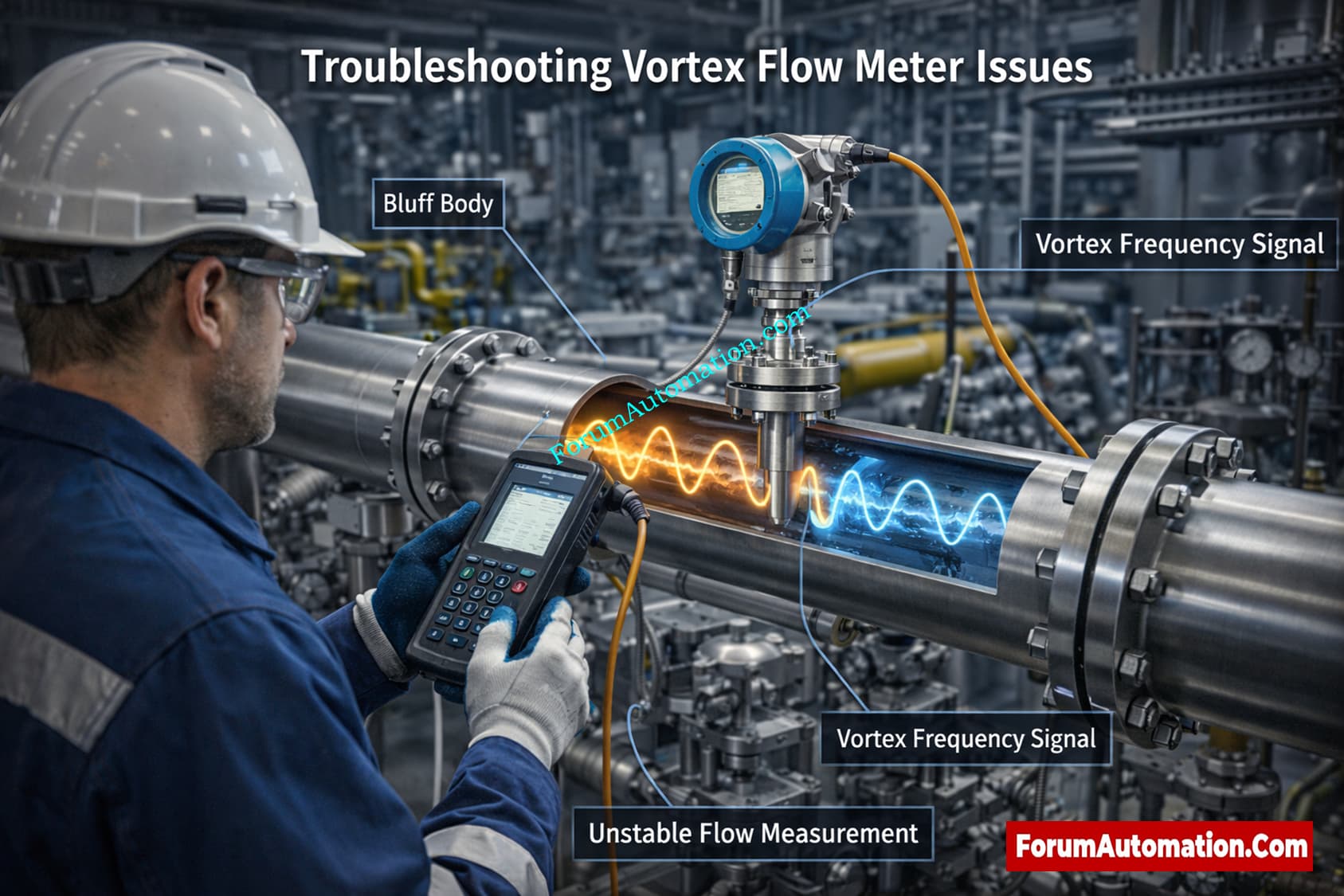
What are common vortex flow meter problems?
Common difficulties with vortex flow meters in plant service and practical tips for fixing them
Symptoms and probable causes
- No or sporadic pulse or absence of output resulting from power supply malfunction, compromised electronics, loose wiring, or transmitter failure.
- Erratic readings or noise can be produced by mechanical vibration, straight piping that isn’t strong enough on either side, two-phase flow with gas or vapor mixed in, or loose mounting.
- When the flow goes below the meter’s minimum Reynolds number or K factor limit, the readings are low or the sensitivity is low.
- Stable but wrong frequency because to electrical noise, a bad filter, or a bad scaling setup
- Drift can happen when the bluff body gets dirty, erodes, or builds up over time, which makes the signal weaker or the response slower.
Field troubleshooting checklist
- Check the installation to make sure the straight pipe lengths are correct, the orientation is correct, and the full bore piping is in place.
- Check the electricals, measure the supply voltage, make sure the shielded cable is still connected, and make sure the grounding is proper.
- Check the process conditions to make sure there is just one phase flow and an adequate Reynolds number. Also, check for gas that is trapped and the right temperature and viscosity.
- Check the sensor, take it out, and look at the bluff body for deposits, erosion, or fouling. Clean or replace it as needed.
- Check the settings for the configuration check K factor pulse scaling filter and the minimum flow thresholds, and then recalibrate if you need to.
Design selection guidance
- For two-phase low-Reynolds or viscous fluids, consider using Coriolis or ultrasonic meters instead.
- To cut down on turbulence and incorrect counts, add vibration isolation pre-filtration or flow conditioners.
- To keep things running well in real plant circumstances, keep track of when installations are commissioned and when routine inspections are due. After a failure, keep track of what happened and write down the root causes.
1 Like