Vortex flowmeters are used to measure pressure in the pipeline, creating vortices in the flow channel using a stationary object (Bluff body). The vortex flowmeters are used for measuring gases and liquids in pipeline flowing full.
Principle:
Principle of vortex flowmeter is based on the Theodore von Karman’s work vortex shedding street
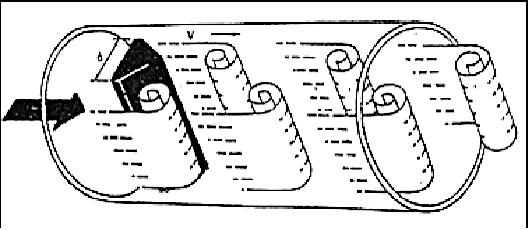
Each vortex will form at the bluff downstream, then detach from the object and continue to move with the flowing gas or liquid, one side at a time in alternating fashion. This phenomenon is known as vortex shedding, and the pattern of moving vortices carried downstream of the stationary object is known as a vortex street.

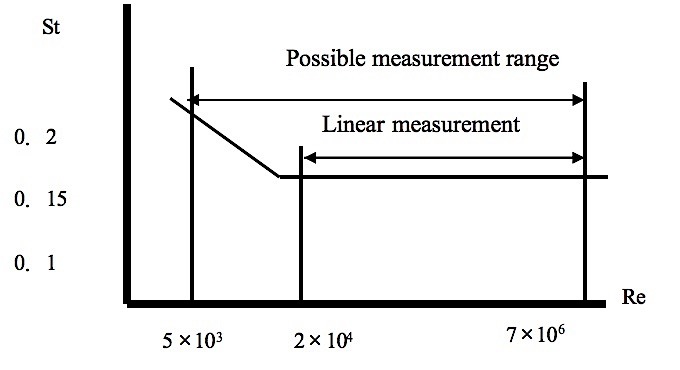
It was determined that the distance between successive vortices downstream of the stationary object is relatively constant, and directly proportional to the width of the object, for a wide range of Reynolds number values.
f=StV/d
f = vortex frequency
St = Strouhal’s number dimensionless
V = medium flow rate
d = the width of triangle prim
Working:

-
Triangle shaped bluff body is fixed at the centre of the pipeline.
-
Vortices are formed continuously in the stream because of the bluff body. The vortices fade as it moves away from the Bluff body.
-
The vortices formed at either side of the bluff body are alternate to each other. So that, there is a pressure difference on either side.
-
These pressure difference is measured continuously by sensor tubes installed on either side. The fluctuation of pressure is measured and converted to an alternating signal as an output.
-
The frequency of the alternating signal produced is proportional to the frequency of the vortices produced. The frequency of the vortices is directionally proportional to the flow.
Advantages of Vortex flowmeter:
-
Can be used for Gas, liquid and steam
-
Low wear
-
Low cost for installation and maintanence
-
Wide range ability
-
Inherently linear output
-
Immune to density and viscosity changes
-
Applicable to wide range of process temperature
Disadvantages of Vortex flowmeter:
-
Works over a particular velocity range
-
Not suitable very low flow rates
-
Requires specialization for different fluid flow measurement