Variable Frequency Drives (VFDs) are widely used in industrial automation to control
-
Motor speed,
-
Improve efficiency and
-
Reduce starting current.
Here are some key concepts behind VFD motor control:
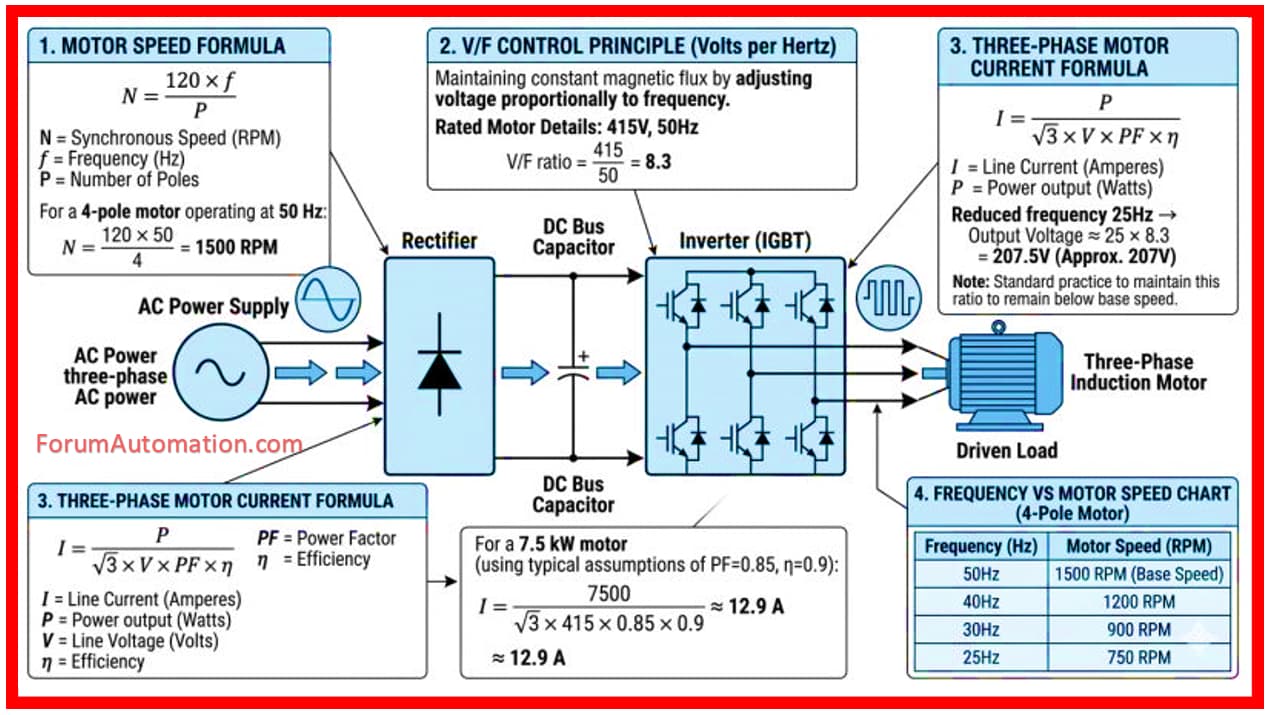
Motor Speed Formula
Where
N = Synchronous Speed (RPM)
f = Frequency (Hz)
P = Number of Poles
Example
For a 4-pole motor at 50 Hz
N = (120 × 50) / 4 = 1500 RPM
V/F Control Principle (Volts per Hertz)
VFD maintains constant magnetic flux by adjusting voltage proportional to frequency.
For a 415V and 50Hz motor:
V/F ratio = 415 / 50 = 8.3
If frequency reduces to 25 Hz
Voltage ≈ 25 × 8.3 ≈ 207 V
Three-Phase Motor Current Formula
I = P / (√3 × V × PF × η)
Where
I = Line Current
P = Power (W)
V = Line Voltage
PF = Power Factor
η = Efficiency
Example (7.5 kW motor)
I ≈ 12.9 A
Motor Speed vs Frequency (4-Pole Motor)
-
50 Hz → 1500 RPM
-
40 Hz → 1200 RPM
-
30 Hz → 900 RPM
-
25 Hz → 750 RPM
Understanding these relationships helps engineers properly configure VFDs, optimize motor performance and improve energy efficiency in industrial systems.