A Variable Frequency Drive (VFD) is an electronic device used to control the speed, torque, acceleration, deceleration, and direction of an AC motor by varying the frequency and voltage supplied to the motor. VFDs are widely used in industrial automation, pumps, fans, compressors, conveyors, HVAC systems, and other motor-driven applications.
A VFD generally operates through four main stages: rectifier, DC bus, inverter, and control unit. First, the incoming three-phase AC supply is converted into DC using a rectifier, typically consisting of six diodes. The resulting pulsating DC is then filtered through the DC bus or DC link, which uses capacitors and, where applicable, inductors or chokes to reduce voltage and current ripple.
The filtered DC voltage is supplied to the inverter section, where semiconductor switching devices such as IGBTs or MOSFETs rapidly switch the DC voltage to produce a variable-frequency, variable-voltage three-phase AC output. Pulse Width Modulation (PWM) is commonly used to generate the required output waveform.
Motor speed is primarily related to supply frequency and can be calculated using
Ns = 120f/P
where
Ns is synchronous speed,
f is frequency and
P is the number of motor poles.
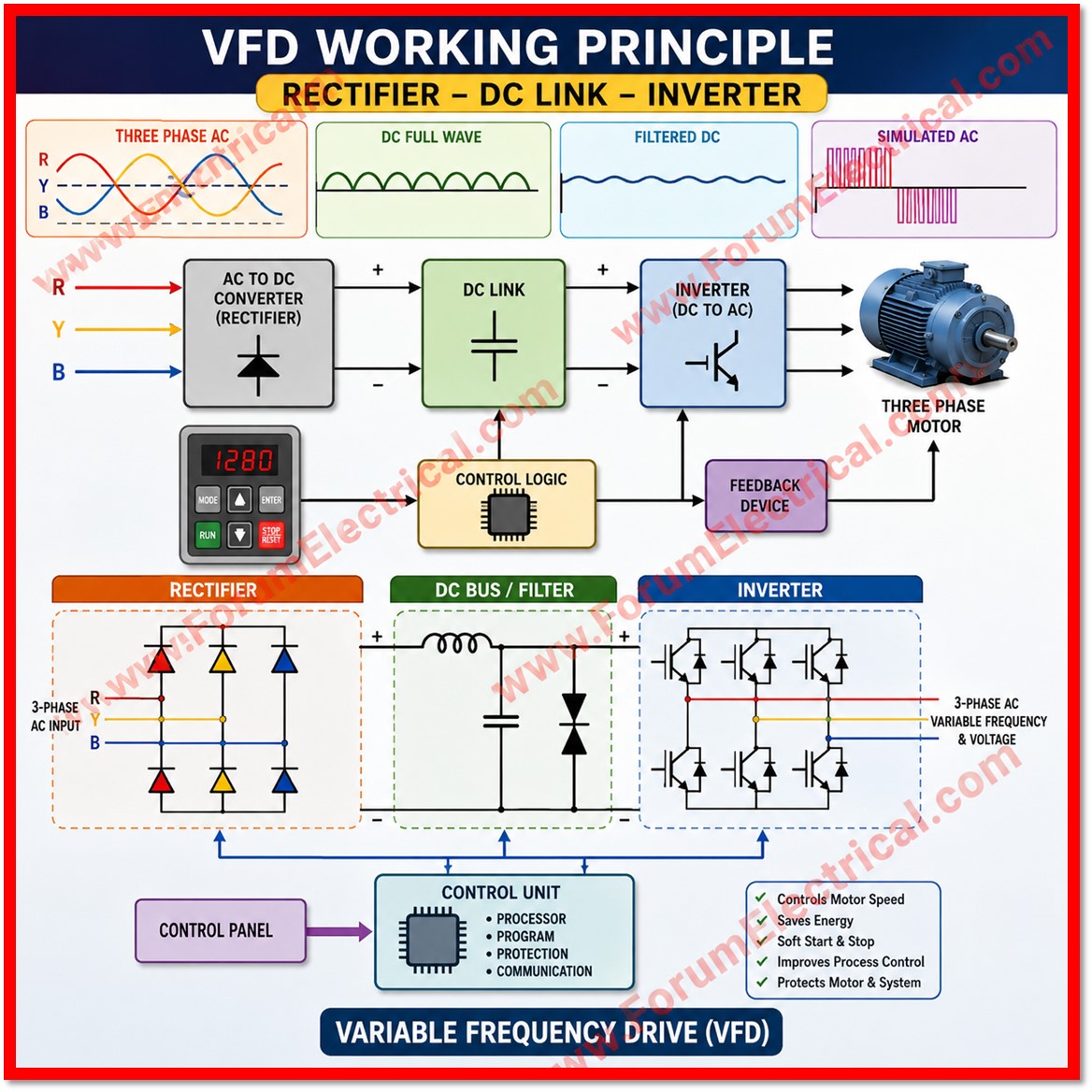
By providing controlled frequency and voltage, a VFD enables smooth motor starting and stopping, reduced starting current, precise speed control, improved process control, and energy savings, particularly in variable-torque applications.