Transmission towers are an important part of the electrical power transmission network.
They support conductors and maintain the required mechanical strength and electrical clearances.
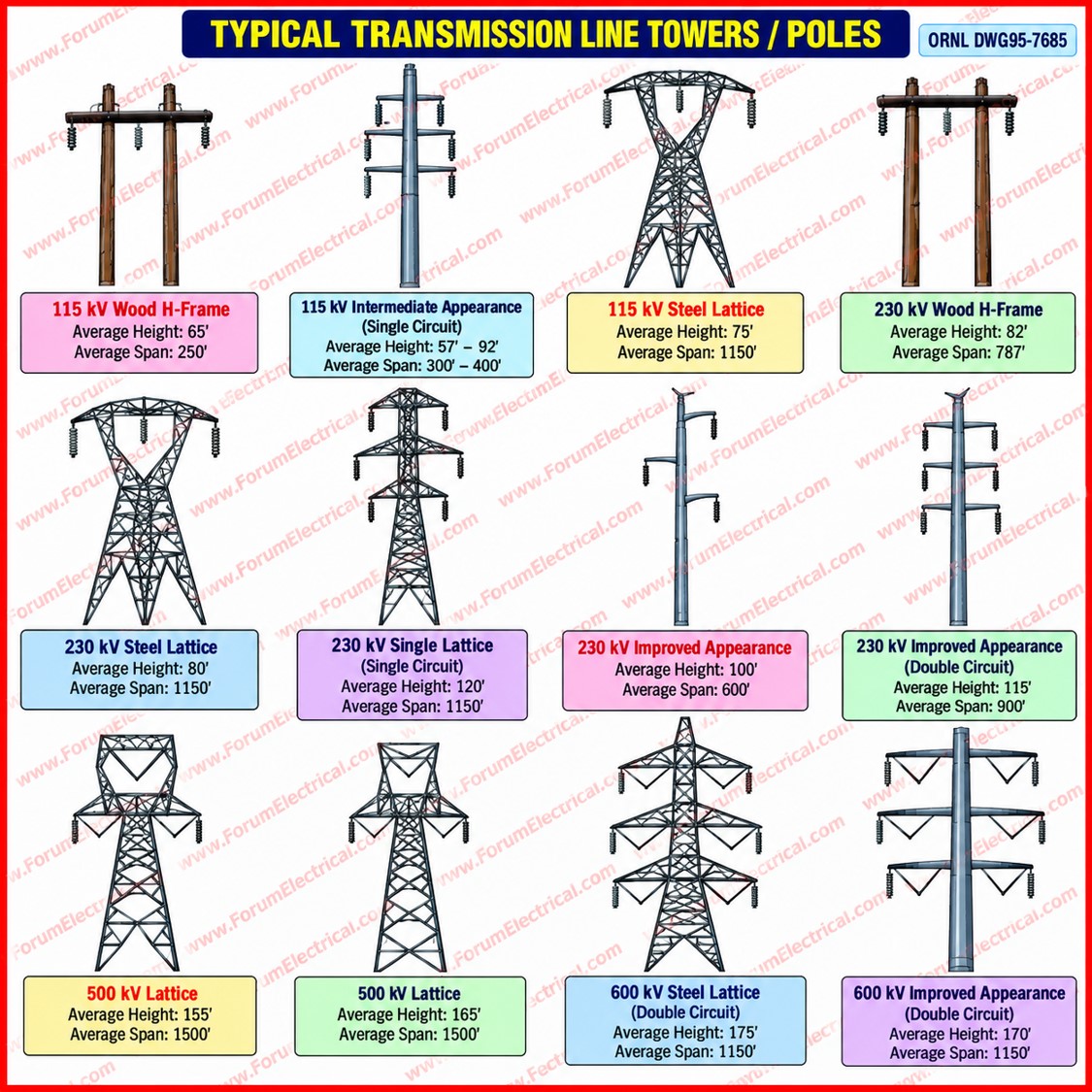
1). Suspension / Tangent Tower
Used mainly on straight sections of a transmission line.
2). Tension / Strain Tower
Designed to withstand conductor tension and used at section points and important crossings.
3). Angle Tower
Used where the transmission line changes its direction.
4). Dead-End / Terminal Tower
Used at the end of a line or near substation entry/exit points and designed for high conductor tension.
5). Transposition Tower
Used to change the physical position of the three-phase conductors to maintain better electrical balance.
6). Special Tower
Used for special requirements such as river, railway, highway or long-span crossings.
Tower classification by circuits:
Single Circuit → Double Circuit → Multi Circuit
Typical Power Flow:
Generating Station → Step-Up Transformer → Transmission Line → Grid Substation
The correct tower design depends on voltage level, line angle, span, conductor loading, terrain, wind conditions and crossing requirements.