Types of Maintenance
[color=#ff0000]What is Maintenance? [/color]
Maintenance is one of the most important areas for ensuring the continuity, safety & efficiency of industrial processes, buildings and other technological systems.
[color=#ff0000]Types of Maintenance [/color]
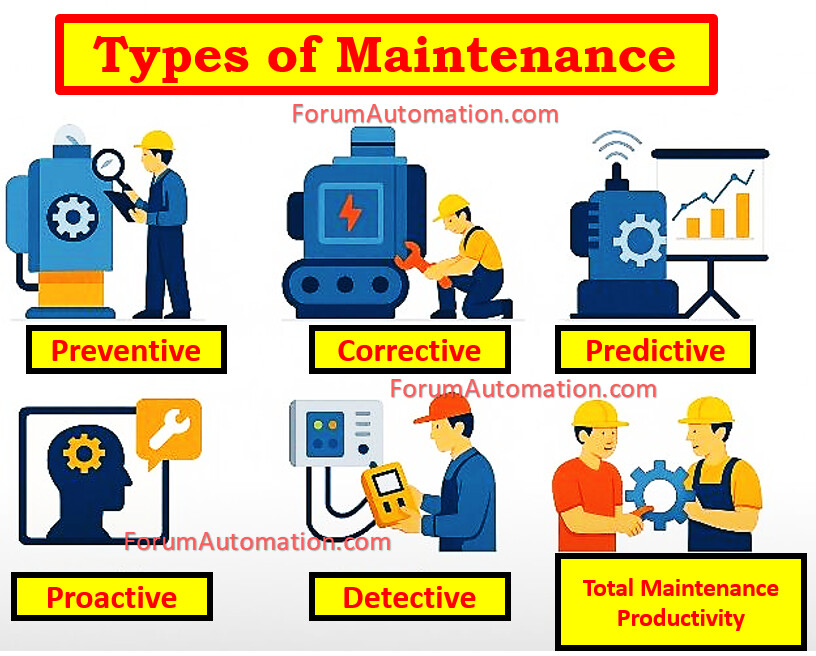
The different types of [url= Insulation Resistance Test in Preventive Maintenance][color=#1E00A3] maintenance [/color][/url] are:
1). Corrective Maintenance
2). [url= Standard Operating Procedure (SOP) for Preventive Maintenance of Earth Pit][color=#1E00A3] Preventive Maintenance [/color][/url]
3). Predictive Maintenance
4). Detective Maintenance
5). Proactive Maintenance
[color=#ff0000]1). Corrective Maintenance [/color]
Equipment breakdowns might be intentional or spontaneous.
Ideal for non-critical systems (or) when downtime is minimal.
[color=#ff0000]2). Preventive Maintenance [/color]
Scheduled at regular intervals based on time (or) equipment utilization.
It includes scheduled inspections, adjustments & replacements to prevent failures.
Concentrate on reducing downtime & extending asset life.
[color=#ff0000]3). Predictive Maintenance [/color]
Continuous monitoring of conditions, such as vibration, temperature, and noise, is used.
It use technology to anticipate breakdowns.
It necessitates data analysis & diagnostic tools.
[color=#ff0000]4). Detective Maintenance [/color]
Detect hidden holes in security & protection systems.
Very common in circumstances wherein the failure is not immediately apparent but can result in dangers.
[color=#ff0000]5). Proactive Maintenance [/color]
This method prioritizes identifying and resolving the root cause of errors, frequently in conjunction with reliability technologies like RCM. It needs a culture of continual improvement and a thorough examination of failure modes.
In conclusion, selecting the appropriate solution for every component of machinery is important for balancing cost, availability & safety. Maintenance advancement in a corporation requires an understanding that there is no single optimal technique, but rather a smart combination of them.
You can also follow us on [color=#ff7700]AutomationForum.co[/color], [url= https://www.facebook.com/instrumentation.control][color=#1E00A3]Facebook[/color][/url] and [url= https://www.linkedin.com/showcase/81532759/feed/posts/][color=#1E00A3]Linkedin[/color][/url] to receive daily Instrumentation updates.
You can also follow us on [color=#ff7700] ForumElectrical.com [/color], [color=#1E00A3] Facebook [/color] and [color=#1E00A3] Linkedin[/color] to receive daily Electrical updates.