Types of Faults in Power Systems
Faults in power systems are abnormal electrical conditions that can disrupt operation, damage equipment, and compromise system reliability. Understanding different fault types is essential for power system analysis, protection coordination, and safe network operation.
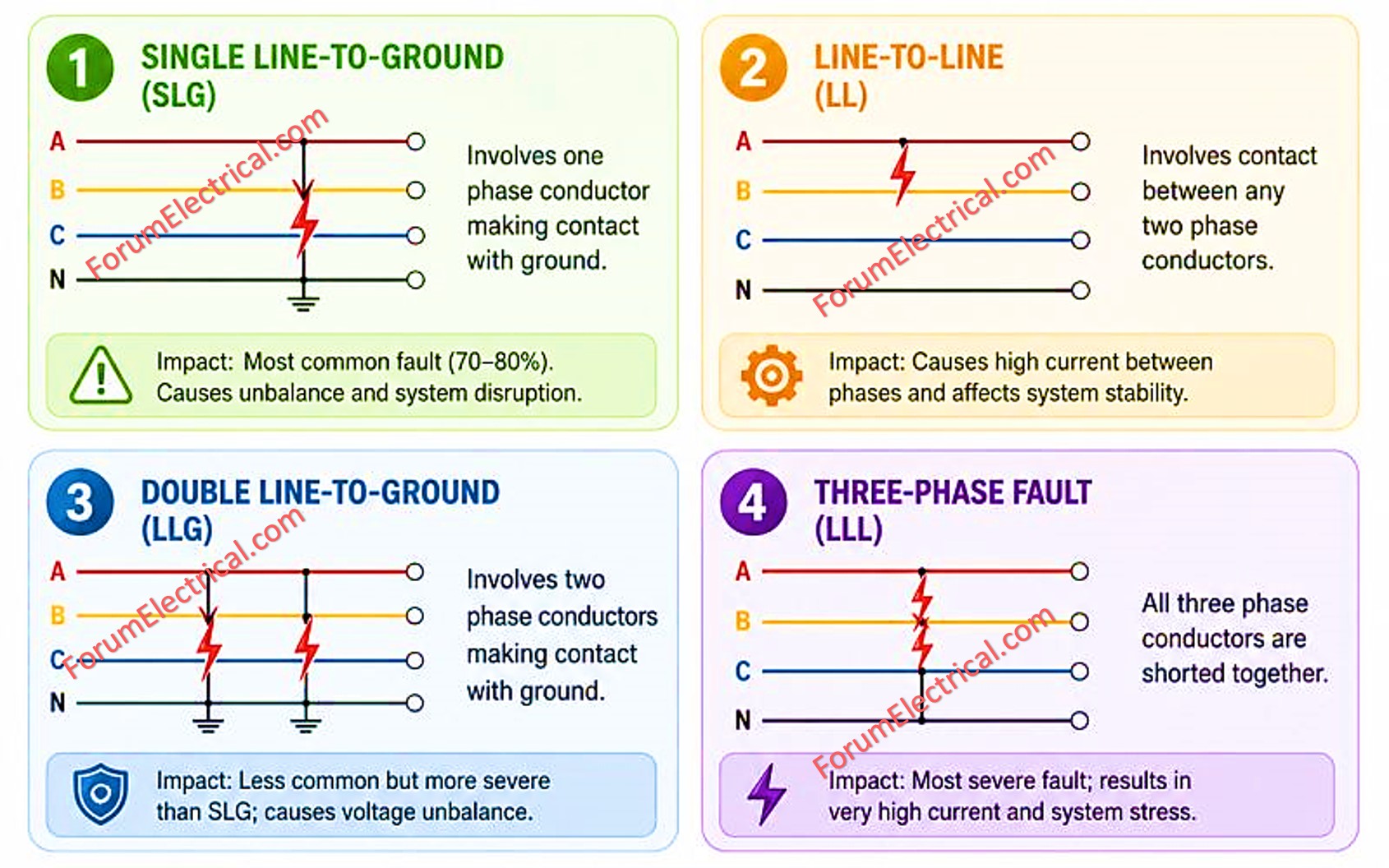
Single Line-to-Ground (SLG) Fault
Most common fault type (70–80% of all faults)
Occurs when one phase conductor contacts the ground
Causes voltage imbalance and protection system operation
Line-to-Line (LL) Fault
Occurs when two phase conductors come into contact
Produces high fault currents
Can affect system stability and equipment performance
Double Line-to-Ground (LLG) Fault
Involves two phases connected to ground
More severe than SLG faults
Creates significant current and voltage disturbances
Three-Phase (LLL) Fault
All three phases are short-circuited together
Produces the highest fault current levels
Used as the basis for equipment short-circuit ratings and protection studies