Types of Electrical Connection used in Power Systems
A solid technical awareness of electrical connection types plays an essential function in the design, operation and reliability of modern power networks.
Below is a detailed overview of widely used configurations and their practical significance:
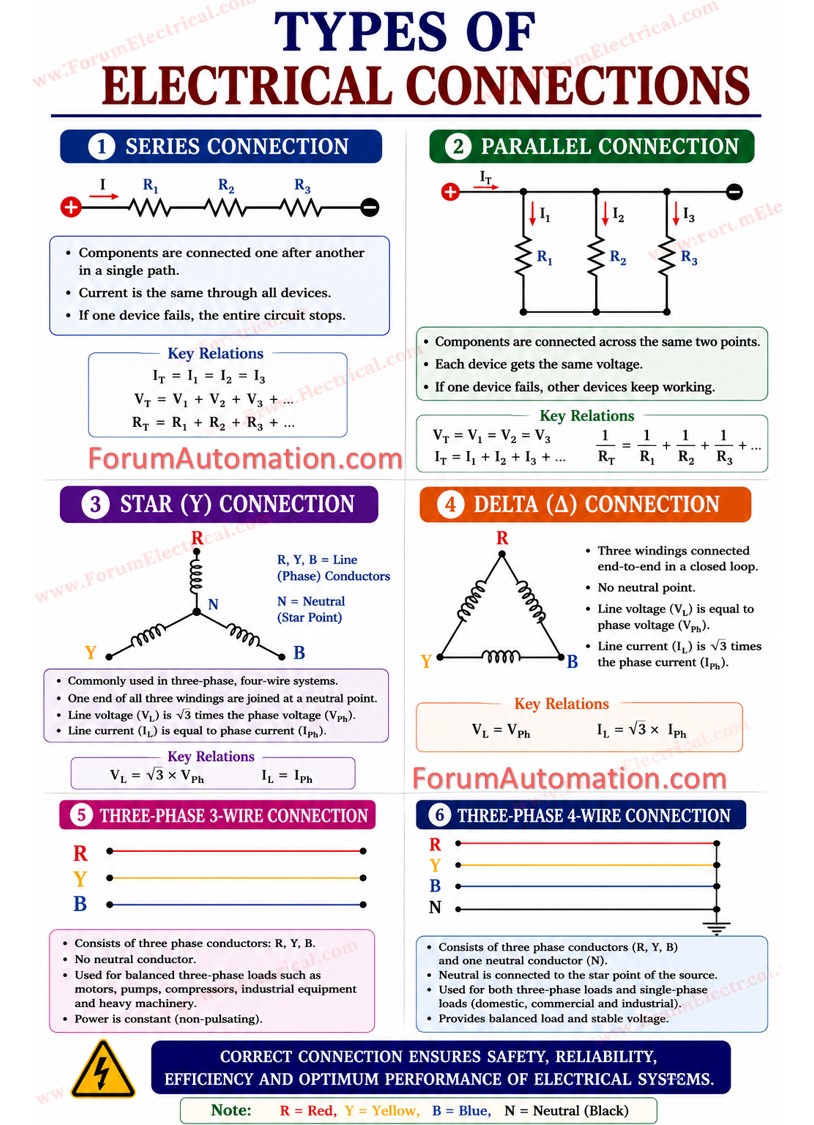
1). Series Connection
2). Parallel Connection
5). Three-Phase 3-Wire System
6). Three-Phase 4-Wire System
Series Connection
Single current path with equal current through all components; widely used where controlled current flow is required.
Parallel Connection
Same voltage across components, ensuring operational continuity even if one branch fails.
Star (Y) Connection
Common in three-phase systems providing a neutral point and improved voltage regulation for balanced loads.
Delta (Δ) Connection
Closed-loop configuration without neutral; preferred for high-power applications and motor operations.
Three-Phase 3-Wire System
Efficient solution for balanced industrial loads, especially in motor-driven systems.
Three-Phase 4-Wire System
Supports both single-phase and three-phase loads, making it ideal for mixed residential and commercial usage.
Strengthening these fundamentals supports better system design, improved fault diagnosis and safer power distribution that the core skills for electrical and power engineering professionals.