Types of Control Systems and Their Industrial Applications
Control systems regulate machine operation and industrial processes by controlling process variables to achieve desired performance, accuracy, and stability.
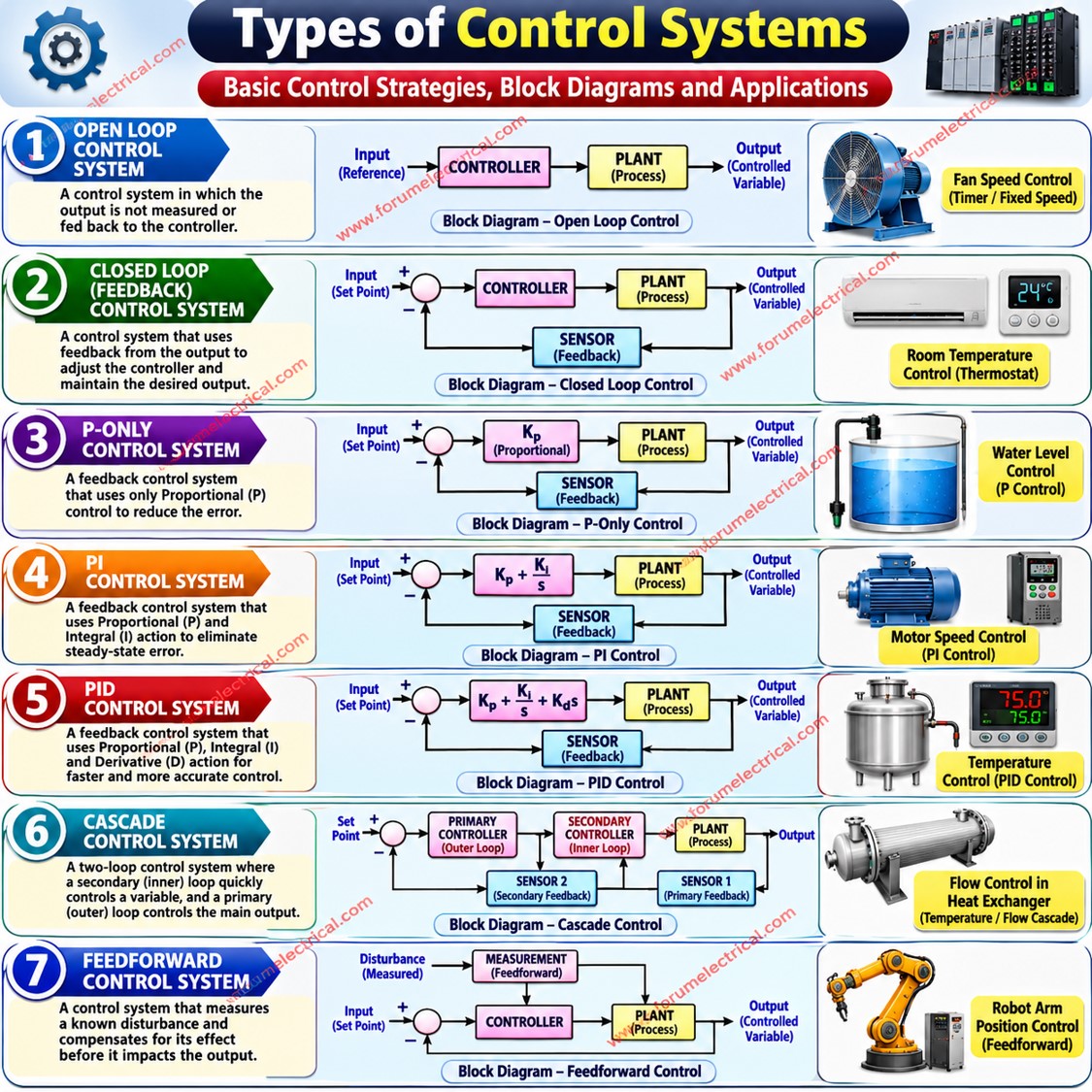
1. Open-Loop Control System
Operates without output feedback.
Control action is independent of the actual output.
Simple, economical, but cannot automatically compensate for disturbances.
Example: Timer-based washing machine.
2. Closed-Loop Control System
Uses feedback from sensors to compare actual output with the setpoint.
Automatically adjusts control action based on the error signal.
Example: Automatic room temperature control.
3. Proportional (P) Controller
Produces a control output proportional to the instantaneous error.
Provides a fast response but may retain steady-state error.
Example: Industrial process temperature control.
4. Proportional-Integral (PI) Controller
Combines proportional and integral actions.
Reduces or eliminates steady-state error under suitable operating conditions.
Example: Variable-frequency drive (VFD) motor speed control.
5. Proportional-Integral-Derivative (PID) Controller
Combines proportional, integral, and derivative actions.
Improves dynamic response and disturbance rejection when properly tuned.
Example: Industrial temperature and pressure control.
6. Cascade Control System
Uses primary and secondary feedback control loops.
The primary controller sets the setpoint of the secondary controller.
Improves disturbance rejection when disturbances affect the secondary loop.
Example: Heat exchanger temperature control using an inner flow control loop.
7. Feedforward Control System
Measures disturbances and applies corrective action before their effects significantly influence the controlled variable.
Requires a suitable process model and disturbance measurement.
Example: Boiler feedwater flow compensation for steam demand changes.
These control strategies are widely applied in PLCs, DCS, SCADA, process instrumentation, robotics, motor drives, and industrial automation.