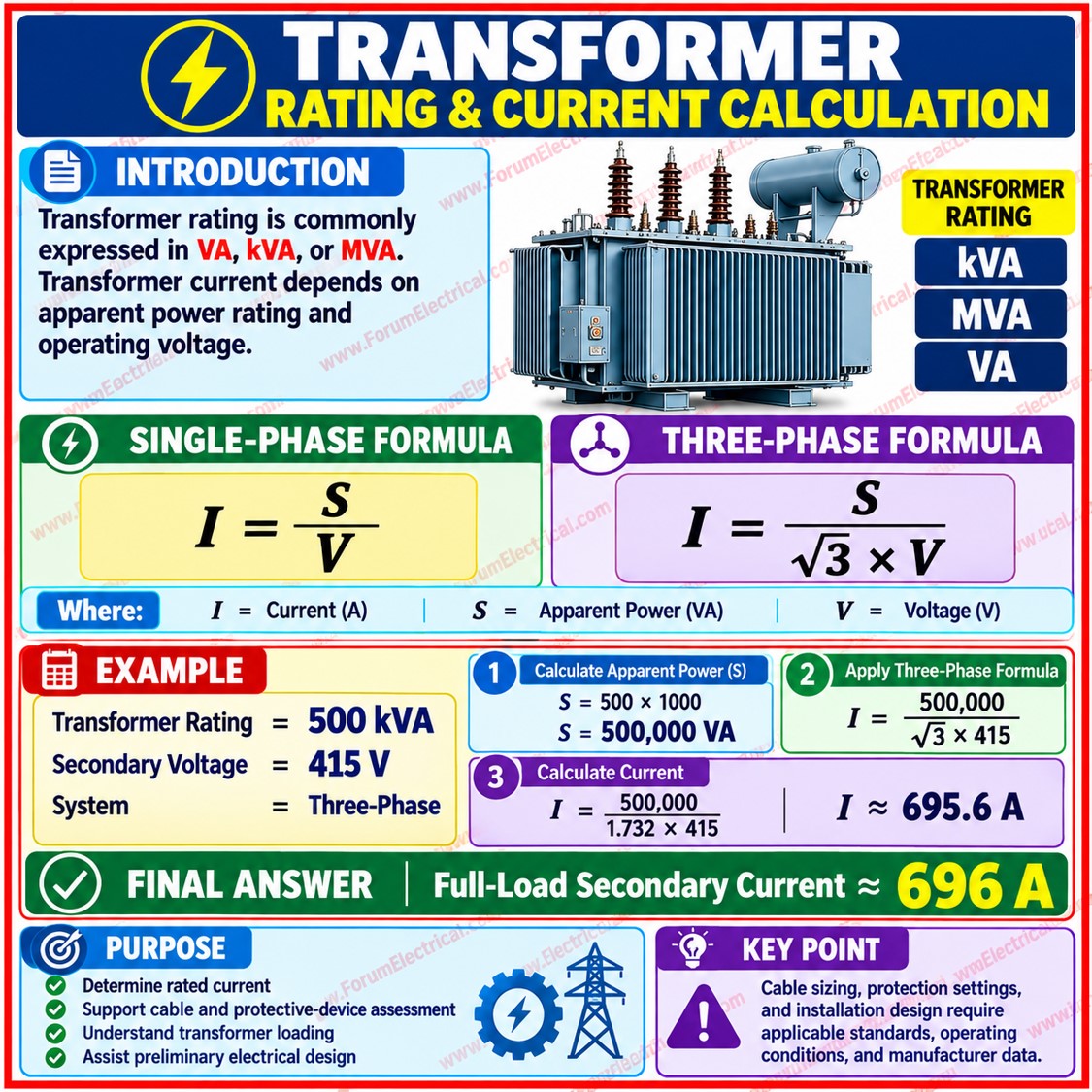
Transformer rating is generally expressed in kVA (kilovolt-amperes), not kW. The kVA rating indicates the apparent power that a transformer can supply within its voltage, current, temperature-rise, and insulation limits.
CALCULATOR
Transformer KVA Calculator based on load
Transformer Rating (kVA) = Voltage x Current / 1000
SINGLE-PHASE TRANSFORMER
kVA = (V x I) / 1000
THREE-PHASE TRANSFORMER
kVA = (√3 x V x I) / 1000
WHERE
V = Voltage in volts
I = Current in amperes
√3 = 1.732
SINGLE-PHASE EXAMPLE
Voltage = 230 V
Current = 43.48 A
kVA = (230 × 43.48) / 1000
kVA ≈ 10 kVA
Transformer rating = 10 kVA
THREE-PHASE EXAMPLE
Line voltage = 415 V
Line current = 13.92 A
kVA = (1.732 x 415 x 13.92) / 1000
kVA ≈ 10 kVA
Transformer rating = 10 kVA
LOAD-BASED CALCULATION
If the load is given in kW:
Required kVA = Load (kW) / Power Factor
Example:
Load = 80 kW
Power factor = 0.8
Required kVA = 80 / 0.8
Required kVA = 100 kVA
With allowance for future expansion, inrush current, harmonics, ambient conditions, and continuous loading, the selected standard transformer rating may need to be higher than the calculated minimum.
IMPORTANT SELECTION FACTORS
• Connected and maximum demand load
• Power factor
• Future load growth
• Motor starting current
• Ambient temperature
• Harmonic loads
• Cooling method
• Voltage ratio and frequency
• Applicable standards and manufacturer recommendations
IMPORTANT NOTE
The final transformer rating must be selected by a qualified electrical designer after checking demand load, diversity, voltage regulation, protection, short-circuit level, and installation conditions.