Transformer Losses
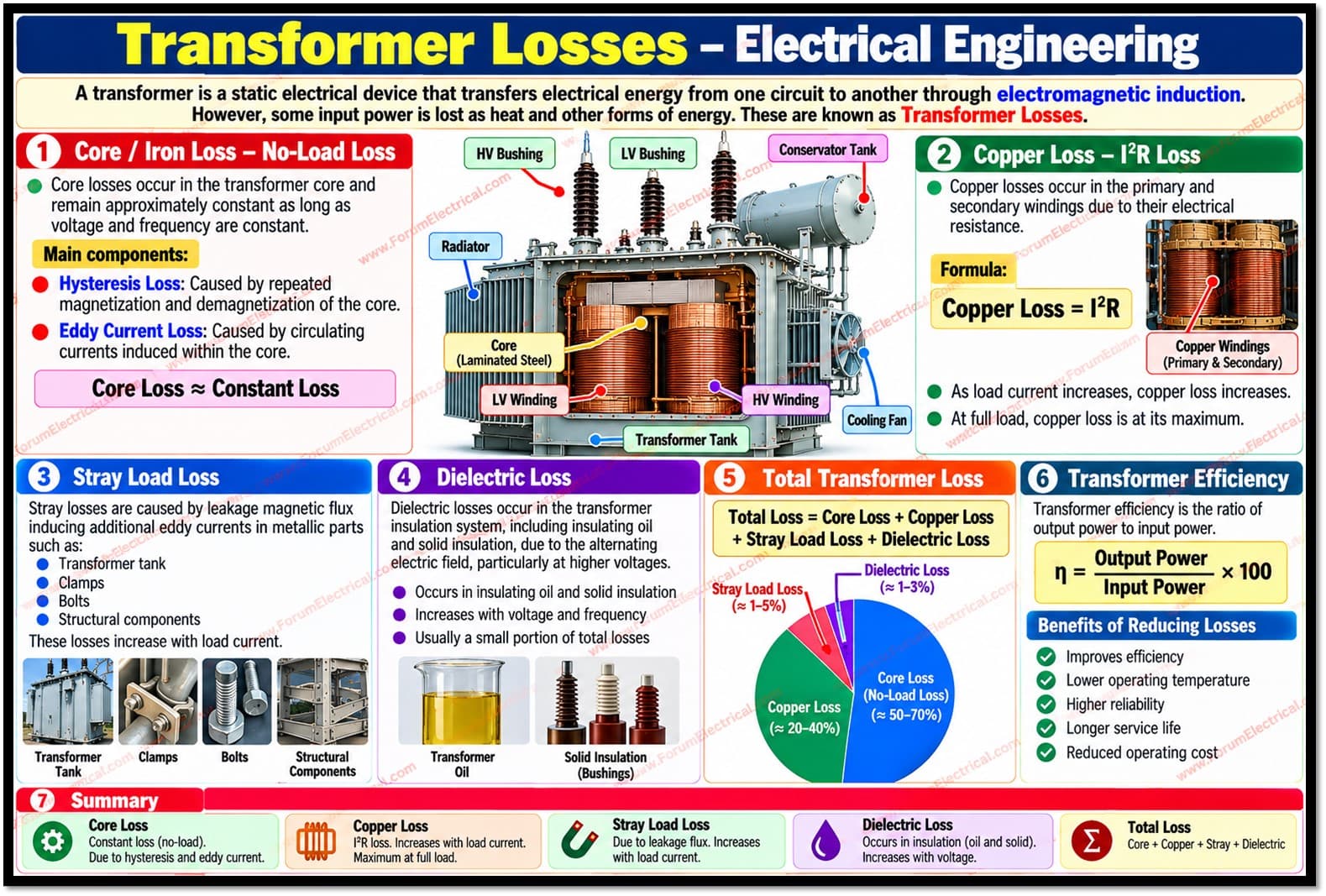
A transformer is a static electrical device that transfers electrical energy from one circuit to another through electromagnetic induction. However, some input power is lost as heat and other forms of energy. These are known as Transformer Losses.
1). Core / Iron Loss - No-Load Loss
Core losses occur in the transformer core and remain approximately constant as long as voltage and frequency are constant.
Main components:
Hysteresis Loss: Caused by repeated magnetization and demagnetization of the core.
Eddy Current Loss: Caused by circulating currents induced within the core.
Core Loss ≈ Constant Loss
2). Copper Loss - I²R Loss
Copper losses occur in the primary and secondary windings due to their electrical resistance.
Formula:
Copper Loss = I²R
As load current increases, copper loss increases. At full load, copper loss is at its maximum.
3). Stray Load Loss
Stray losses are caused by leakage magnetic flux inducing additional eddy currents in metallic parts such as:
- Transformer tank
- Clamps
- Bolts
- Structural components
These losses increase with load current.
4). Dielectric Loss
Dielectric losses occur in the transformer insulation system, including insulating oil and solid insulation, due to the alternating electric field, particularly at higher voltages.
Total Transformer Loss
Total Loss = Core Loss + Copper Loss + Stray Load Loss + Dielectric Loss
Transformer Efficiency
η = (Output Power / Input Power) x 100
In practical transformer operation, minimizing these losses improves efficiency, temperature performance, reliability, and service life.