Transformer Impedance
Every transformer has internal resistance (R) and leakage reactance (X)
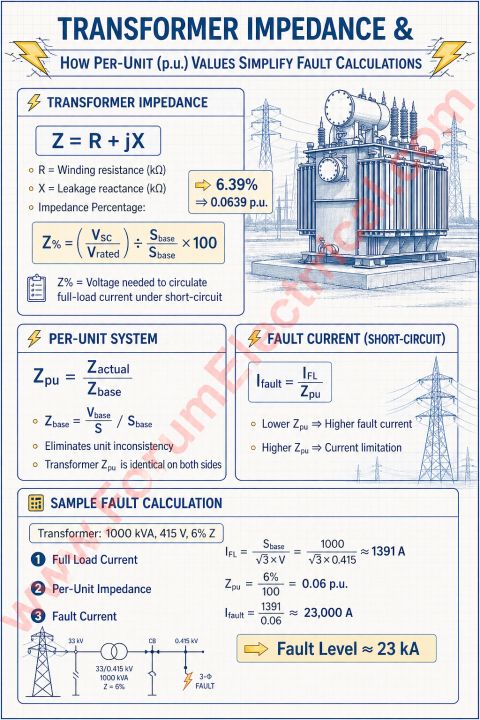
Represented as:
Z = R + jX
This impedance:
• Limits fault current
• Influences voltage regulation
• Defines system stiffness
• Expressed as % impedance (%Z)
Example:
5% impedance means the transformer requires 5% of rated voltage to circulate full-load current under short-circuit condition
Per-Unit (p.u.) System
Engineers normalize values using base quantities (MVA, KV)
Zpu = Zactual / Zbase
Why it is Important?
• Eliminates unit complexity.
• Makes multi-voltage systems comparable.
• Keeps transformer impedance consistent across both sides.
Example:
10% impedance = 0.1 p.u. (independent of rating)
Why These Two Are Always Connected
Transformer impedance is naturally expressed in per-unit form
Fault current becomes:
Ifault = IFL / Zpu
Lower Zpu Higher fault current
Higher Zpu Natural current limitation
It simplifies fault analysis and stability studies
It enables direct comparison across equipment ratings
Essential for:
• Protection coordination
• Grid planning
• Load flow analysis
• Equipment sizing
• Engineering Takeaway
Per-unit is not just a mathematical tool it is the common language of power system engineers.