Top 10 Essential Electrical & Motor Troubleshooting Q&As for Engineers
Whether you work in industrial maintenance, MEP projects, electrical commissioning, or motor control, understanding these fundamental troubleshooting concepts is essential for safe and reliable field operations.
- Phase Sequence: The sequence in which the three phases of an AC power supply reach their maximum values, commonly represented as L1 → L2 → L3. Correct phase sequence is important for proper motor rotation.
- Phase Failure: The loss of one phase in a three-phase power system. It can cause excessive current in the remaining phases, overheating, and potential motor damage.
- Voltage Drop: The reduction in voltage that occurs as current flows through the impedance of a conductor or electrical circuit. Excessive voltage drop can affect equipment performance.
- Continuity Testing: A test used to verify whether an electrical path is complete. The circuit should be de-energized before using a multimeter in continuity or resistance mode.
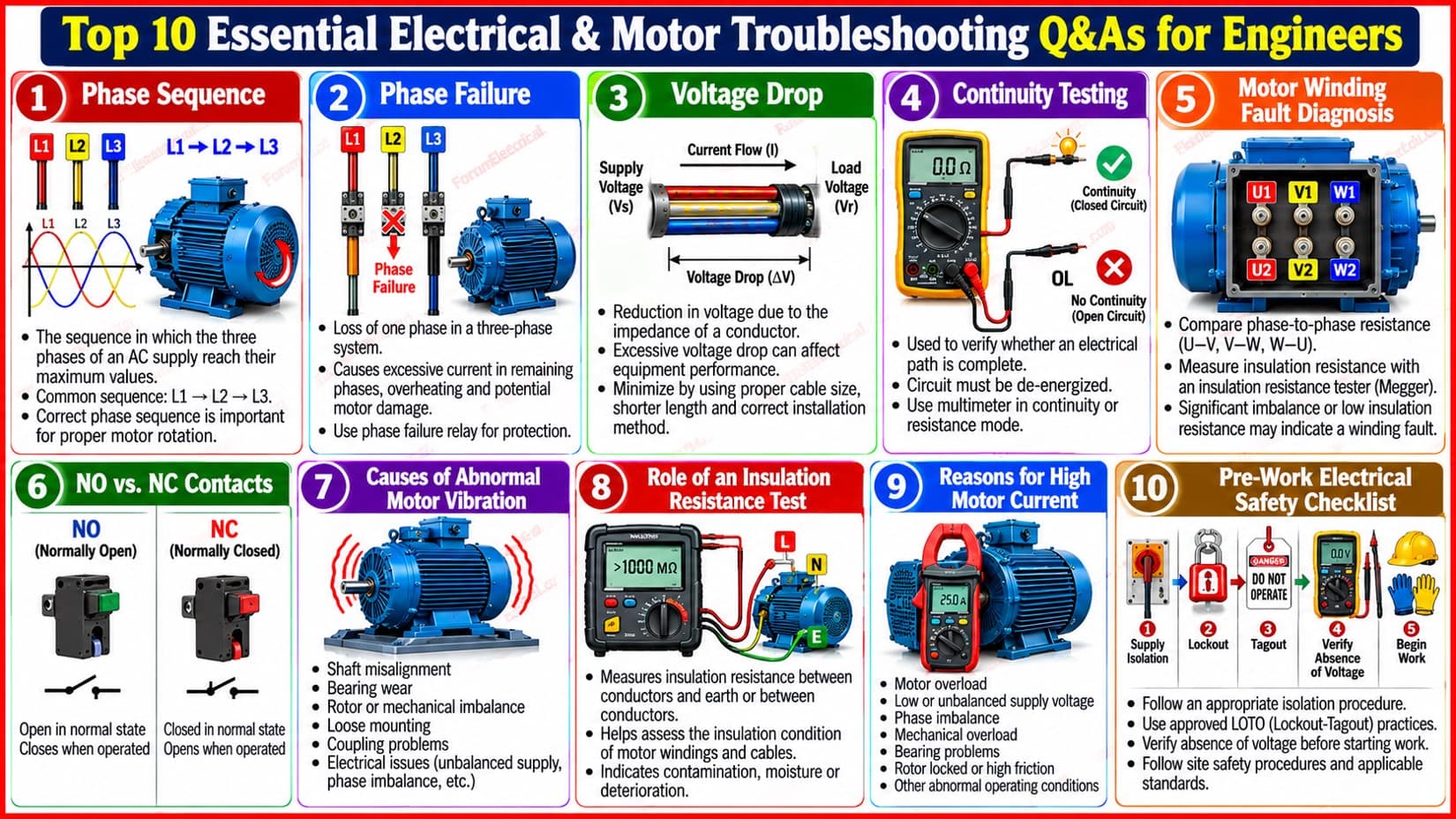
- Motor Winding Fault Diagnosis: Motor windings can be checked by comparing phase-to-phase resistance and measuring insulation resistance with an insulation resistance tester. Significant imbalance or low insulation resistance may indicate a fault.
- NO vs. NC Contacts: NO (Normally Open): The contact remains open in its normal state and closes when operated. NC (Normally Closed): The contact remains closed in its normal state and opens when operated.
- Causes of Abnormal Motor Vibration: Common causes include shaft misalignment, bearing wear, rotor or mechanical imbalance, loose mounting, and coupling problems.
- Role of an Insulation Resistance Test: An insulation resistance test measures the resistance of electrical insulation between conductors and earth or between conductors. It helps assess the insulation condition of motor windings and cables.
- Reasons for High Motor Current: High current can result from motor overload, low or unbalanced supply voltage, phase imbalance, mechanical overload, bearing problems, or other abnormal operating conditions.
- Pre-Work Electrical Safety Checklist: Before starting electrical maintenance, follow an appropriate isolation procedure: Supply Isolation → Lockout → Tagout → Verify Absence of Voltage → Begin Work Always follow the applicable electrical safety procedures, site requirements, and approved LOTO practices.