The Tan Delta (Dissipation Factor) Test is important diagnostic test used to evaluate the condition of electrical insulation in high-voltage equipment such as power transformers, current transformers (CTs), voltage transformers (VTs/PTs), bushings, cables, generators, and motors. These tests help detect insulation deterioration before a failure occurs.
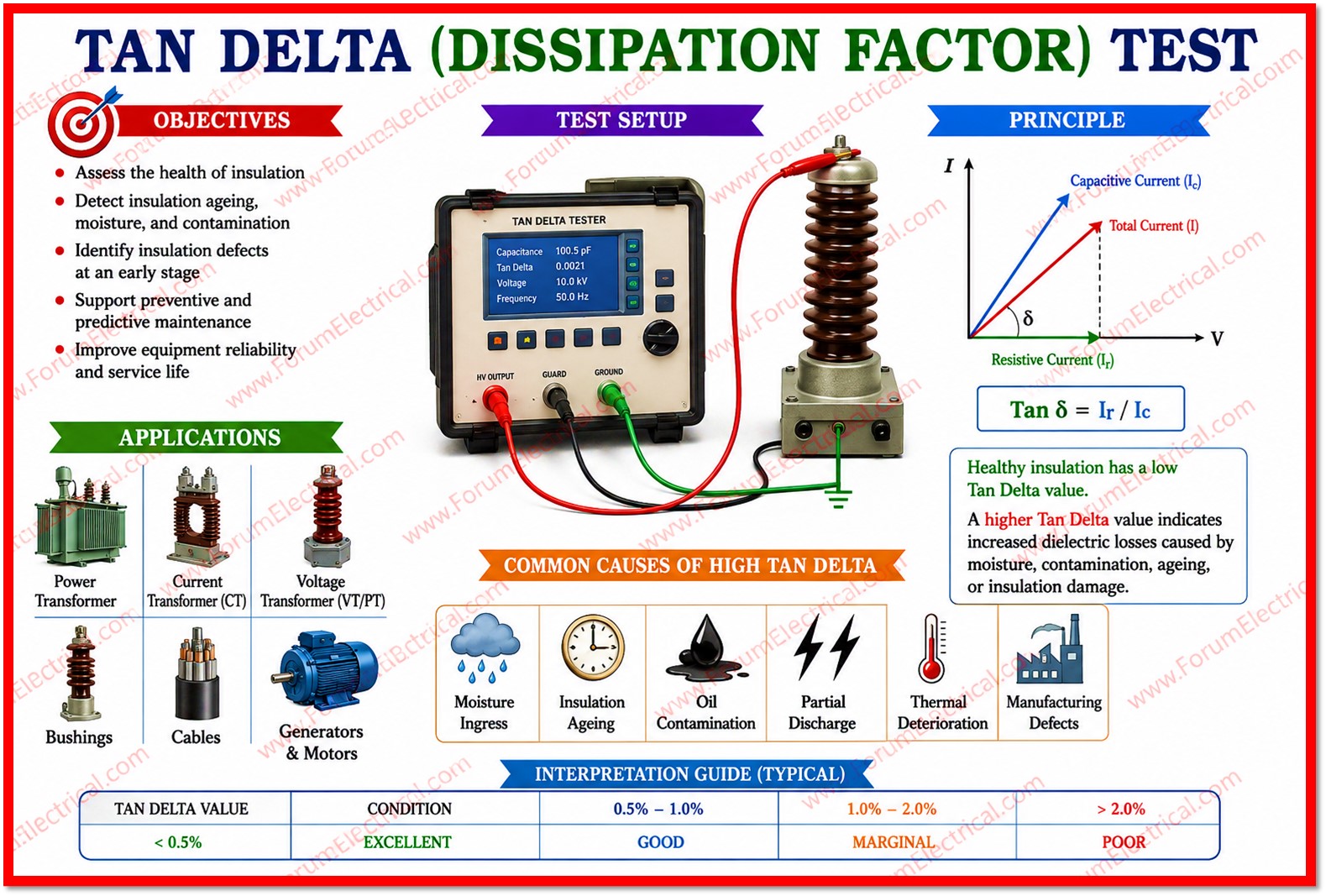
Objectives
Assess the health of insulation.
Detect insulation ageing, moisture, and contamination.
Identify insulation defects at an early stage.
Support preventive and predictive maintenance.
Improve equipment reliability and service life.
Tan Delta (Dissipation Factor) Test
The Tan Delta Test measures the dielectric losses in insulation by determining the loss tangent (tan δ). It indicates how much electrical energy is lost as heat due to insulation deterioration.
Principle
Healthy insulation has a low Tan Delta value.
A higher Tan Delta value indicates increased dielectric losses caused by moisture, contamination, ageing, or insulation damage.
Common Causes of High Tan Delta
Moisture ingress
Insulation ageing
Oil contamination
Partial discharge
Thermal deterioration
Manufacturing defects