Symmetrical vs Asymmetrical Fault Current - What is the Difference?
Every power systems engineer should clearly understand the difference between symmetrical and asymmetrical fault current, because both play different roles in equipment selection and system protection.
A symmetrical fault current is the steady-state RMS short-circuit current that remains after the transient DC offset has decayed. It is calculated using:
An asymmetrical fault current represents the actual current that flows immediately after a fault occurs. It consists of the AC fault current combined with a decaying DC offset, making the initial current significantly higher than the symmetrical RMS value.
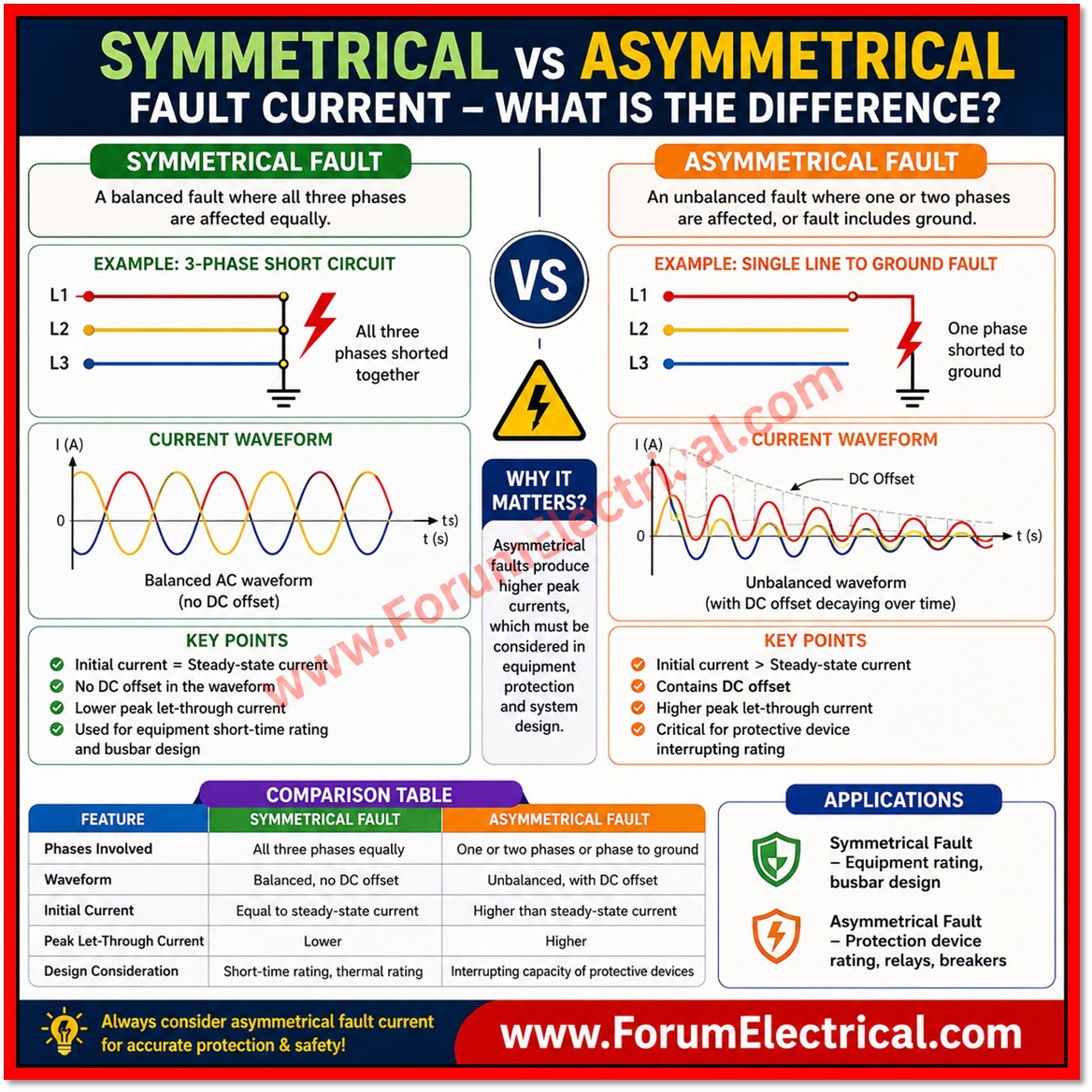
Symmetrical vs Asymmetrical Fault Current
| Parameter | Symmetrical Fault Current | Asymmetrical Fault Current |
|---|---|---|
| Current Type | RMS steady-state | Initial peak with DC offset |
| DC Component | No | Yes |
| Primary Use | Thermal withstand and interrupting rating | Making capacity and mechanical withstand |
| Influenced by X/R Ratio | No | Yes |
| Typical Value | Lower | Higher |