String Inverter vs. Central Inverter
In a solar photovoltaic (PV) power plant, inverters convert DC power generated by PV modules into grid-compatible AC power. Selecting between string and central inverter architectures depends on installed capacity, PV array configuration, site conditions, grid requirements, system efficiency, and operation and maintenance (O&M) strategy.
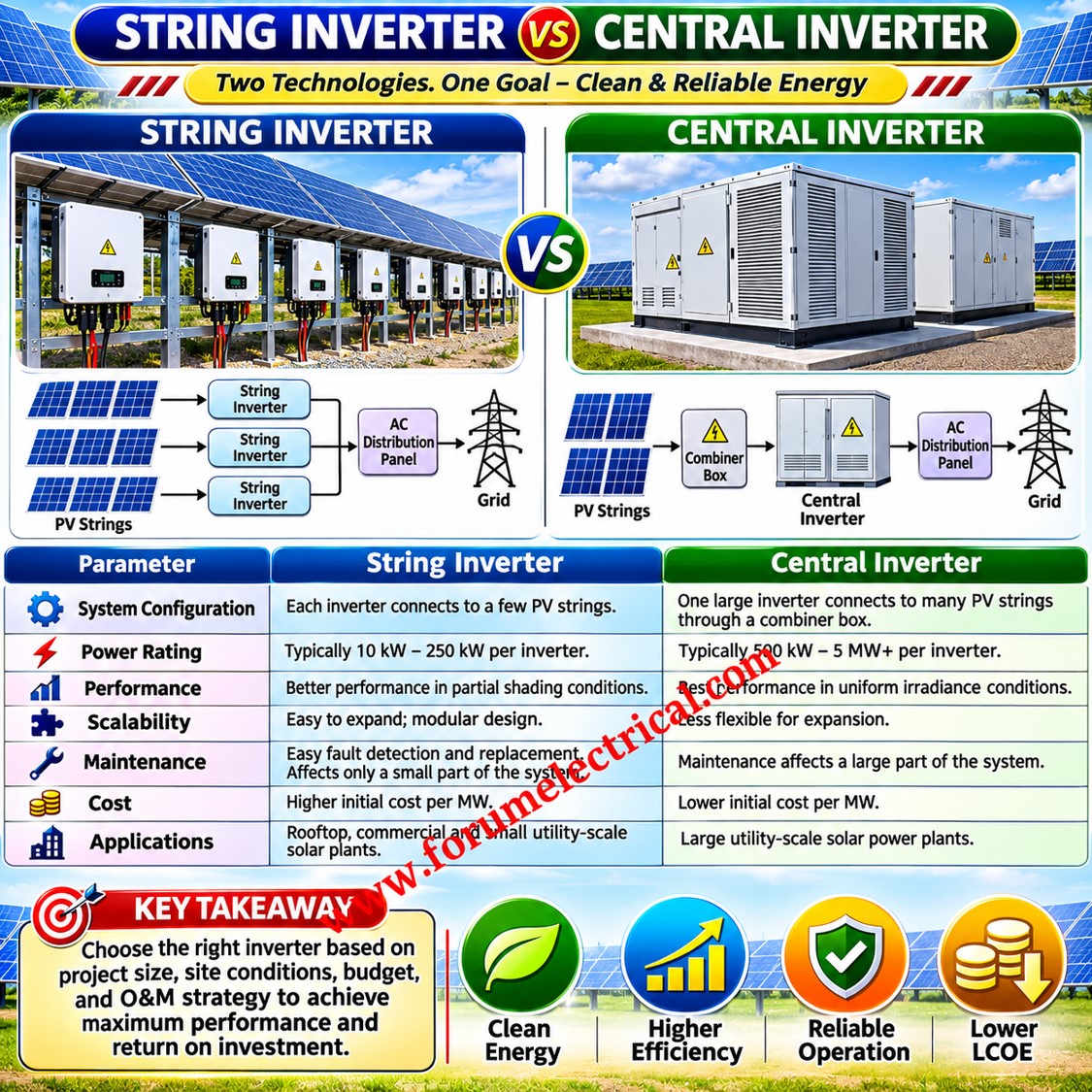
String Inverter
- Suitable for residential rooftops, commercial installations, and utility-scale solar projects.
- Each inverter independently processes DC power from multiple PV strings.
- Distributed Maximum Power Point Tracking (MPPT) enables better energy harvesting when different PV strings experience varying irradiance or shading conditions.
- Modular architecture provides greater design flexibility and easier capacity expansion.
- Inverter-level monitoring helps identify faults and simplifies maintenance.
- Failure of one inverter generally affects only its associated PV strings.
Central Inverter
- Commonly used in large utility-scale solar PV installations.
- A single high-capacity inverter processes DC power from multiple PV string inputs, often through DC combiner boxes.
- Centralized power conversion can reduce equipment and installation costs per MW in suitable large-scale projects.
- Requires coordinated DC collection, protection, isolation, and monitoring systems.
- Centralized architecture can simplify plant-level maintenance but creates a larger single point of failure.
- Suitable for large PV arrays with carefully designed string grouping and compatible operating conditions.
Key Technical Considerations
There is no universally superior inverter architecture. String inverters offer modularity, distributed MPPT, and design flexibility, whereas central inverters can provide cost-effective power conversion for large, uniform PV installations.
The final selection should consider DC/AC ratio, MPPT configuration, voltage and current limits, conversion efficiency, clipping losses, partial shading, grid-code compliance, fault isolation, availability, lifecycle cost, and O&M requirements.
Choosing the appropriate inverter architecture helps optimize energy yield, system reliability, maintainability, and overall solar plant performance.