SCADA vs BMS: Key Differences, Applications and Selection
What Is the Difference Between SCADA and BMS?
SCADA (Supervisory Control and Data Acquisition) and BMS (Building Management System) are automation systems that serve different operational needs. Understanding the difference between SCADA and BMS allows engineers to choose the right platform for industrial facilities, commercial buildings and integrated infrastructure projects.
What Is SCADA?
SCADA system monitors and supervizes the industrial processes by PLC, RTU, field instruments, communication networks and operator workstations. It captures real time data, shows alarms and records historical patterns. It allows authorized operators to deliver supervisory commands.
Main applications are oil and gas facilities, water treatment plants, refineries, power stations, pipelines, manufacturing units
SCADA allows an engineer to monitor tank contents, pump status, pipeline pressure and flow parameters from a central control center, for example.
What Is BMS?
A BMS controls building services to provide enhanced occupant comfort, energy efficiency and facility performance. It controls heating, ventilation and air conditioning, lights, chillers and some building infrastructure systems.
Typical uses are hospitals, offices, airports, shopping centers and data centers.
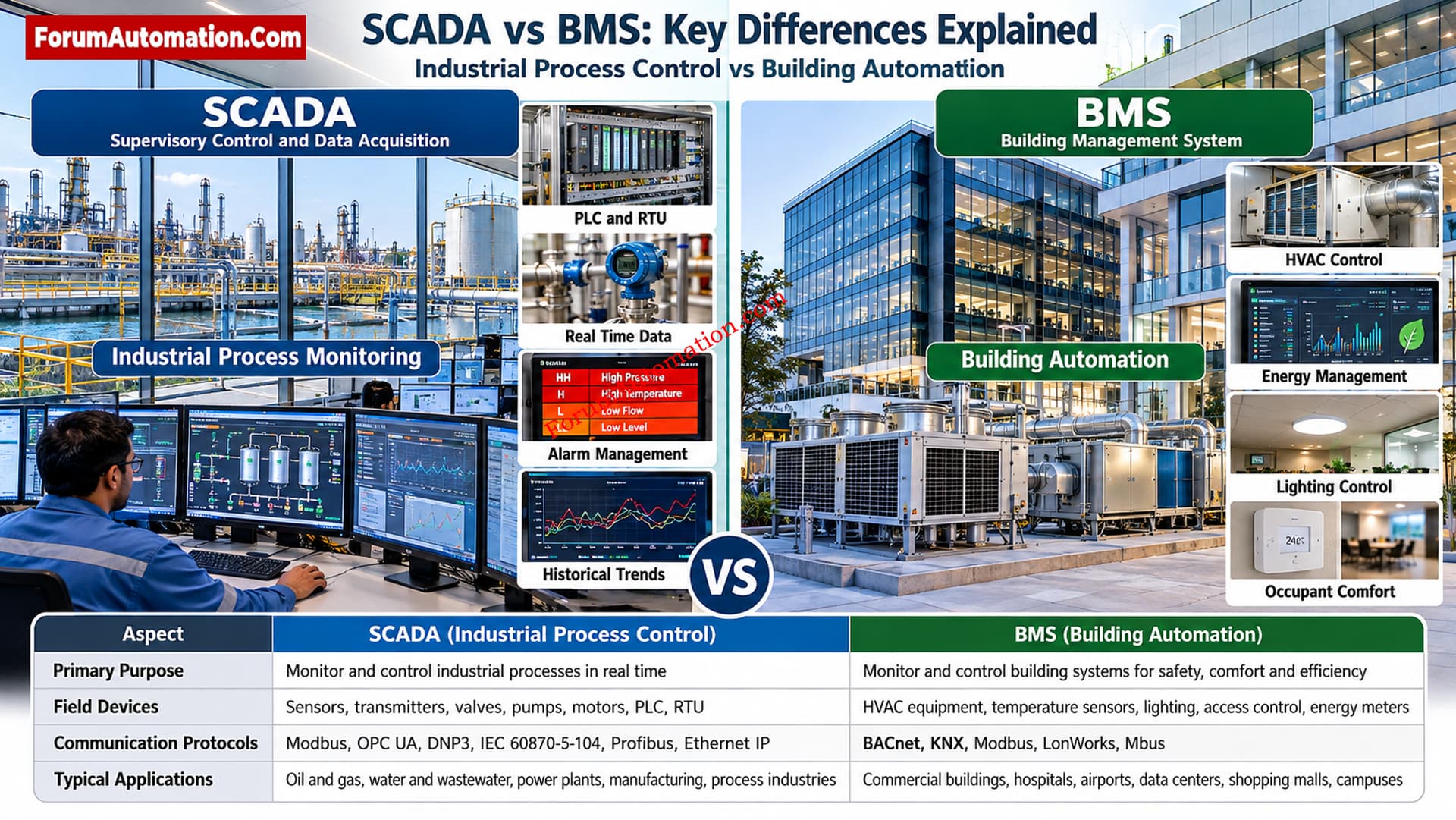
SCADA vs BMS: Key Differences
SCADA is used to monitor industrial processes, whereas BMS is used to control building services.
Field devices typically communicate with PLCs, RTUs, transmitters, and industrial meters within SCADA systems. Typical BMS hardware comprises building controllers, thermostats, dampers and HVAC sensors.
Communications: Modbus, OPC UA, Industrial Ethernet for SCADA BMS most often employs BACnet, KNX and other appropriate integration protocols.
Operational Focus SCADA is focused on alerts, process visibility and production continuity. BMS is concerned with comfort, energy consumption and building efficiency.
Which System Should Engineers Select?
Choose SCADA for industrial process control and BMS for building management. Large industrial campuses may need both systems, coupled through properly developed interfaces.
Always validate interoperability, cybersecurity, alarm ownership and control limits during commissioning.