Sag in Overhead Transmission Lines
Sag is the vertical distance between the conductor’s lowest point and the horizontal line joining its two support points. It is an essential mechanical design parameter in overhead transmission lines.
Proper sag calculation ensures:
1. Adequate ground and statutory clearance.
2. Accommodation of conductor thermal expansion and contraction.
3. Acceptable mechanical tension in conductors and supporting structures.
4. Reliable operation under varying temperature, wind, and ice-loading conditions.
5. Sag depends on conductor weight, span length, conductor tension, temperature, wind loading, and support elevation differences.
6. Excessive sag can violate minimum ground clearance, while insufficient sag can result in excessive conductor tension and mechanical loading on towers and insulators.
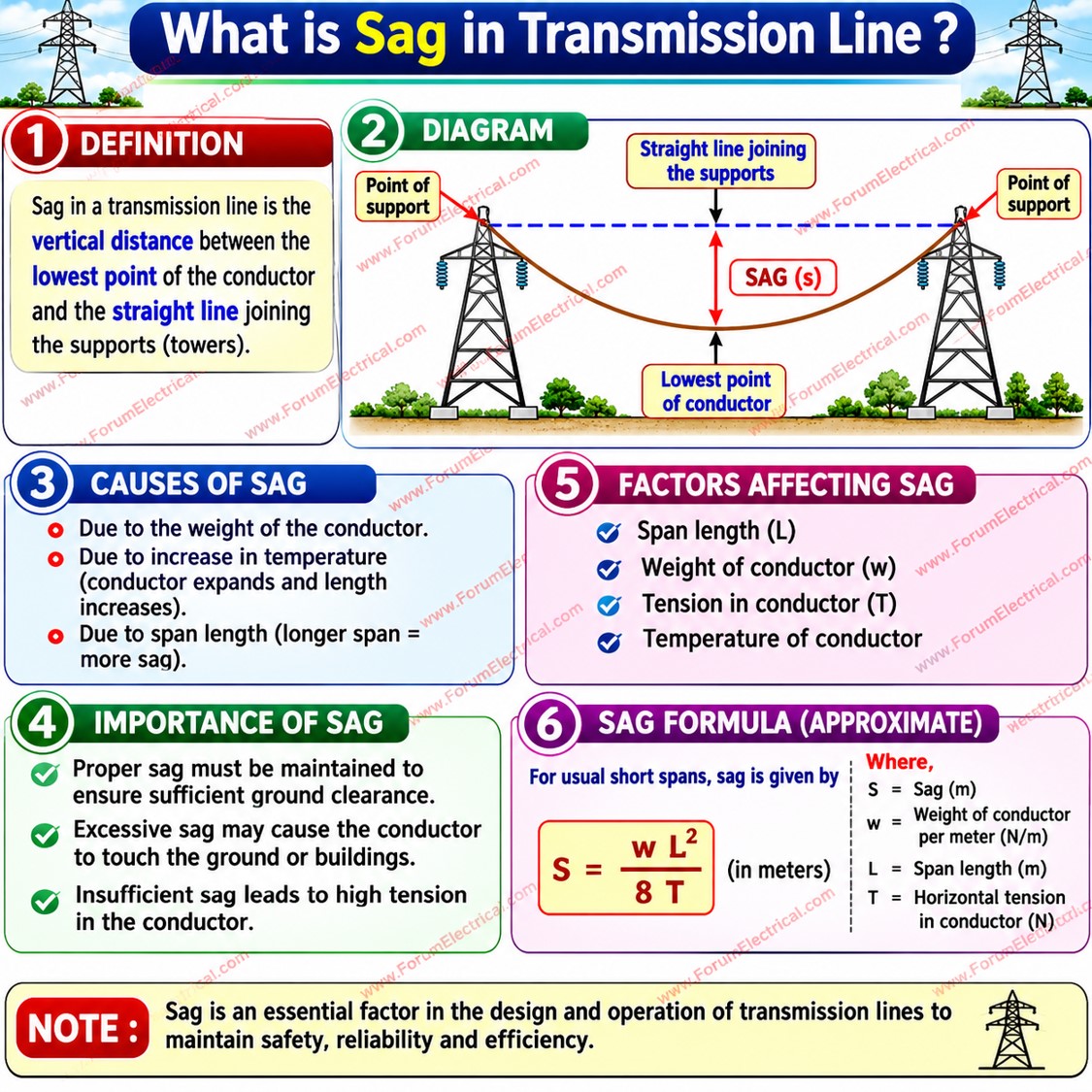
Engineering Note: Accurate sag-tension calculations are essential for safe, reliable, and mechanically sound overhead transmission line design.