Radar Level Transmitter Showing False High Level During Heavy Rain
I’m facing a strange issue with an 80 GHz radar level transmitter installed on a diesel storage tank. During heavy rain, the level suddenly jumps from around 45% to nearly 90%, which triggers a high-level alarm in the DCS. We checked the tank inventory and even verified the level manually, and the actual level remains around 45%. Once the rain stops, the reading slowly returns to normal. The transmitter has been running fine for years, but we recently installed a new sampling pipe inside the tank. Has anyone experienced something similar? What would you check first—antenna condition, false echo mapping, or something else?
1 Like
Radar Level Transmitter Showing False High Level During Heavy Rain
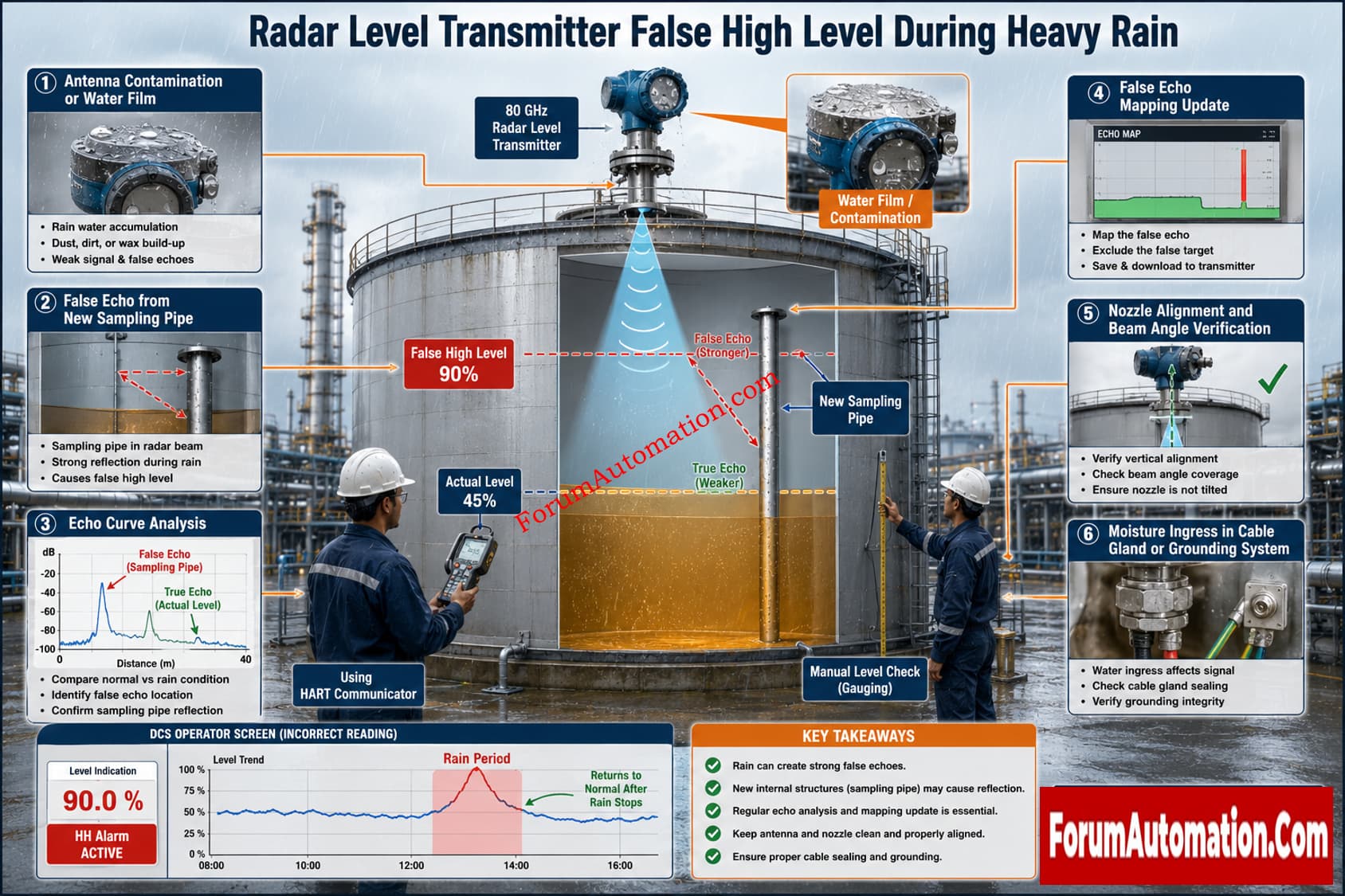
Sudden misleading high level readings in an 80 GHz radar level transmitter during heavy rain are typically indicative of shifting echo conditions rather than a real process upset. Manual measuring shows the fuel level is steady and the problem started after a new sampling pipe was fitted so check for reflections before blaming transmitter failure. Heavy rain can form a water layer on the antenna, radome or nozzle which reduces signal strength and causes powerful reflections from internal structures to dominate. The new sampling pipe can also introduce an additional echo path that is more significant when rain changes the dielectric conditions near the antenna.
Priority Inspection Checklist
- Check antenna and radome for water, dirt, wax or condensation.
- Check the echo curve while it is raining and compare it with normal conditions.
- Install sampling pipe: check for false echo mapping.
- Ensure the sampling pipe is within the radar beam angle.
- Check nozzle alignment, antenna direction, and mounting tightness.
- Check dielectric settings, tank geometry and config parameters are the same.
- Check for moisture penetration at the grounding and cable glands.
Recommended Troubleshooting Approach
During rain, use the transmitter software or HART communicator to take diagnostic echo profiles. Update the false echo map if new echoes are observed at the site of the sample pipe after checking the real tank geometry. Make sure the antenna surface is clean and water can run easily off the nozzle. If required, reposition the transmitter a little or move the sample pipe out of the radar beam. Verify high level alarm settings after corrective steps and trend signal across numerous rain occurrences. Most false level alerts for rain are caused by shifting echo reflections, installation adjustments or antenna contamination rather than transmitter electronics, therefore thorough echo analysis is the quickest approach to a permanent remedy.
1 Like