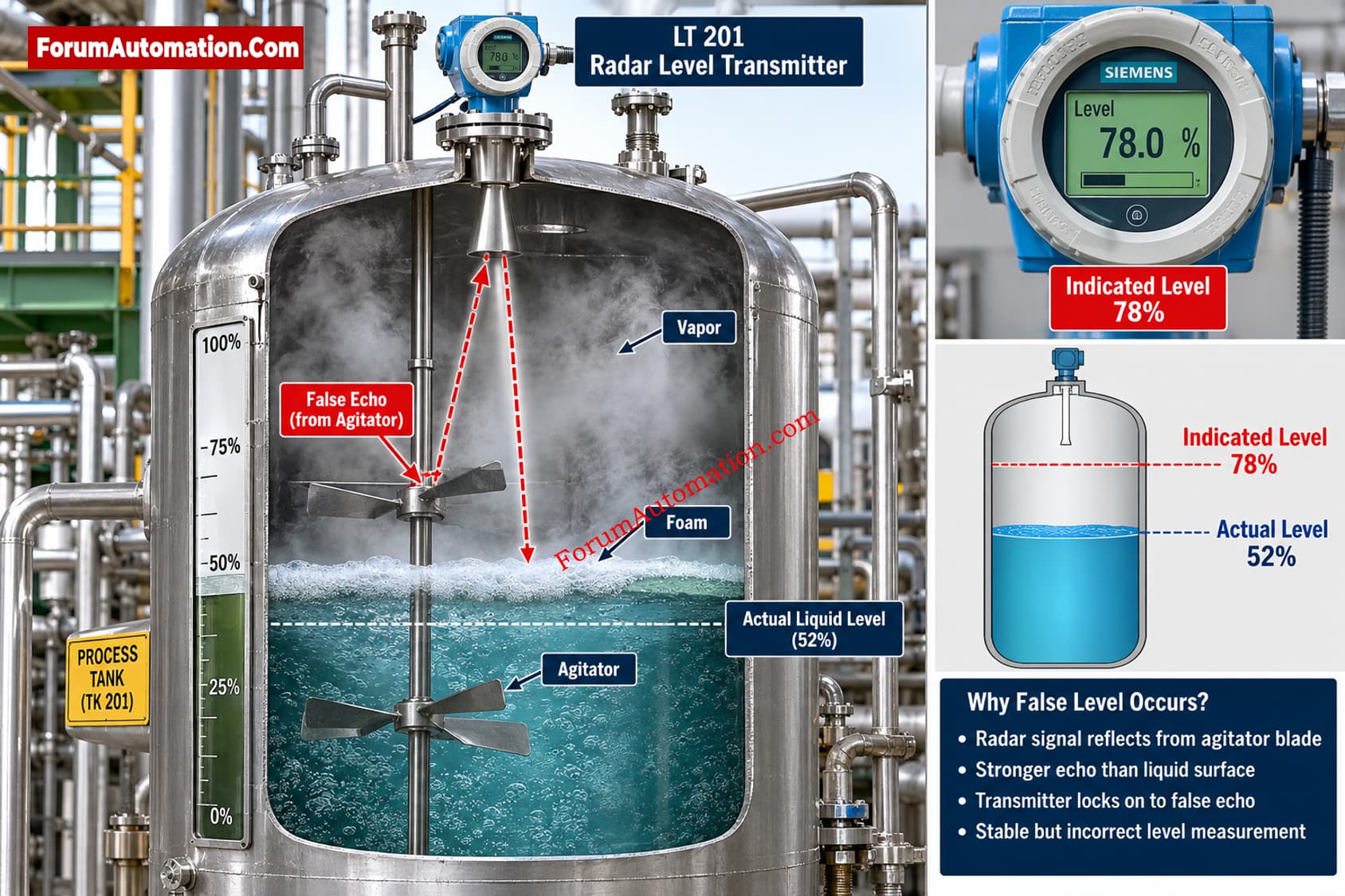
Calibrating the receiver does not necessary cause the radar level indication to become misleading. Because the radar instruments detect the reflected electromagnetic signal from the process surface, any factor that causes a significant undesired reflection or modifies the signal path can impact the measured level.
In this situation, agitator, foam, vapor conditions and possible internal vessel obstructions should be investigated first.
Most Likely Causes
Possible causes include false echoes from internal vessel structures, agitator blades, buildup on the antenna, excessive foam, condensation, turbulent surface conditions, incorrect tank geometry configuration, incorrect reference height, or an unsuitable mounting location.
A partially blocked or contaminated antenna can also change the quality of the radar signal.
If the shown level is steady yet inaccurate, a false echo caused by an internal obstruction or an inappropriate setting should be considered.
What Should Be Checked First?
The first step is to check the transmitter diagnostic information and echo profile, if the radar instrument has this function.
The engineer needs to verify that the transmitter is indeed sensing the process surface and not picking up some other reflection.
The transmitter configuration must next be compared with the approved instrument data sheet and the tank dimensions.
It is important to pay special attention to the reference point, the measuring range, the tank height, the antenna arrangement and the false echo suppression settings.
Recommended Troubleshooting Sequence
- Independent measurement to confirm the real process level.
- Check the process conditions.
- Check the echo curve or signal profile of the radar
- Search for false echoes from agitators, nozzles, ladders, heating coils or other internal structure.
- Check the antenna for accumulation or condensation, where safe to do so.
- Watch for foam or heavy vapor.
- Check transmitter mount and direction.
- Verify the specified tank height and reference distance.
- Check the range of measure and the calibration for empty tank.
- Look at the setting for false echo mapping or suppression.
- Ensure the selected antenna and radar are appropriate for the purpose.
Why Can an Agitator Cause a False Reading?
A radar transmitter emits electromagnetic radiation into the process and measures the reflected signal.
If an agitator or other internal structure provides a greater or more constant reflection than the actual liquid surface, the transmitter may perceive that reflection as the process level.
This can produce a stable but incorrect measurement.
That is why simply recalibrating the transmitter may not solve the problem.
Practical Recommendation
Before replacing the radar transmitter, verify the echo profile, process conditions, vessel internals, antenna condition, mounting arrangement, and configuration parameters.
If the process has changed since the original commissioning, the radar application should be reviewed again rather than assuming that the transmitter has failed.