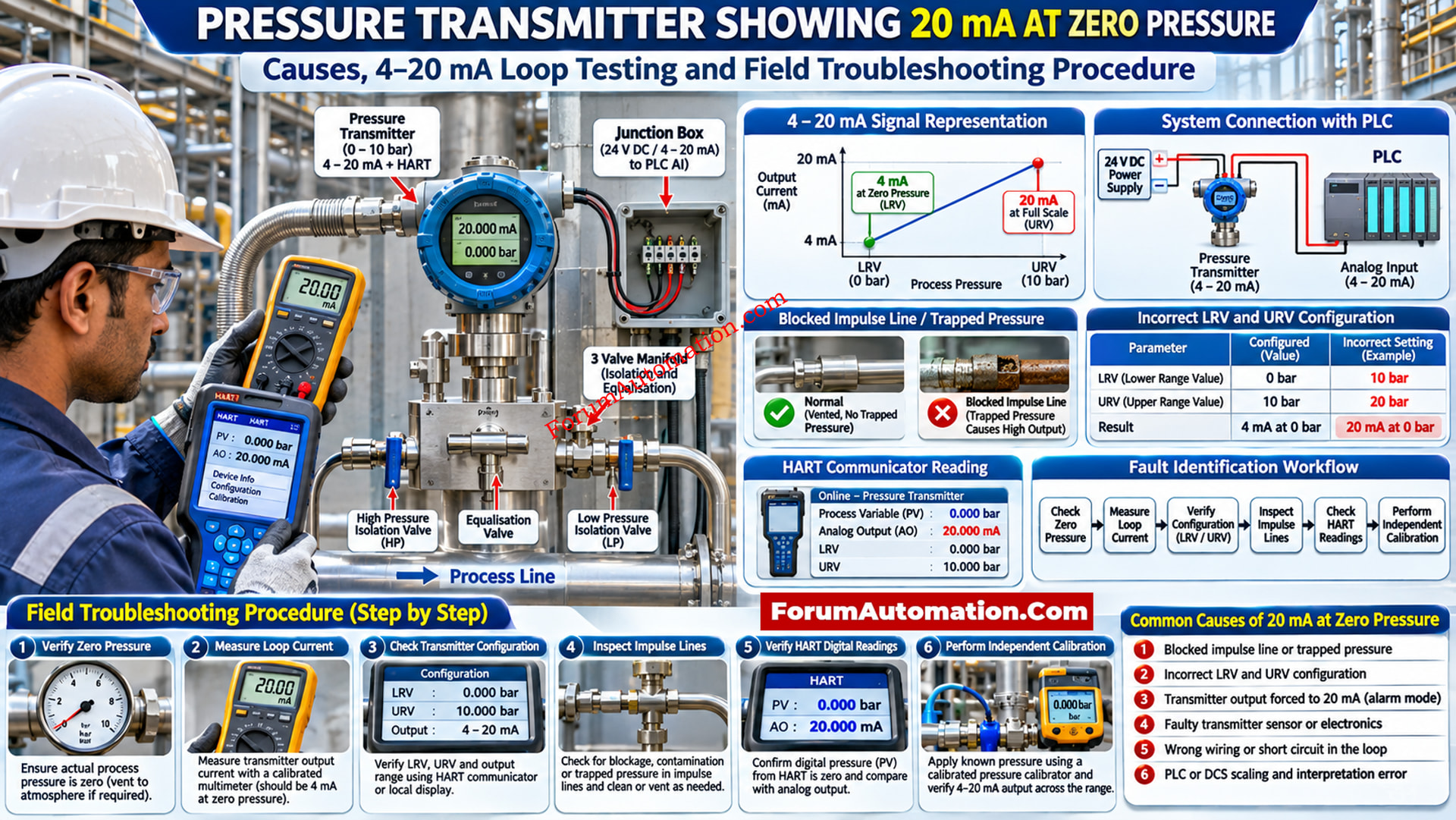
Pressure Transmitter Showing 20 mA Even When Process Pressure Is Zero: What Could Be the Cause?
**A pressure transmitter indicates 20 mA continuously, even after isolating the process connection and confirming zero pressure. What should we check first?
**
Pressure Transmitter Fixed at 20 mA at Zero Pressure
A steady 20 mA signal at confirmed zero pressure requires separating transmitter output from loop and control system indications.
Checks to perform first
1. Verify actual loop current. Use a calibrated multimeter in series with the 4–20 mA loop under approved site procedures. Compare the measured current with the PLC or DCS indication. If the meter reads 4 mA but the control system shows 20 mA, investigate input configuration, wiring, channel selection and scaling.
2. Confirm the pressure reference. Check that the correct process connection is isolated and vented. For a differential pressure transmitter, verify both sides, manifold valve positions and equalisation.
3. Check transmitter configuration. Confirm lower and upper range values, engineering units, transfer function, output mode and configured alarm direction. Incorrect ranging or loop test mode can produce unexpected output.
4. Inspect the process interface. Look for blocked impulse tubing, trapped pressure, a closed root valve, plugged manifold or residual hydrostatic head. Never loosen fittings until the process is isolated and depressurised.
5. Test independently. Use a HART communicator to compare the digital pressure variable with analog output. Apply a known pressure using a suitable pressure calibrator. If digital pressure is zero but output remains 20 mA, investigate output trim, electronics or failure mode.
Practical diagnosis
Check transmitter terminals and marshalling cabinet wiring for continuity carefully. Review burnout direction. Record voltage, current, configuration and test pressure. Do not adjust zero or span until the cause is identified.