Understanding transformer protection schemes is essential for electrical engineers, substation engineers, and maintenance technicians.
Key Power Transformer Protection Devices:
-
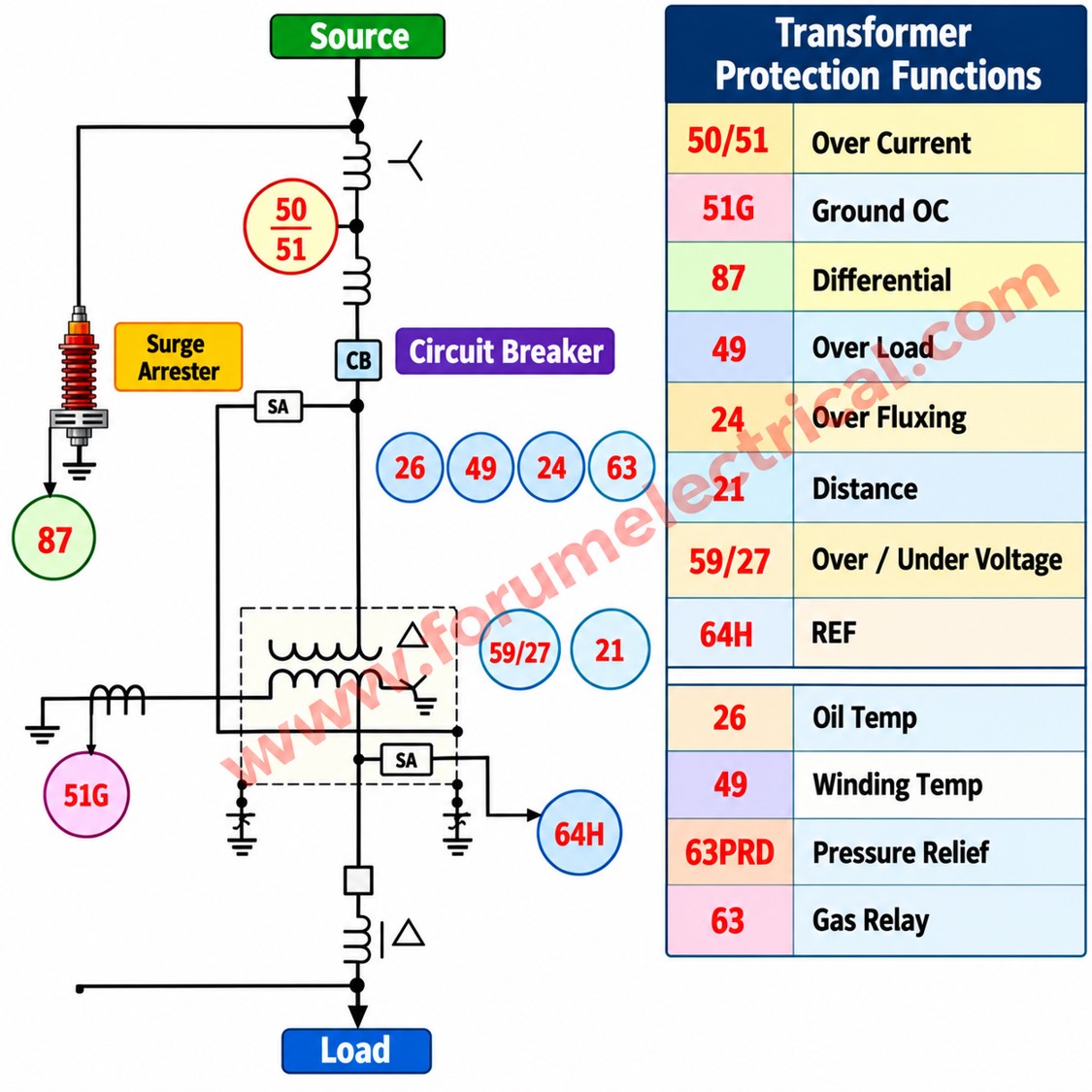
Differential Protection (87T): Detects internal phase faults by comparing the currents entering and leaving the transformer, with compensation for transformer ratio and phase shift.
-
Restricted Earth Fault Protection (REF): Provides sensitive protection against earth faults within a defined transformer winding zone.
-
Buchholz Relay: Detects gas accumulation and oil surges associated with certain internal faults in conservator-type oil-immersed transformers.
-
Oil Temperature Indicator (OTI): Monitors transformer oil temperature and initiates alarms or cooling controls when configured thresholds are reached.
-
Winding Temperature Indicator (WTI): Monitors estimated winding hot-spot temperature and can initiate alarms, cooling control, or trips according to the protection scheme.
-
Pressure Relief Device (PRD): Relieves excessive internal pressure to reduce the risk of tank rupture.
-
Overcurrent and Earth Fault Protection (50/51 and 50N/51N): Protects against excessive phase currents and earth faults, providing backup protection where applicable.
-
Surge Arresters: Limit transient overvoltages caused by lightning and switching operations.
Why is Transformer Protection Important?
Transformer protection helps detect electrical and internal faults, limit equipment damage, reduce fire hazards, minimize unplanned outages, and improve power system reliability.
Engineering Tip: Differential protection (87T) is primarily used for internal electrical faults, while Buchholz protection detects gas accumulation and oil surges associated with certain faults in applicable oil-immersed transformers. Protection settings and trip logic must be coordinated with transformer ratings, grounding arrangements, and system fault levels.