Power Factor (PF) = Real Power (kW) ÷ Apparent Power (kVA)
For a sinusoidal AC system, PF = cos φ, where φ is the phase angle between voltage and current.
A lower power factor requires higher current to deliver the same kW load at the same voltage, increasing equipment loading and I²R losses. FORMULA:
Power Factor (PF) = kW ÷ kVA
Where: • kW = Real Power • kVA = Apparent Power • PF = Power Factor
EXAMPLE:
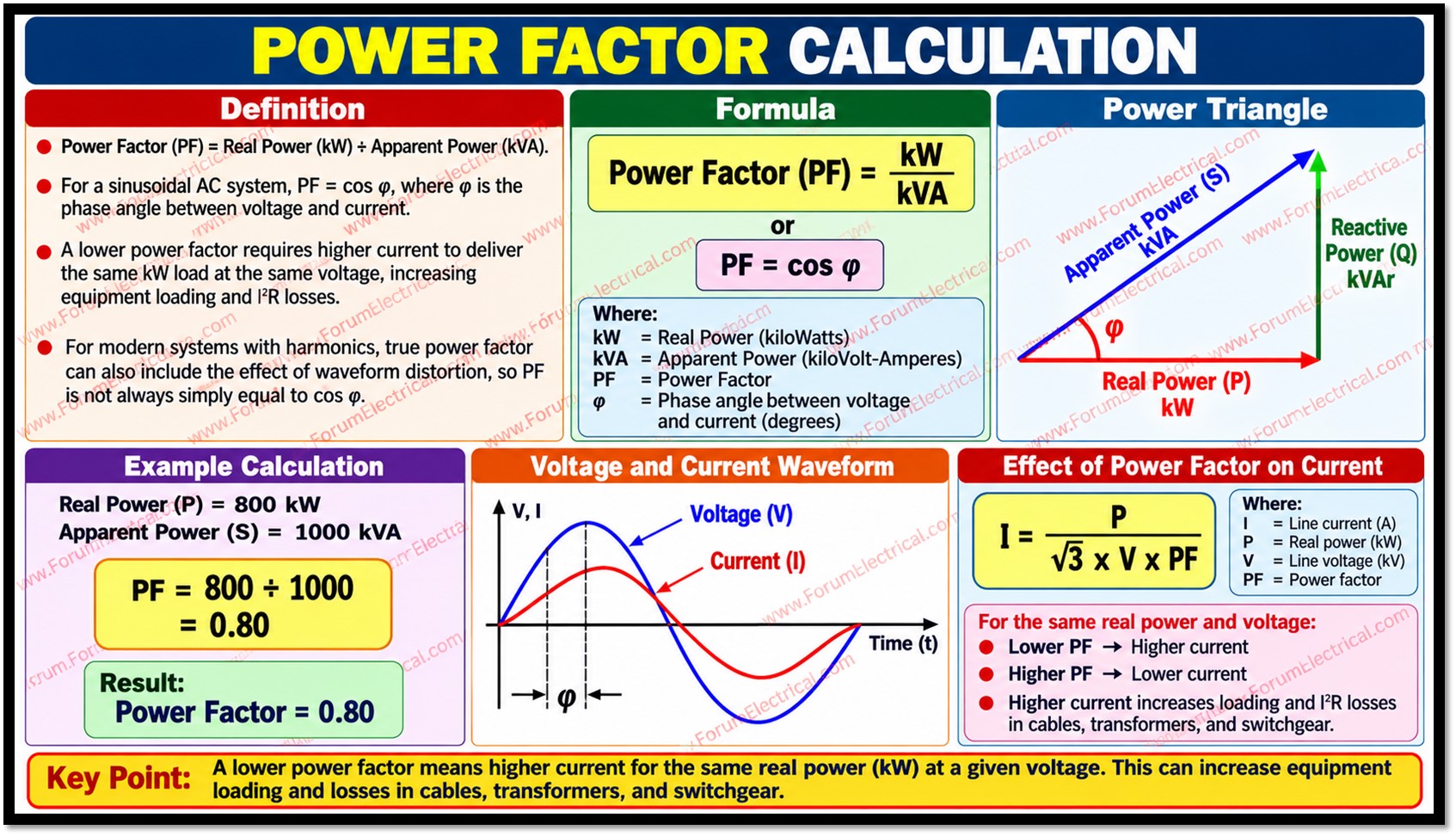
Real Power = 800 kW Apparent Power = 1000 kVA
PF = 800 ÷ 1000 = 0.80
RESULT: Power Factor = 0.80
Another relation:
PF = cos φ
where φ is the phase angle between voltage and current.
KEY POINT: A lower power factor generally means higher current for the same kW load, which can affect cable, transformer, and switchgear loading.
Lower PF means higher current for the same real power (kW) at a given voltage. This can increase loading and losses in cables, transformers, and switchgear.
For modern systems with harmonics, true power factor can also include the effect of waveform distortion, so PF is not always simply equal to cos φ.