Parallel Operation of Three Phase Transformers
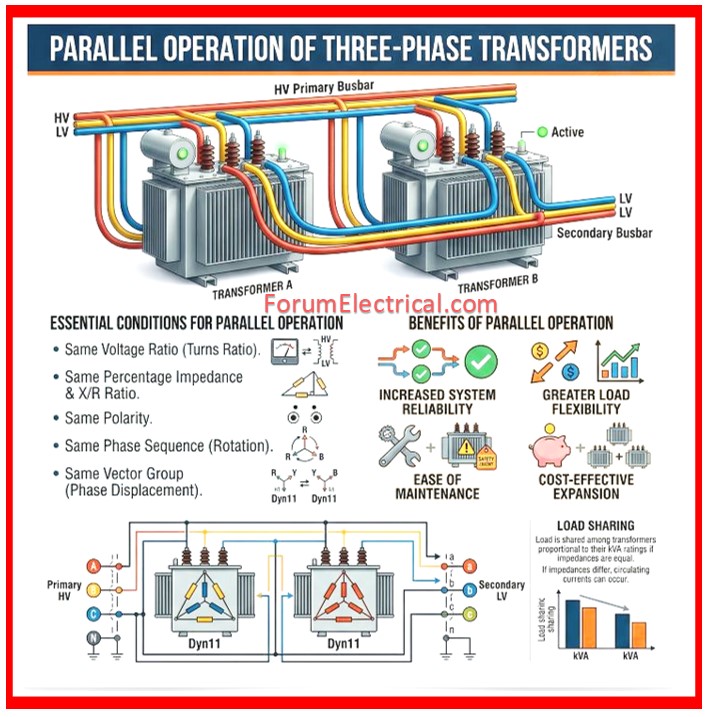
Parallel operation of three-phase transformers means connecting two or more transformers to the same electrical busbar so they can share the load simultaneously and supply power together to a common system.
Why Do We Use Parallel Operation?
- Increase Load Capacity – Multiple transformers can share high loads when one transformer is not enough.
- Improved Reliability – If one transformer fails, the other transformer can continue supplying power.
- Maintenance Flexibility – One transformer can be taken out for maintenance without interrupting supply.
- Better Efficiency – During low demand, one transformer can be switched OFF to reduce no-load losses.
- Future Expansion – Additional transformers can be added as power demand increases.
Conditions Required for Parallel Operation
For successful parallel operation, the following conditions must be satisfied:
1. Same Voltage Ratio
Both transformers must have the same primary and secondary voltage ratings. If the ratio differs, circulating current may flow between transformers.
2. Same Polarity
Transformers must have the same polarity; otherwise, severe short-circuit currents may occur.
3. Same Phase Sequence
The phase sequence (R-Y-B) of both transformers must match correctly.
4. Same Vector Group
The transformers should have the same vector group (e.g., Dyn11 with Dyn11). Different phase displacement causes improper synchronization.
5. Same Percentage Impedance (%Z)
The impedance percentage should be equal or nearly equal to ensure proper load sharing.
6. Similar KVA Rating
Transformers should have similar kVA ratings for balanced load distribution.
Example
Suppose two transformers are connected in parallel:
- Transformer 1 = 1000 kVA
- Transformer 2 = 500 kVA
The load sharing depends on impedance. If impedance is equal, the load is shared according to transformer capacity:
- 1000 kVA transformer → 66.7% load
- 500 kVA transformer → 33.3% load
Advantages
Improved system reliability Increased power capacity Easy maintenance without shutdown Better operational flexibility Reduced downtime
Disadvantages
Improper load sharing if impedance differs Circulating currents due to voltage mismatch Risk of overheating if one transformer becomes overloaded