Normal Capacitor Bank or Detuned Capacitor Bank: Which one should you use?
What is a Normal Capacitor Bank?
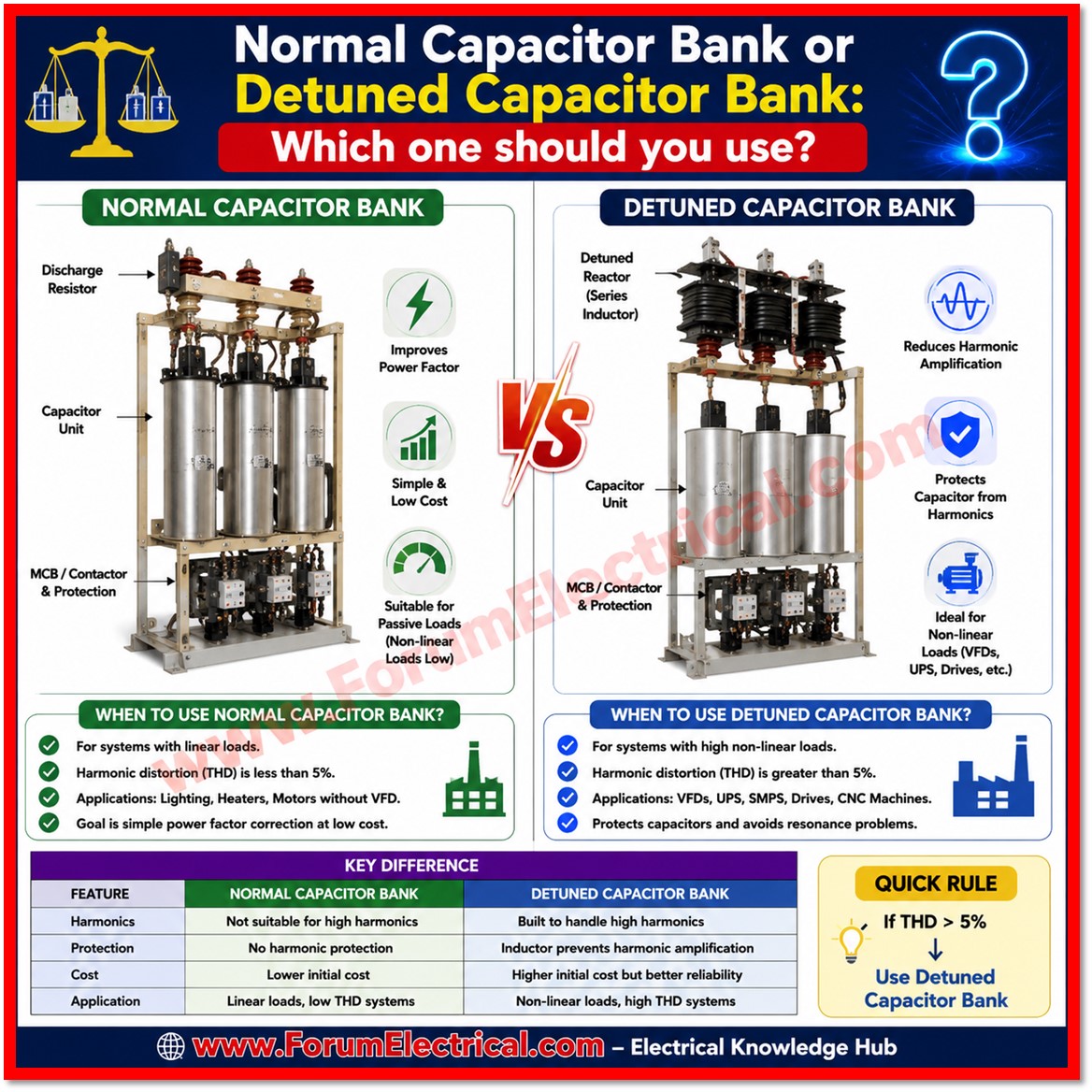
A normal capacitor bank consists of capacitors connected directly to the electrical system, generally through switching and protection devices. It is mainly used for power factor correction by supplying capacitive reactive power.
It is suitable for electrical systems with low harmonic distortion and without significant harmonic-producing loads.
What is a Detuned Capacitor Bank?
A detuned capacitor bank combines capacitors with series reactors. The reactor shifts the system’s resonant frequency away from dominant harmonic frequencies, reducing the possibility of resonance and limiting harmonic currents flowing into the capacitor bank.
Detuned banks are commonly used where loads include:
- Variable Frequency Drives (VFDs)
- UPS systems
- Rectifiers
- Welding equipment
- Data centers
- Solar inverters
- Other nonlinear loads
Normal vs Detuned Capacitor Bank
| Feature | Normal Capacitor Bank | Detuned Capacitor Bank |
|---|---|---|
| Main purpose | Power factor correction | Power factor correction + harmonic protection |
| Series reactor | No | Yes |
| Harmonic environment | Low | Moderate to high |
| Resonance risk | Higher | Significantly reduced |
| Cost | Lower | Higher |
| Maintenance | Relatively simple | Requires reactor and capacitor maintenance |
| Suitable for VFD loads | Generally not preferred | Preferred |
| Harmonic protection | Limited | Better |
| Installation | Simple | More complex |
Which One is Better?
For a clean electrical system with minimal harmonics, a normal capacitor bank may be sufficient. However, if the installation contains a significant number of VFDs, UPS systems, rectifiers, or other nonlinear loads, a detuned capacitor bank is generally the safer choice.
The selection should ultimately be based on the system’s harmonic study, load profile, short-circuit level, and resonance assessment, rather than simply choosing based on capacitor kVAR rating.