LSIG protection is an advanced protection feature that is available in electronic trip units of Air Circuit Breakers (ACB) and high-end Molded Case Circuit Breakers (MCCB).
It provides four types of protection functions:
• L - Long Time Protection (Overload)
• S - Short Time Protection
• I - Instantaneous Protection
• G - Ground Fault Protection
These functions protect electrical systems from the
• Overloads,
• Short circuits and
• Earth faults with adjustable settings.
1). L – Long Time Protection (Overload Protection)
Purpose
Protects against the overload currents that occur when equipment draws more current than its rated capacity for a prolonged time.
Typical Causes
• Motor overload
• Excessive load on feeder
• Mechanical jam in motor
Characteristics
• Operates with inverse time delay
• Higher overload → faster tripping
• Lower overload → slower tripping
Example
• Breaker rating: 100 A
• Long time setting: 80 A
• Breaker trips if current exceeds 80 A for preset time.
Adjustable Parameters
• Long time pickup current (Ir)
• Long time delay (tr)
2). S - Short Time Protection (Short Circuit with Delay)
Purpose
Protects against the short circuits while allowing coordination with the downstream breakers.
Why delay is required?
Allows the downstream breaker to clear fault first and ensures the selective coordination
Characteristics
• Operates at high current levels (typically 2–10 x In)
• Includes intentional time delay
Example
• Short time pickup: 5 x In
• Delay: 0.3 seconds
• Breaker trips only if downstream breaker fails.
Adjustable Parameters
• Short time pickup (Isd)
• Short time delay (tsd)
• I²t ON/OFF option
3). I - Instantaneous Protection (Immediate Short Circuit Protection)
Purpose
It provides an immediate protection against the severe short circuits.
Characteristics
• No intentional delay
• Trips instantly when current exceeds preset value
• Typical Setting
8 -15 x In
Example
If In = 100 A
• Instantaneous setting = 1000 A
• Breaker trips immediately at 1000 A.
4). G - Ground Fault Protection (Earth Fault Protection)
Purpose
It protects against earth leakage faults
Importance
Prevents:
• Equipment damage
• Fire hazards
• Electrical shock
Characteristics
• Detects imbalance between phase and neutral currents
• Trips when leakage exceeds preset value
Typical Settings
• Pickup: 0.2 to 0.6 x In
• Delay: 0.1 to 0.5 seconds
LSIG Protection Summary Table
| Protection | Full Form | Protects Against | Time Delay |
|---|---|---|---|
| L | Long Time | Overload | Yes (Inverse) |
| S | Short Time | Short circuit (with coordination) | Yes |
| I | Instantaneous | Severe short circuit | No |
| G | Ground Fault | Earth fault | Yes |
LSIG Protection Curve
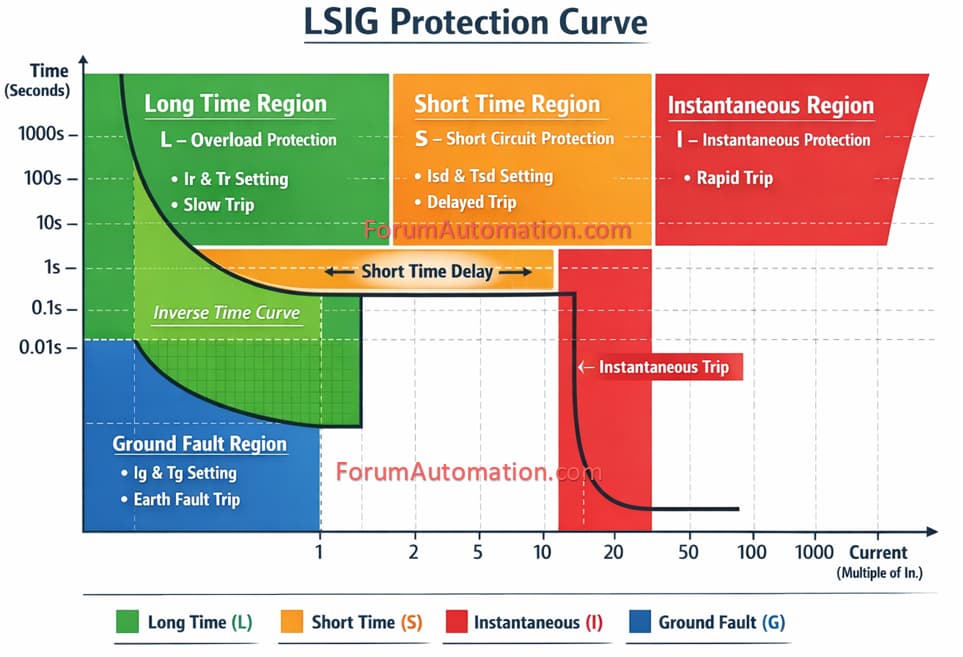
The protection curve has 4 regions:
1). Long time region → overload protection
2). Short time region → delayed short circuit protection
3). Instantaneous region → immediate trip
4). Ground fault region → earth fault protection
These curves ensure the proper coordination and protection hierarchy.
Where LSIG Protection is used?
Common applications include:
• Air Circuit Breakers (ACB)
• High-end MCCB
• Main incomer breakers
• Generator protection
• Transformer protection
• Industrial panels
• Substations
Example of LSIG Settings
Breaker rating: 1600 A
• L: 0.8 x In = 1280 A, delay 10 s
• S: 5 x In = 8000 A, delay 0.3 s
• I: 10 x In = 16000 A
• G: 0.4 x In = 640 A, delay 0.2 s
Advantages of LSIG Protection
• Provides complete protection.
• Adjustable settings.
• Improves system coordination.
• Prevents nuisance tripping.
• Protects equipment and personnel.
Difference Between LSIG and Thermalmagnetic Protection
| Features | LSIG Protection | Thermal-Magnetic Protection |
|---|---|---|
| Accuracy | High | Moderate |
| Adjustable | Yes | Limited |
| Ground fault protection | Yes | No |
| Coordination | Excellent | Limited |
| Used in | ACB, advanced MCCB | Basic MCCB |
LSIG protection is an advanced and also an essential protection system used in modern circuit breakers.
It provides complete protection against overload, short circuit & ground faults while ensuring the proper coordination and safety of electrical systems.
You can also follow us on AutomationForum.co, Facebook and Linkedin to receive daily Instrumentation updates.
You can also follow us on ForumElectrical.com , Facebook and Linkedin to receive daily Electrical updates.