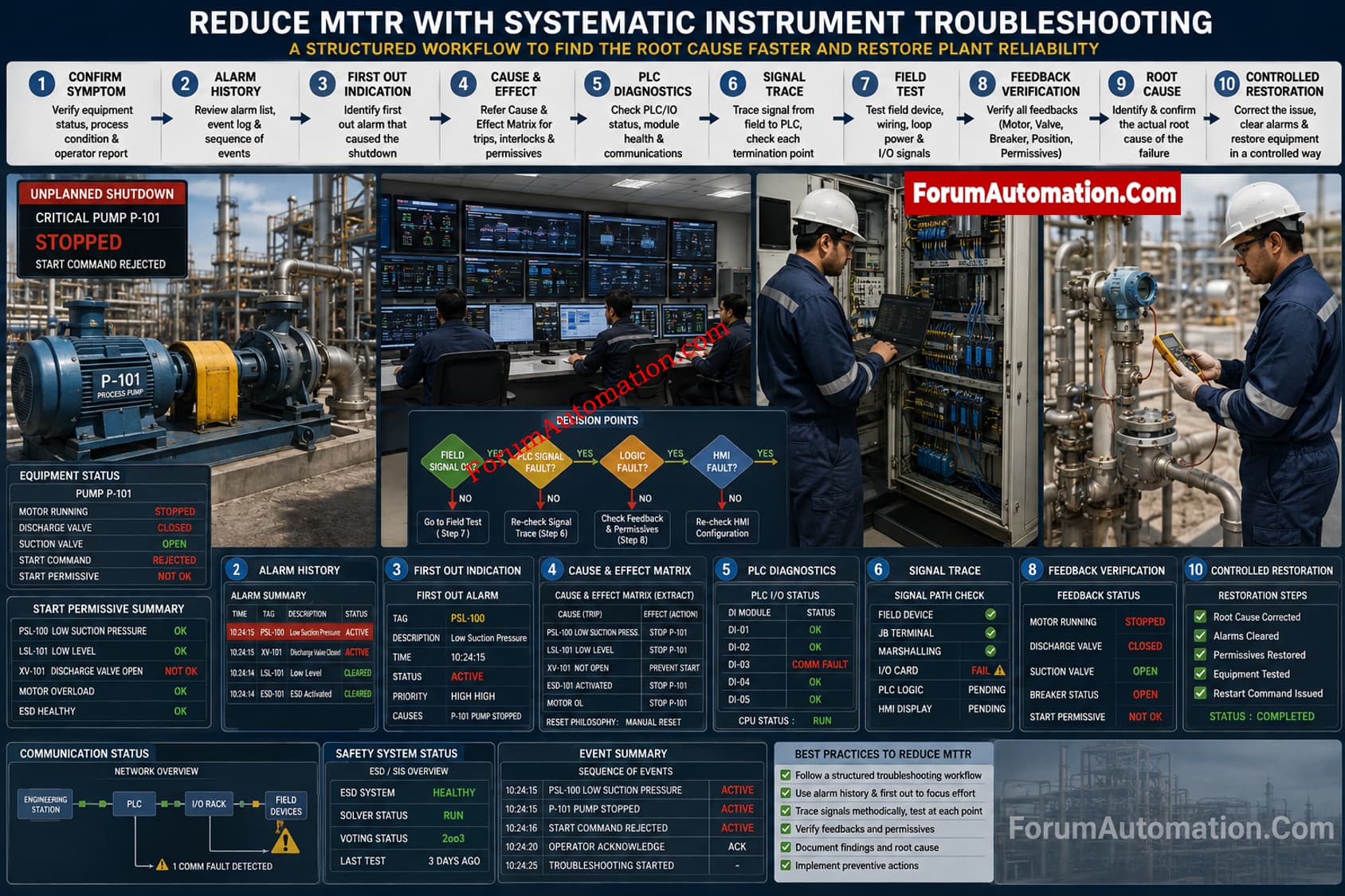
Instrument Fault Is Taking Too Long to Diagnose During an Unplanned Process Plant Shutdown
During an unplanned plant shutdown, a critical pump trips and cannot be restarted. The control room indicates that all major permissives are healthy, but the PLC continues to block the restart command. Maintenance engineers spend several hours checking transmitters, relays, wiring and PLC logic without a structured troubleshooting sequence. Different teams investigate the same signals, several healthy components are replaced unnecessarily, and plant downtime continues to increase.
How can instrumentation and control engineers develop a systematic troubleshooting workflow to reduce Mean Time to Repair MTTR? What should be checked first, and how can alarm history, PLC diagnostics, first out indication, signal tracing, Cause and Effect documents, loop drawings and fault reporting be used to identify the root cause faster?
Reducing MTTR in Instrumentation and Control Systems
Build a Signal Tracing Workflow
Reducing MTTR starts with controlling the troubleshooting process, not replacing components faster. The objective is to find the last point where the signal or logic was correct, then move systematically toward the fault. A structured diagnosis is especially important during safety critical shutdowns.
Troubleshooting Sequence
- Confirm the symptom, equipment status and failure time with the control room.
- Check alarm history, event logs, sequence of events and first out indication before touching field hardware.
- Review the Cause and Effect Matrix (Trips, interlocks and restart permissives influencing the equipment).
- Check the PLC or safety system diagnostics for module issues, communication errors, forced values and channel status.
- Trace the path from field device to junction box, marshalling, isolator, I/O card, logic and HMI.
- Compare live status with loop drawings, termination drawings and I/O lists.
- Test the suspect signal at defined points using calibrated instruments and record results.
- Check feedback signals for motor run, valve position, breaker condition, and permissible confirmation.
- Do not replace a component until you have evidence that it is the failure point.
Improve Future MTTR
Maintain first out displays, standardized troubleshooting checklists, updated drawings and accessible PLC diagnostic procedures. Record failure symptoms, root cause and corrective action after every shutdown.
Divide the system into sections and eliminate healthy sections quickly. If the field signal is correct but the PLC value is incorrect, check I/O settings, wiring, scaling or diagnostics. If the PLC is OK and the HMI is bad, check the communications or the display logic.
Structured troubleshooting eliminates duplicate effort, prevents wasteful replacement and gives operations a clear path from alarm to root cause.