An ideal pulse waveform has exactly vertical rising and falling edges going from LOW to HIGH levels with no distortion.
In actual circuits, however, no pulse is genuinely optimal. Real pulses have finite rise and fall durations, with the signal gradually reaching 90% of its amplitude before returning to 10%.
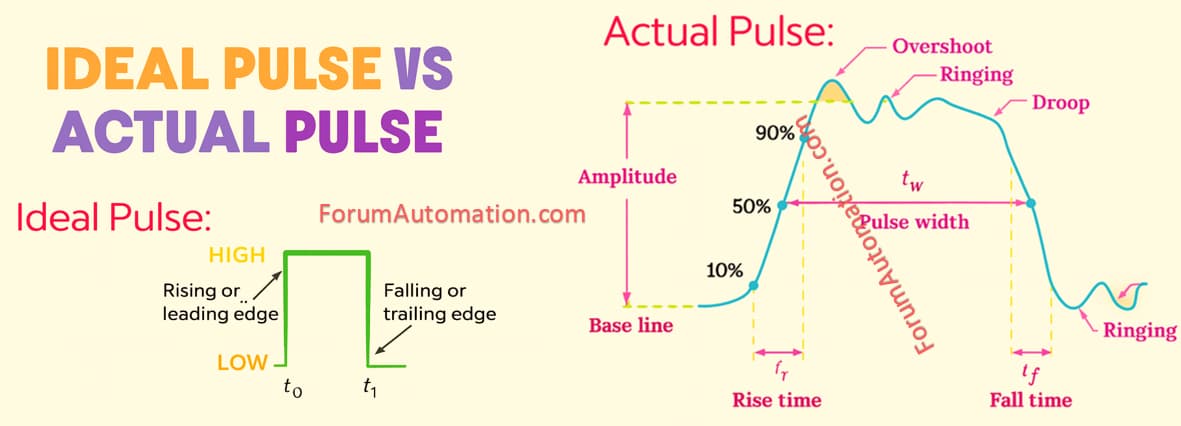
Additional distortions like as overshoot, undershoot, and ringing are caused by excessive inductance, capacitance & impedance abnormalities.
During the HIGH state, the pulse may drop which is a gradual fall in amplitude.
Noise, transmission line impacts and component restrictions all affect signal quality.
Although the nominal pulse width remains constant, rounded edges and timing variations might disrupt functioning.
Understanding these non-ideal characteristics is essential for high-speed digital design, signal integrity analysis, PCB layout & accurate timing measurements with oscilloscopes and communications systems.
You can also follow us on AutomationForum.co, Facebook and Linkedin to receive daily Instrumentation updates.
You can also follow us on ForumElectrical.com , Facebook and Linkedin to receive daily Electrical updates.