HT Panel (High Tension Panel) and LT Panel (Low Tension Panel)
1). HT Panel (High Tension Panel)
The HT panel is the entry point for bulk power in the large facilities.
It handles electricity that is coming directly from the grid before it is stepped down by a transformer.
Voltage Range
Typically handles 11kV (11,000V), 33kV (or) higher.
Key Component
It uses a VCB (Vacuum Circuit Breaker) (or) SF6 Breaker.
These are designed to quench the massive electrical arcs that occur when breaking high voltage (HV) circuits.
Function
It receives high-voltage power that protects the downstream transformer from surges and allows for safe switching of the primary supply.
Location
Installed between the utility company line and the consumers stepdown transformer.
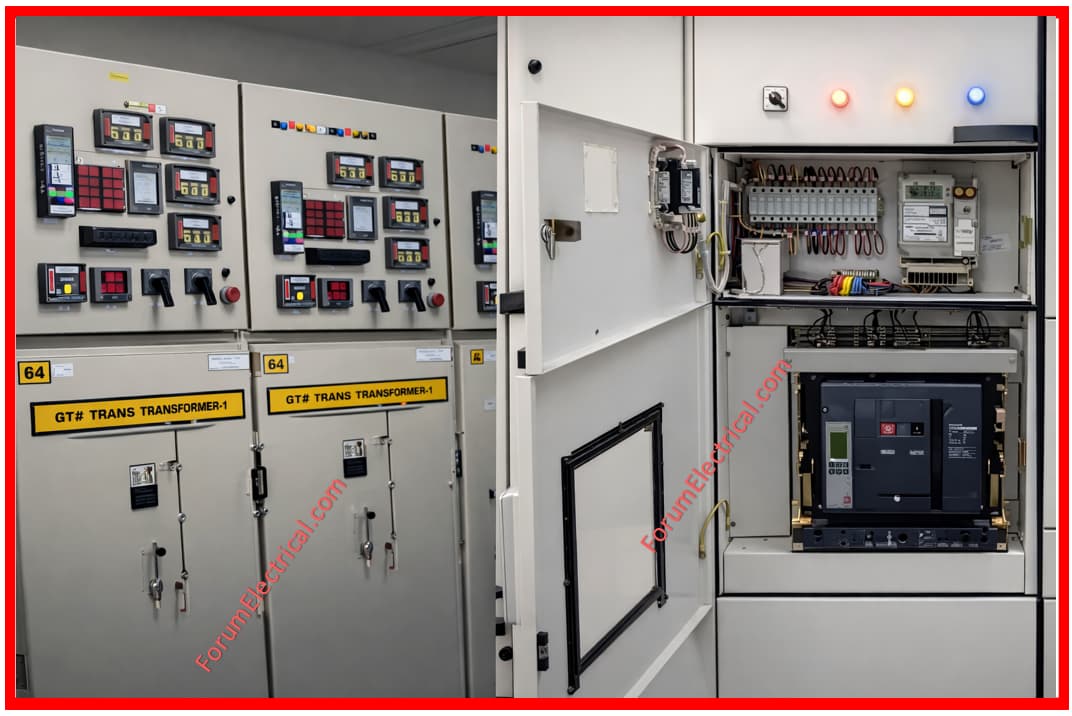
2). LT Panel (Low Tension Panel)
The LT panel is the “distribution hub.”
Once the transformer converts high voltage into a usable level (like 415V for industries or 230V for homes), the LT panel takes over.
Voltage Range
Works with voltages below 1000V (usually 415V three-phase).
Key Components
Uses ACB (Air Circuit Breakers), MCCB (Molded Case Circuit Breakers), and MCBs.
Function
It receives power from the transformer’s secondary side and distributes it to various loads (motors, lights, machinery, or sub-panels).
Location
Installed after the transformer, usually inside a dedicated electrical room of a building or factory.
You can also follow us on AutomationForum.co, Facebook and Linkedin to receive daily Instrumentation updates.
You can also follow us on ForumElectrical.com , Facebook and Linkedin to receive daily Electrical updates.