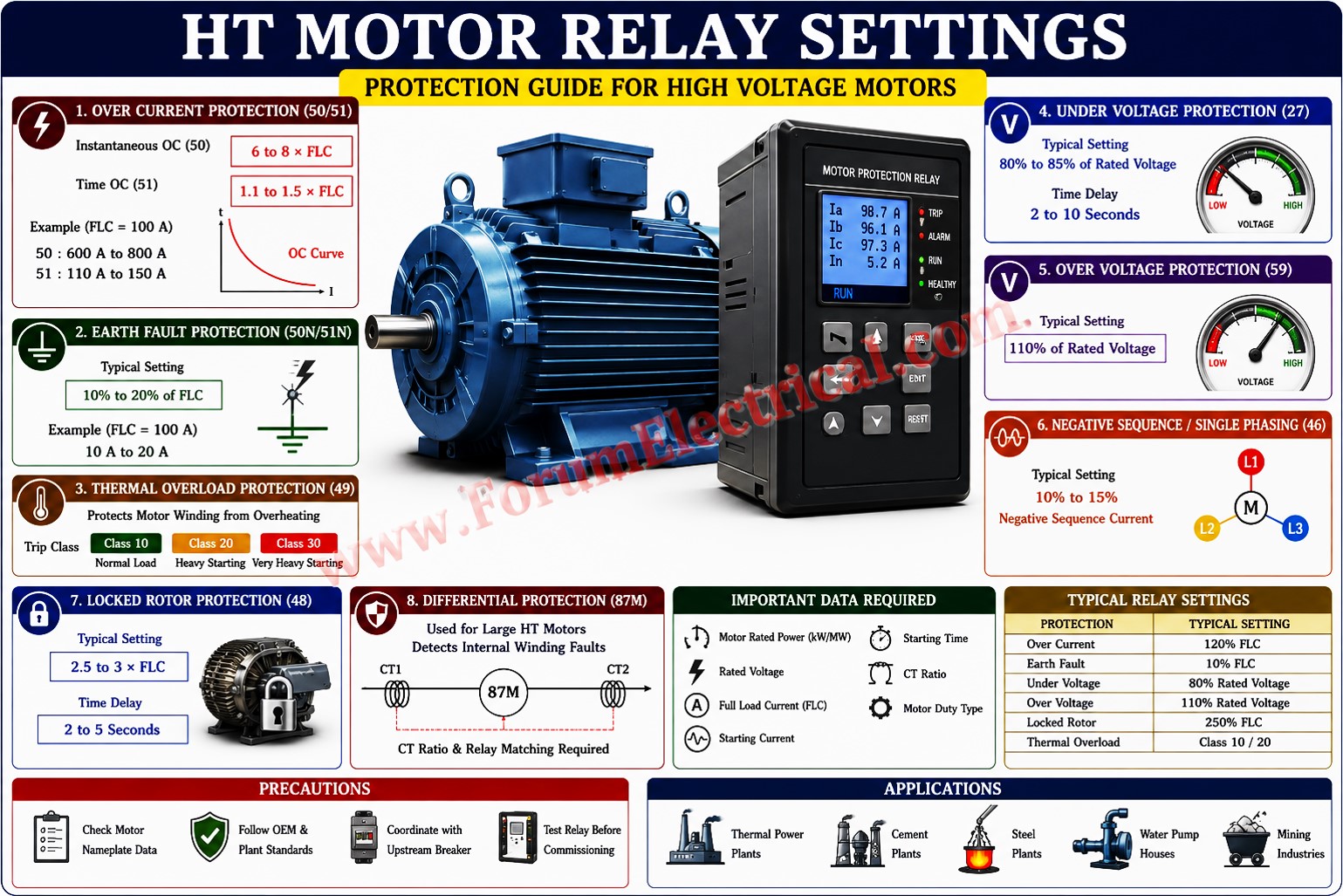
HT Motor Relay Settings are important for protecting High Tension (HT) motors from faults such as
- Overload,
- Short circuit,
- Earth fault,
- Overheating,
- Voltage imbalance and
- Rotor jamming.
Proper relay settings improve motor reliability, reduce downtime and prevent costly equipment failures.
Common Protection Relays for HT Motors
Common Protection Relays for HT Motors are
1). Over Current Protection (50/51)
2). Earth Fault Protection (50N/51N)
3). Thermal Overload Protection (49)
4). Under Voltage Protection (27)
5). Over Voltage Protection (59)
6). Negative Sequence / Single Phasing Protection (46)
7). Locked Rotor Protection (48)
8). Differential Protection (87M)
1). Over Current Protection (50/51)
Protects the motor from overload and short circuits.
- Instantaneous Over Current (50): 6 to 8 × Full Load Current (FLC)
- Time Over Current (51): 1.1 to 1.5 × FLC
Example: For a motor with 100 A FLC, the OC setting may range from 110 A to 150 A.
2). Earth Fault Protection (50N/51N)
Protects against leakage current to ground.
Typical Setting: 10% to 20% of motor FLC.
3). Thermal Overload Protection (49)
Protects motor windings from the overheating.
Trip Classes:
- Class 10 → Normal load
- Class 20 → Heavy starting
- Class 30 → Very heavy starting
4). Under Voltage Protection (27)
Trips the motor during the low voltage conditions.
Typical Setting: 80% to 85% of rated voltage with a 2–10 second delay.
5). Over Voltage Protection (59)
Protects insulation from excessive voltage stress.
Typical Setting: 110% of rated voltage.
6). Negative Sequence / Single Phasing Protection (46)
Protects against phase imbalance & single phasing.
Typical Setting: 10% to 15% negative sequence current.
7). Locked Rotor Protection (48)
Protects the motor when the rotor gets jammed.
Typical Setting: 2.5 to 3 × FLC with 2–5 second delay.
8). Differential Protection (87M)
Used in large HT motors to detect internal winding faults using CT comparison.
Before configuring HT motor relays collect:
- Motor Rated Power
- Rated Voltage
- Full Load Current (FLC)
- Starting Current
- Starting Time
- CT Ratio
- Motor Duty Type
Typical HT Motor Relay Settings
| Protection | Typical Setting |
|---|---|
| Over Current | 120% FLC |
| Earth Fault | 10% FLC |
| Under Voltage | 80% Rated Voltage |
| Over Voltage | 110% Rated Voltage |
| Locked Rotor | 250% FLC |
| Thermal Overload | Class 10 / 20 |
Precautions
- Always verify motor nameplate data.
- Follow OEM and plant standards.
- Coordinate settings with upstream protection.
- Test relay operation before commissioning.
Applications
HT motor relay protection is widely used in:
- Thermal Power Plants,
- Cement Plants,
- Steel Plants,
- Water Pump Houses and
- Mining Industries.
Proper HT motor relay settings help prevent failures, improve reliability and extend motor service life in industrial applications.