Many electricians and engineers see breaker ratings daily but the technical meaning behind those numbers is often overlooked.
Air Circuit Breaker (ACB)
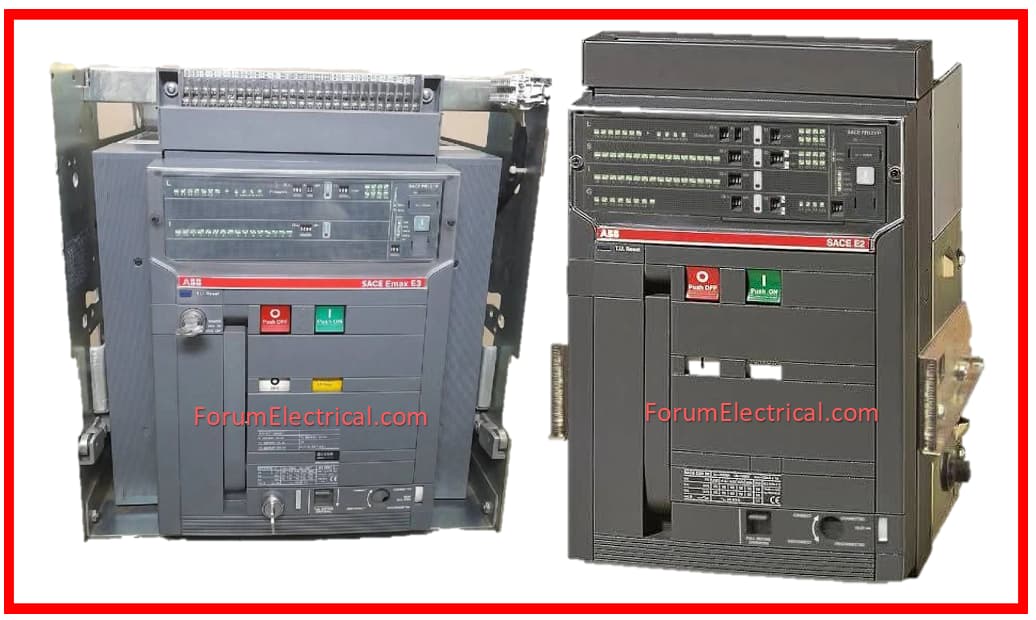
An Air Circuit Breaker (ACB) nameplate is essentially its technical identity card.
It defines
- Installation limits,
- Protection capability,
- Coordination behavior and
- System safety margins.
Understanding these specifications is critical for reliable power distribution.
Rated Current (In = 3200A)
The rated current represents the maximum continuous current the breaker can carry under specified conditions without exceeding temperature limits.
All upstream and downstream design parameters such as busbar sizing, cable selection, panel thermal design, and protection coordination are based on this value.
A 3200A ACB is typically used as a main incomer, bus coupler, transformer feeder, or generator breaker in industrial and commercial power systems.
Applicable Standard (IEC/EN 60947-2)
Compliance with IEC/EN 60947-2 confirms that the breaker meets internationally recognized low-voltage switchgear standards.
This ensures verified short-circuit performance, defined protection characteristics, dielectric strength and mechanical endurance.
Standard compliance is mandatory for safe installation and regulatory approval.
Utilization Category (Category B)
Category B breakers are designed with a short-time delay capability. This allows intentional time grading for selective coordination.
During fault conditions, downstream breakers trip first while the upstream breaker remains closed for a defined delay period.
This feature is essential in large distribution boards, substations, and industrial plants where system continuity is critical.
Rated Insulation Voltage (Ui = 1000V)
The rated insulation voltage defines the maximum voltage the breaker insulation system can withstand without breakdown.
Even if the operational voltage is 415V or 690V a Ui of 1000V provides an additional safety margin, improving dielectric reliability and long-term performance.
Rated Operational Voltage (Ue = 440V / 690V)
The rated operational voltage specifies the voltage levels at which the breaker can safely interrupt fault currents.
The system voltage must always fall within these limits to ensure correct arc extinction and safe operation.
Short-Circuit Breaking Capacity (Icu / Ics)
At 440V, the breaker has a breaking capacity of 80kA, and at 690V, 75kA.
Icu represents the ultimate breaking capacity, meaning the maximum fault current the breaker can interrupt safely.
Ics represents the service breaking capacity. When Ics equals Icu, the breaker remains fully operational even after interrupting its maximum rated fault current. This indicates high mechanical strength and robust arc quenching performance.
Short-Time Withstand Current (Icw = 80kA for 0.5s)
The short-time withstand current rating indicates that the breaker can carry 80kA for 0.5 seconds without tripping or sustaining damage.
This characteristic enables selective coordination by allowing downstream protection devices time to clear faults before the main breaker operates.
Impulse Withstand Voltage (Uimp = 12kV)
The impulse withstand voltage rating defines the breaker’s ability to resist transient overvoltages such as lightning surges or switching surges.
A Uimp of 12kV ensures strong insulation integrity under surge conditions.
You can also follow us on AutomationForum.co, Facebook and Linkedin to receive daily Instrumentation updates.
You can also follow us on ForumElectrical.com , Facebook and Linkedin to receive daily Electrical updates.