1 Like
A Megger (insulation resistance tester) is used to evaluate a capacitor’s dielectric insulation strength rather than its capacitance.
A healthy capacitor has a low resistance while charging and soon rises to a high, steady megaohm (MΩ) value.
A malfunctioning capacitor has low (or) zero resistance.
Safety Precautions
To avoid meter damage or electric shock, discharge the capacitor by shorting the terminals with a resistor (or) insulated screwdriver prior to testing.
Disconnect: Disconnect the capacitor from the circuit.
Step-by-Step Test Procedure
Step-1: Select a voltage on the Megger that matches the capacitor’s rating (e.g., for an AC capacitor).
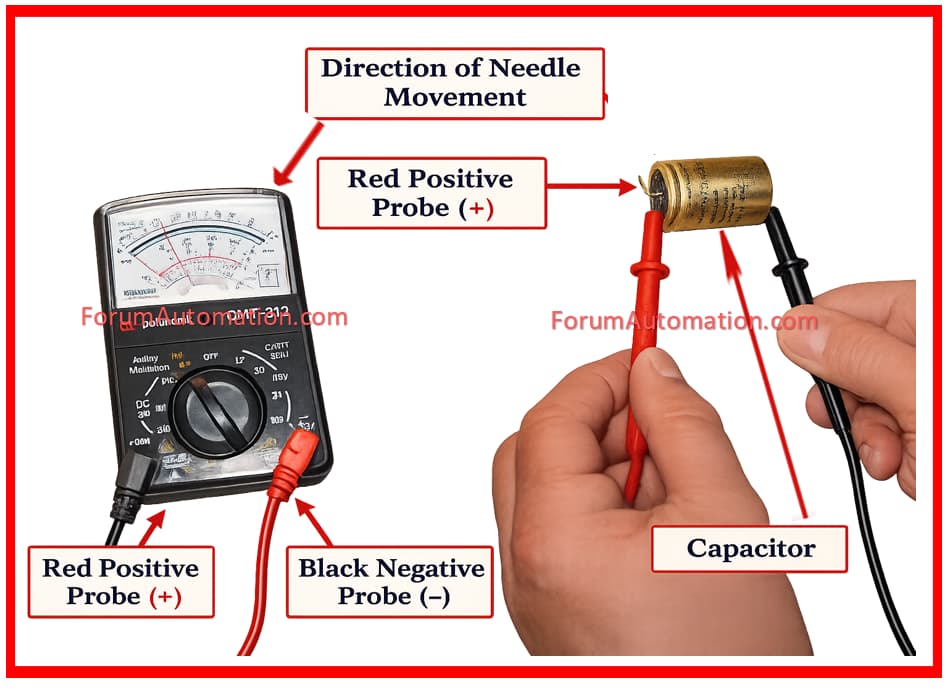
Step-2: Attach the Megger leads to the capacitor terminals.
Step-3: Use the Megger (crank or click the test button).
Observe Reading
A good capacitor should have a low resistance measurement that gradually increases to a high, steady value.
Short circuit: The resistance stays around zero.
Open Circuit: The resistance stays at infinity instantaneously.
Discharge: Take the leads off & discharge the capacitor again.
Interpreting Results
A low insulating resistance indicates that the dielectric has failed. A high resistance (e.g., or more) is often acceptable for many purposes.
A Megger cannot identify whether the capacitance (microfarads) has fallen; use a capacitance meter for it.
Relevant Standards
IEC Standards
IEC 60871-1 - Power capacitors for AC systems (>1000 V)
IEC 60831-1 - Low voltage power capacitors (<1000 V)
IEC 60060 - High voltage testing techniques
IEC 60247 - Insulation resistance and dielectric tests
IEEE Standards
IEEE 18 - Shunt power capacitors
IEEE 1036 - Application guide for power capacitors
IEEE 400 - Insulation testing guide
IS (Indian Standards)
IS 13925 - Shunt capacitors for power systems
IS 13340 - Power Capacitors
You can also follow us on AutomationForum.co, Facebook and Linkedin to receive daily Instrumentation updates.
You can also follow us on ForumElectrical.com , Facebook and Linkedin to receive daily Electrical updates.