How to calculate SNR signal-to-noise ratio?
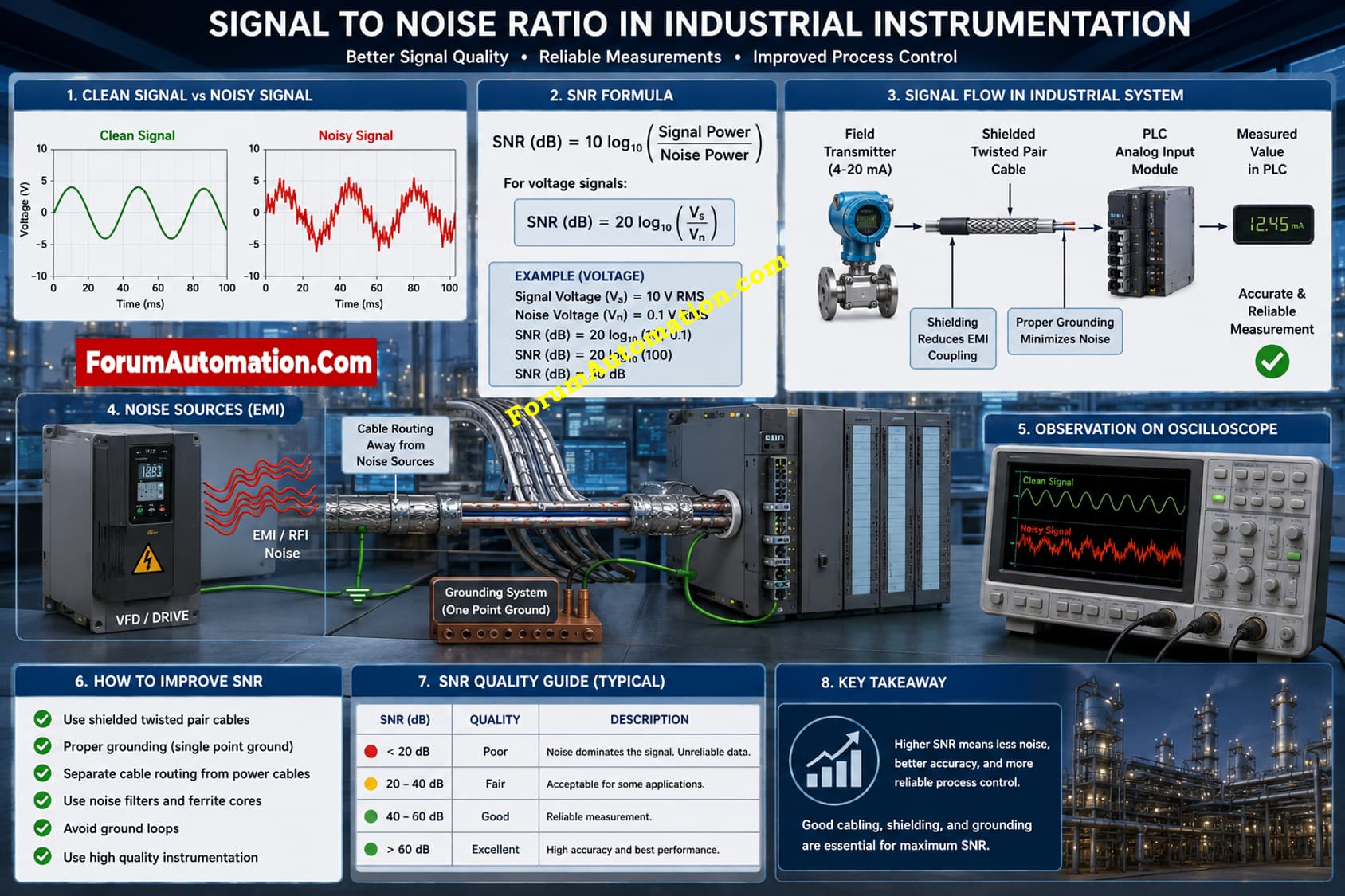
How to Calculate SNR Signal to Noise Ratio?
SNR (Signal to Noise Ratio) is a measure of how much stronger the signal you want is compared to undesirable electrical noise. Higher SNR values lead to more reliable measurements and steady control, and is a significant performance indicator for industrial instruments, communication system, sensors, and process analyzers.
SNR Formula
The most typical calculation is:
SNR (dB) = 10 × log₁₀ (Signal Power / Noise Power)
When using voltage measurements with equal impedance:
SNR (dB) = 20 × log₁₀ (Signal Voltage / Noise Voltage)
Example
If a transmitter signal measures 2 V while noise is 20 mV, then:
SNR = 20 × log₁₀ (2 / 0.02)
SNR = 40 dB
A higher SNR indicates better signal quality and improved measurement accuracy.
Industrial Importance
Instrumentation experts will look into SNR while commissioning transmitters, vibration sensors, thermocouples, analyzers and Industrial Ethernet networks. Low SNR generally leads to unstable process values, false alarms, communication issues and poor control performance.
Methods to Improve SNR
- Use insulated instrument leads .
- Separate the power and signal wiring.
- Be sure you do appropriate grounding.
- Place signal isolators where needed.
- Minimize electromagnetic interference of VFDs.
- Choose good quality sensors with little internal noise.
Field Troubleshooting
When you make measurements, use an oscilloscope or an analyzer to compare the signal and noise levels. Check for grounding loops, broken cable shielding, unsecured connections, and proximity to high power electrical equipment.
SNR is important for the reliable performance of modern industrial automation systems, because it increases the reliability of measurements, optimizes process control, reduces communication mistakes and supports predictive maintenance and accurate plant diagnostics.