How to calculate rangeability?
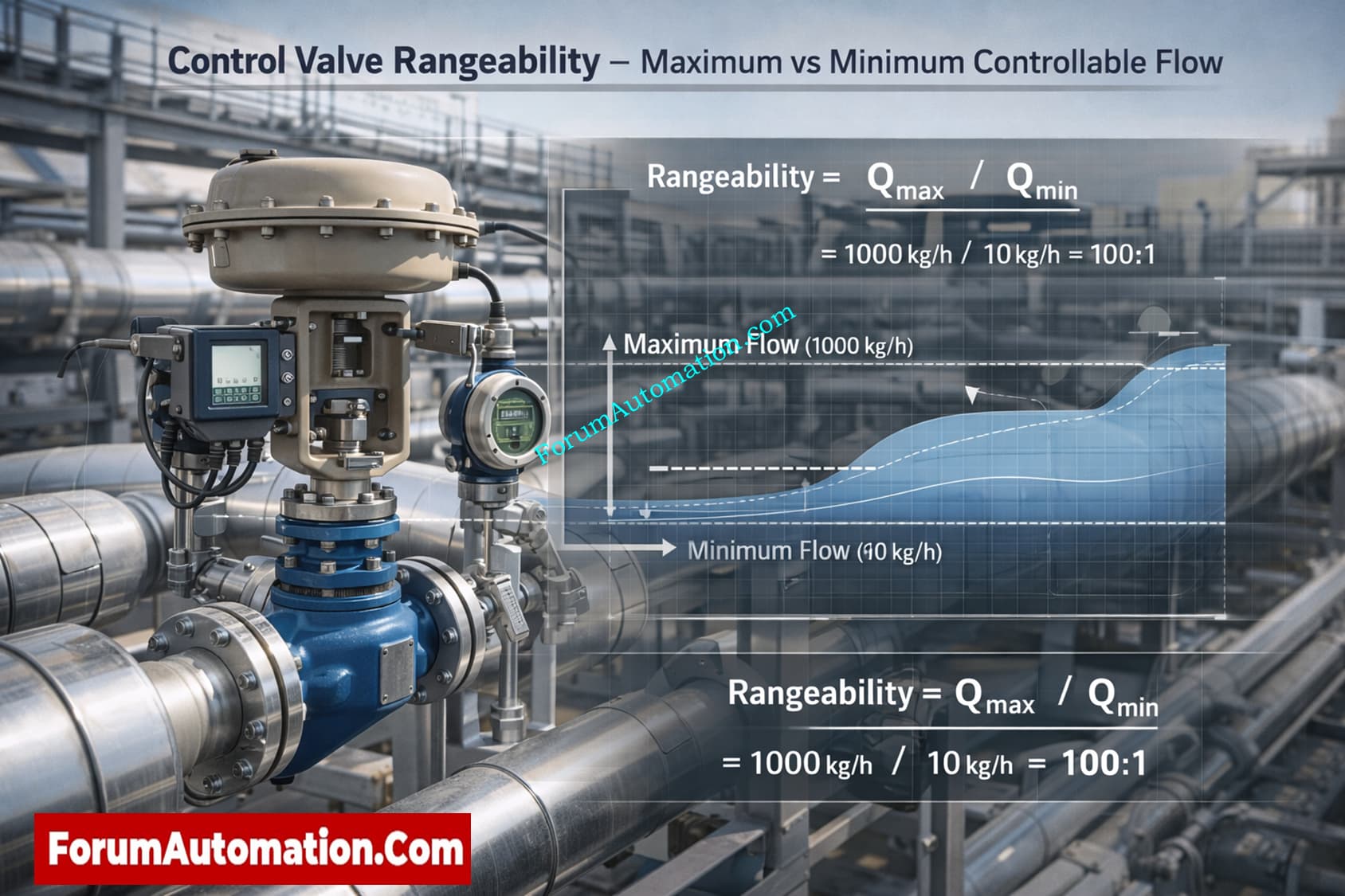
How to calculate rangeability?
Definition
The rangeability of a device is the difference between the highest and lowest flow (or signal) it can correctly control or measure. When choosing hardware for wide process swings, it is an important factor for control valves, flowmeters, and transmitters.
Basic formula
- Rangeability = Maximum value / Minimum controllable value Example: a valve that can control 1000 kg/h down to 10 kg/h has rangeability 1000/10 = 100:1.
Installed vs inherent
- Inherent (trim) rangeability: Inherent (trim) rangeability depends on the valve’s internal characteristics and the trim design.
- Installed rangeability: the real range in the plant that is affected by the piping, the pressure drop, the actuator, and the positioner resolution. When judging how well a field is doing, use installed rangeability.
Step-by-step calculation for a control valve
- From the process design, find out what the maximum flow (Qmax) is.
- Find the minimum controlled flow (Qmin), which is the smallest steady flow that the controller can keep at the setpoint without hunting. This is usually specified by the valve characteristic or the minimum controllable Cv.
- To find the ratio, use the formula Rangeability = Qmax / Qmin.
- Check with installed tests: check the flow at a low stroke and make sure the control is stable and the error band is correct.
Practical tips for engineers
- If you don’t know Qmin, use Cv_min or the minimum controllable percent stroke (for example, 2–5%).
- Think about the deadband of the actuator, the resolution of the positioner, and the precision of the sensor. These things lower the rangeability of the installation.
- If rangeability is low, utilize cascaded valves, multi-stage control, or valves with greater linearizing trim. Write down the installed rangeability in the loop FMEA and the tag history.