How OT is different from IT?
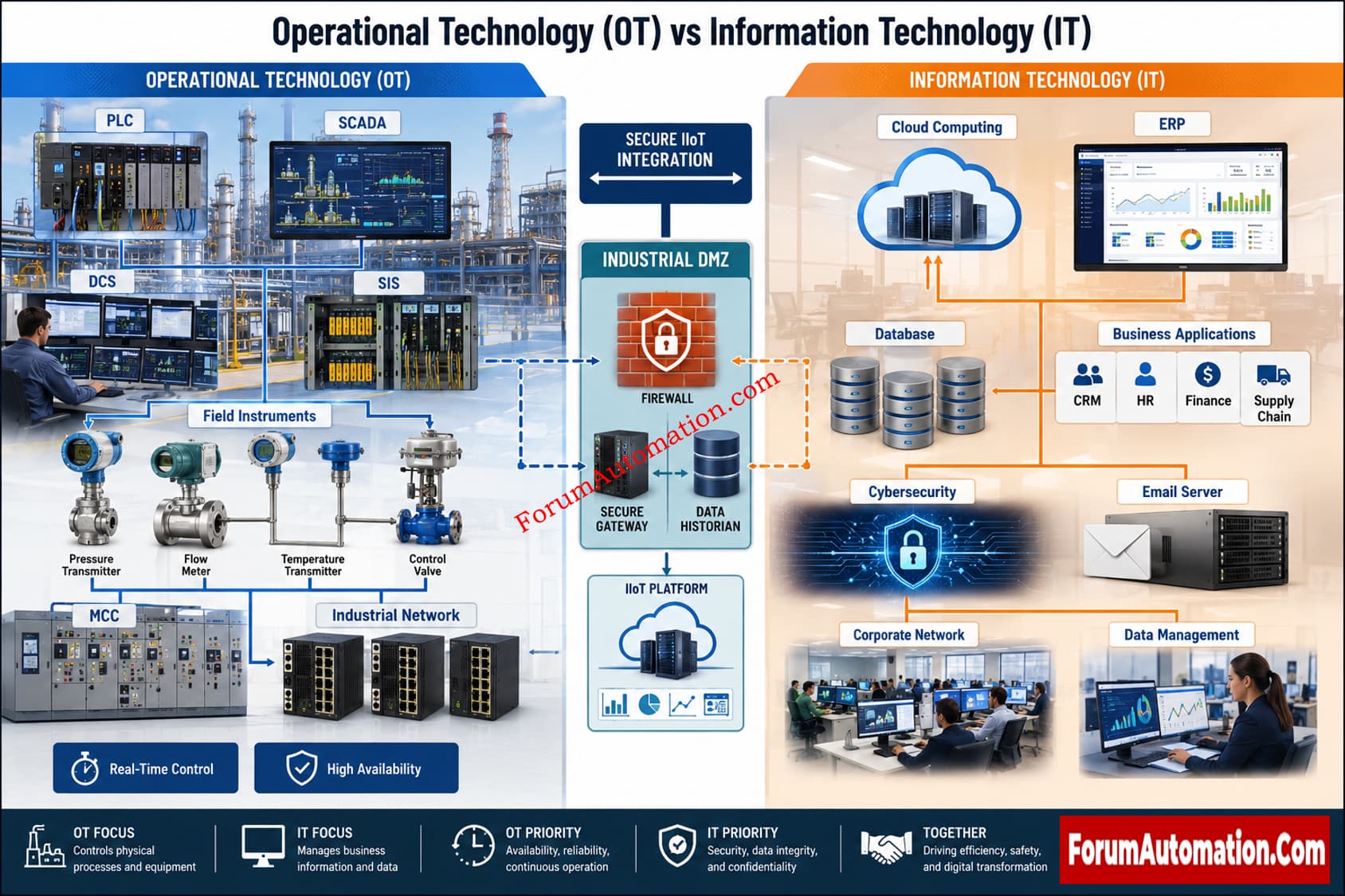
How OT is Different from IT?
Industrial sites use both Operational Technology (OT) and Information Technology (IT), but for distinct objectives. Understanding their distinctions allows engineers to increase cybersecurity, plant reliability and system availability while supporting digital transformation objectives.
OT Focuses on Physical Processes
Operational Technology (OT) runs and monitors industrial equipment such as PLCs, DCS, SCADA systems, safety instrumented systems, analyzers, transmitters, and motor control centers. OT directly interfaces with physical assets, thus failures can shut down production, damage equipment or cause safety hazards. Hence, OT favors system availability, predictable communication and continuous operation over frequent software changes.
IT Manages Business Information
Information Technology include enterprise applications, databases, email servers, cloud services, ERP systems, finance, HR, and office networks. IT is mostly concerned with digital data, and focuses on confidentiality, integrity, data security and regular security patching. Temporary outages are generally acceptable if they improve security or system performance.
Key Practical Differences
- OT: Controls industrial processes and field devices.
- IT: Manages business applications and corporate data.
- OT: Requires high availability with minimal shutdowns.
- IT: Prioritizes cybersecurity, data management, and user access.
- OT: Uses industrial protocols like Modbus, HART, FOUNDATION Fieldbus, and PROFINET.
- IT: Uses standard TCP/IP, HTTP, SMTP, DNS, and database protocols.
Why Integration Matters
Modern Industrial Internet of Things (IIoT) projects combine OT and IT for predictive maintenance, remote monitoring and production analytics. However, to prevent cyber attacks from affecting key control systems, effective network segmentation, firewalls, demilitarized zones (DMZs) and secure remote access are required. The combination of OT and IT works well together to make operations more efficient, while keeping the plant safe, secure from cyber attacks and running the industrial automation reliably.