How much control valve leakage is acceptable?
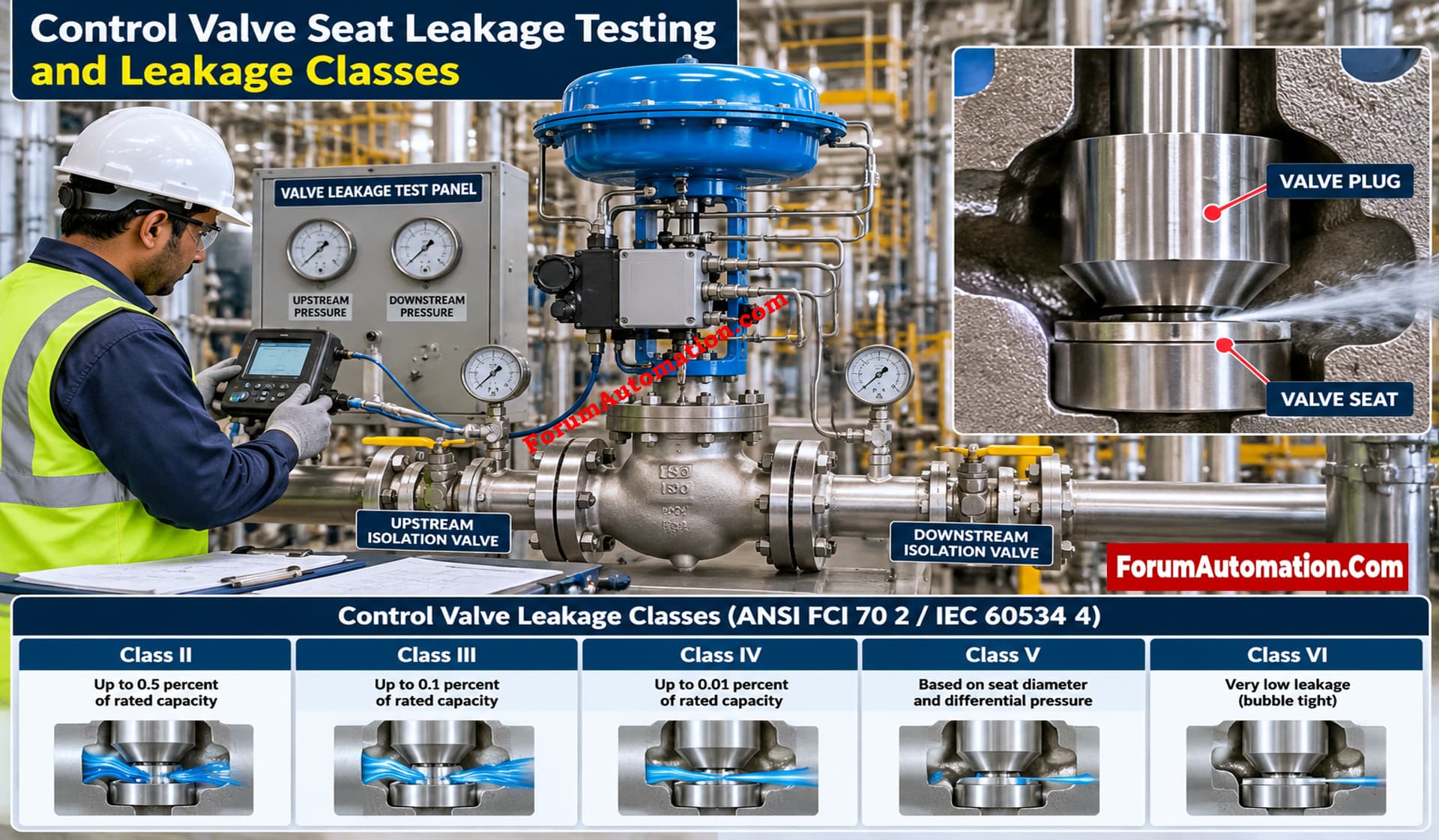
How much control valve leakage is acceptable?
What is acceptable control valve leakage?
Control valve leakage is not automatically a failure. The acceptable amount depends on the specified leakage class, valve design, service conditions, and applicable test standard. ANSI FCI 70 2 and IEC 60534 4 define standardized seat leakage classes for control valves.
Typical leakage limits
Class II permits leakage up to 0.5 percent of rated valve capacity. Class III permits 0.1 percent, while Class IV permits 0.01 percent. Class V uses a tighter leakage calculation based on seat diameter and differential pressure. Class VI is generally associated with resilient seating and specifies a very low bubble based leakage limit.
For a general industrial metal seated control valve, Class IV is commonly encountered. Critical isolation duties may require Class V or Class VI, depending on process requirements. Control valve leakage should not be confused with the zero leakage expectation normally associated with dedicated isolation valves.
Field troubleshooting
If a valve exceeds its specified leakage during FAT, SAT, or plant operation, check actuator closing force, positioner calibration, air supply, valve travel, seat condition, plug condition, and foreign material between seating surfaces. Excessive differential pressure can also affect closing performance.
Before declaring a valve failed, verify the test medium, pressure, temperature, test procedure, seat diameter, and rated capacity against the specified standard. A leakage value measured under different conditions cannot be directly compared with the certified class.
In practice, ask: “What leakage class and test conditions were specified for this valve service?” It avoids disputes.
ANSI FCI 70 2 defines standardized seat leakage classes, while IEC 60534 4 provides corresponding leakage classifications and test requirements. Class II, III and IV are expressed as percentages of rated capacity, whereas Classes V and VI use different leakage measurement methods.