A current transformer (CT) is an instrument transformer utilized to measure the alternating current in an electrical circuit.
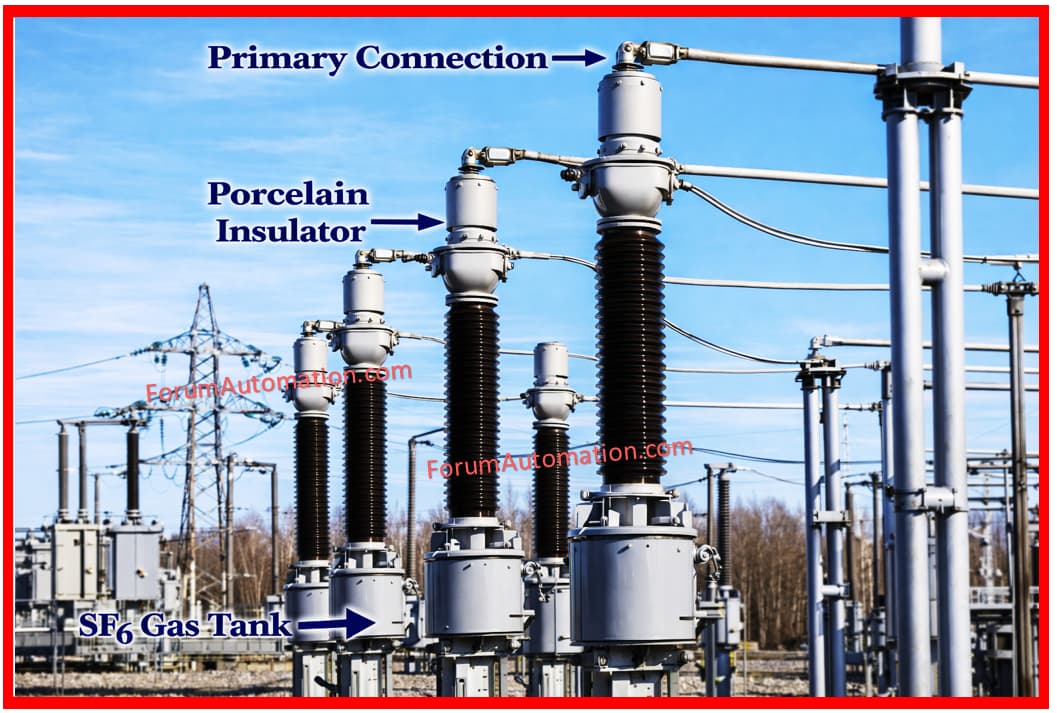
A current transformer safely converts high current into a proportional low current for measurement and protection purposes.
It consists of a primary conductor carrying current and a secondary winding connected to measuring instruments.
The secondary current is proportional to the primary current.
Construction
A CT has a primary winding which is usually a single turn conductor.
A magnetic core is utilized to transfer energy between windings.
A secondary winding is provided to connect measuring (or) protection devices.
The operating principle is similar to that of a voltage transformer.
Working Principle
A high alternating current flows through the primary conductor.
This current produces a magnetic field in the core.
The magnetic field induces a low current in the secondary winding.
The secondary current is safely measured by instruments.
A CT converts high current into a lower proportional current value.
Importance of Current Transformers
-
Current transformers are essential for accurate electrical measurements.
-
They provide a safe method to measure high currents.
-
They are widely used in residential, commercial, and industrial systems.
-
They play a key role in power generation and distribution networks.
-
Their reliability makes them essential components in electrical infrastructure.
Common Uses of Current Transformers
1). Measuring and Monitoring Electric Energy
-
Current transformers are widely used for measuring electrical energy consumption.
-
They enable safe measurement of high current in power lines.
-
Direct measurement of high current and voltage is not practical with standard instruments.
-
Instrument transformers allow accurate measurement regardless of circuit size.
-
Modern electronic meters can detect very small currents with high accuracy.
-
Small measuring devices can be used due to reduced current levels.
-
Multiple meters can be installed in compact enclosures for multi-customer systems.
-
The transformer core size can be small due to low instrument burden.
-
Secondary windings can be designed with very small conductor size.
-
Typical secondary currents can be as low as 100 mA or 0.1 A.
-
Low secondary current reduces secondary voltage levels.
-
This allows safe use of clamp-type current transformers.
-
Self-shorting CTs improve operational safety.
-
Milliamp secondary CTs are preferred for submetering applications.
-
These CTs occupy less space in panel wiring.
-
They eliminate the need for separate shorting blocks.
-
CTs enable monitoring of individual circuits in buildings or industries.
-
They support accurate billing based on energy consumption.
2). Protecting Instruments and Power Systems
-
Current transformers are used for protection against overloads and faults.
-
These are known as protection current transformers.
-
The CT secondary is connected to protective relays.
-
Protective relays monitor current conditions continuously.
-
The relay sends a trip signal during overcurrent conditions.
-
Overcurrent can be caused by overload or short circuit.
-
Circuit breakers operate based on relay signals.
-
Protection CTs must handle higher burden compared to metering CTs.
-
The core size must be larger to avoid saturation.
-
CT saturation must be avoided during fault conditions.
-
Accurate current reproduction is essential during faults.
-
Proper CT performance ensures reliable protection operation.
-
Protection CTs are generally larger in size.