How Does a VFD Control Motor Speed?
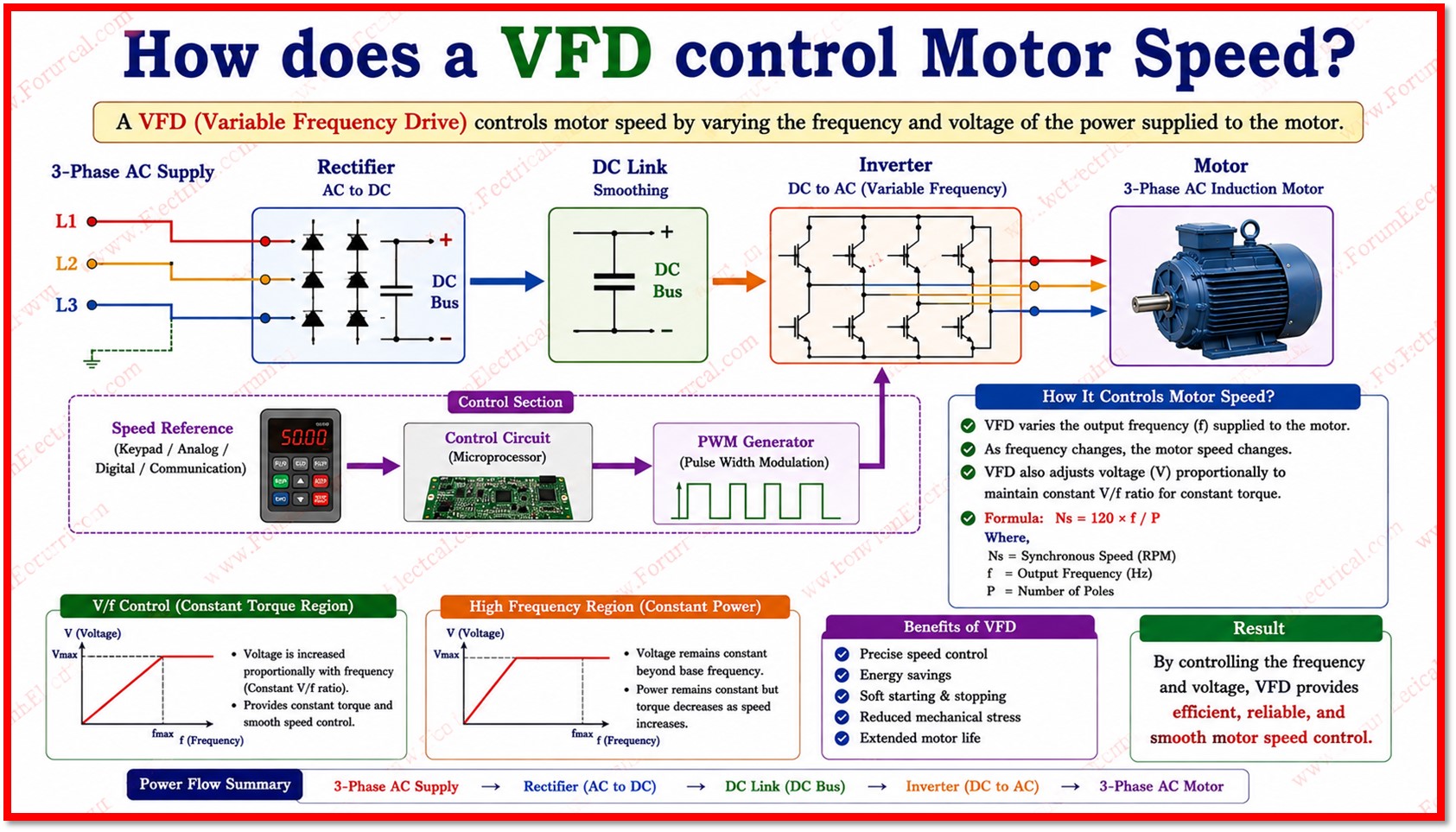
A Variable Frequency Drive (VFD) controls the speed of an AC motor by varying the frequency and voltage supplied to the motor.
Since the speed of an AC motor is directly proportional to the supply frequency, changing the frequency allows precise control of motor speed while maintaining efficient operation.
How VFD Works?
A VFD first converts the incoming AC power into DC using a rectifier. The DC is then filtered and converted back into AC by an inverter, which generates the required output frequency and voltage. By adjusting these values, the VFD controls the motor’s speed, torque and direction smoothly.
Advantages of using a VFD
- Provides precise speed control.
- Reduces energy consumption.
- Minimizes starting current and mechanical stress.
- Enables soft starting and smooth stopping.
- Improves process control and equipment lifespan.
- Offers built-in motor protection and diagnostics.
Applications
VFDs are widely used in pumps, fans, compressors, conveyors, HVAC systems, machine tools, and industrial automation where variable speed operation improves efficiency and productivity.