How does a relay work on AC current? What happens if you connect it to DC current?
A relay is an electromagnetic switching device that is used to control a circuit using another electrical signal.
It works by converting electrical energy into mechanical motion to open or close contacts.
Relays are commonly used in control circuits, protection systems, PLC panels, substations and motor starters.
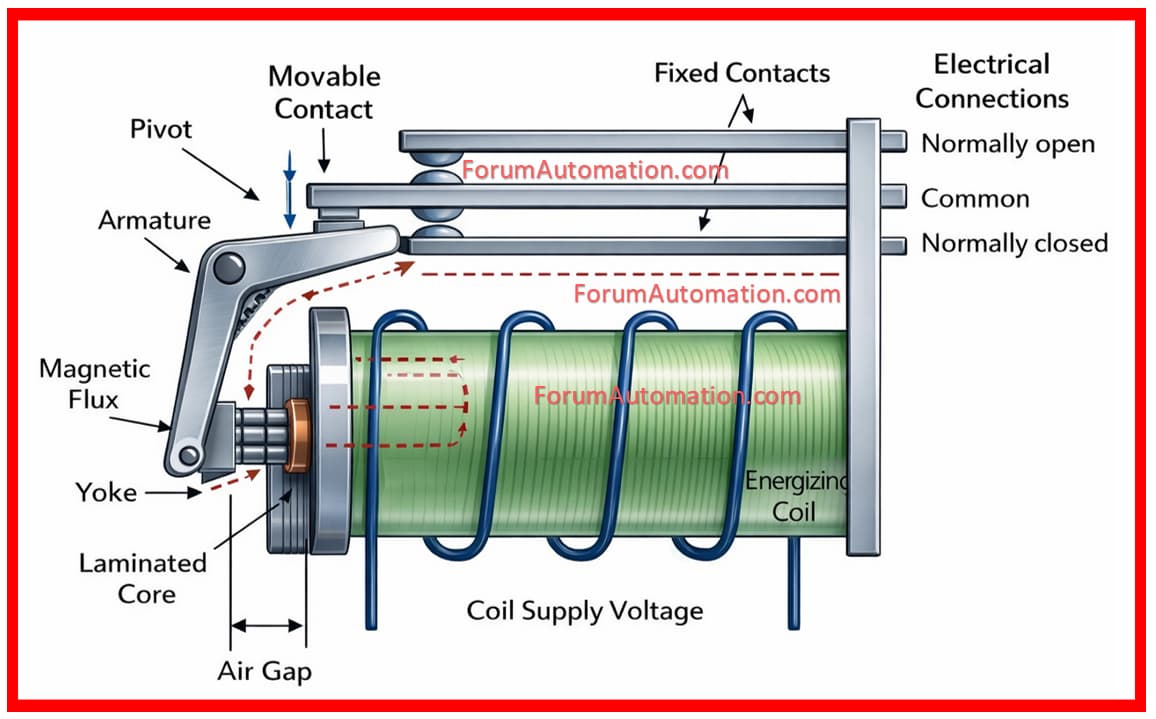
Relay Working on AC Current
When AC voltage is applied to the relay coil:
-
AC current flows through the coil and creates a magnetic field.
-
The magnetic field attracts the armature.
-
The armature changes the relay contacts (NO closes, NC opens).
-
AC relays utilize a shading coil to prevent vibration at zero crossing.
AC Relay is connected to DC
-
DC removes inductive reactance of the coil.
-
Current increases significantly.
-
The relay overheats and the coil may burn.
DC Relay is connected to AC
-
Relay may buzz (or) vibrate.
-
Contacts may chatter due to alternating magnetic field.
-
Improper operation (or) coil damage may occur.
Difference Between AC Relay and DC Relay
| Parameter | AC Relay | DC Relay |
|---|---|---|
| Power supply | Alternating current | Direct current |
| Magnetic field | Alternating | Constant |
| Shading coil | Present | Not required |
| Coil impedance | Resistance + inductive reactance | Only resistance |
| Noise | Minimal | May chatter with AC |
You can also follow us on AutomationForum.co, Facebook and Linkedin to receive daily Instrumentation updates.
You can also follow us on ForumElectrical.com , Facebook and Linkedin to receive daily Electrical updates.