How does a Miniature Relay Holding Circuit work?
Reference Image Provided by the Respondent
2 Likes
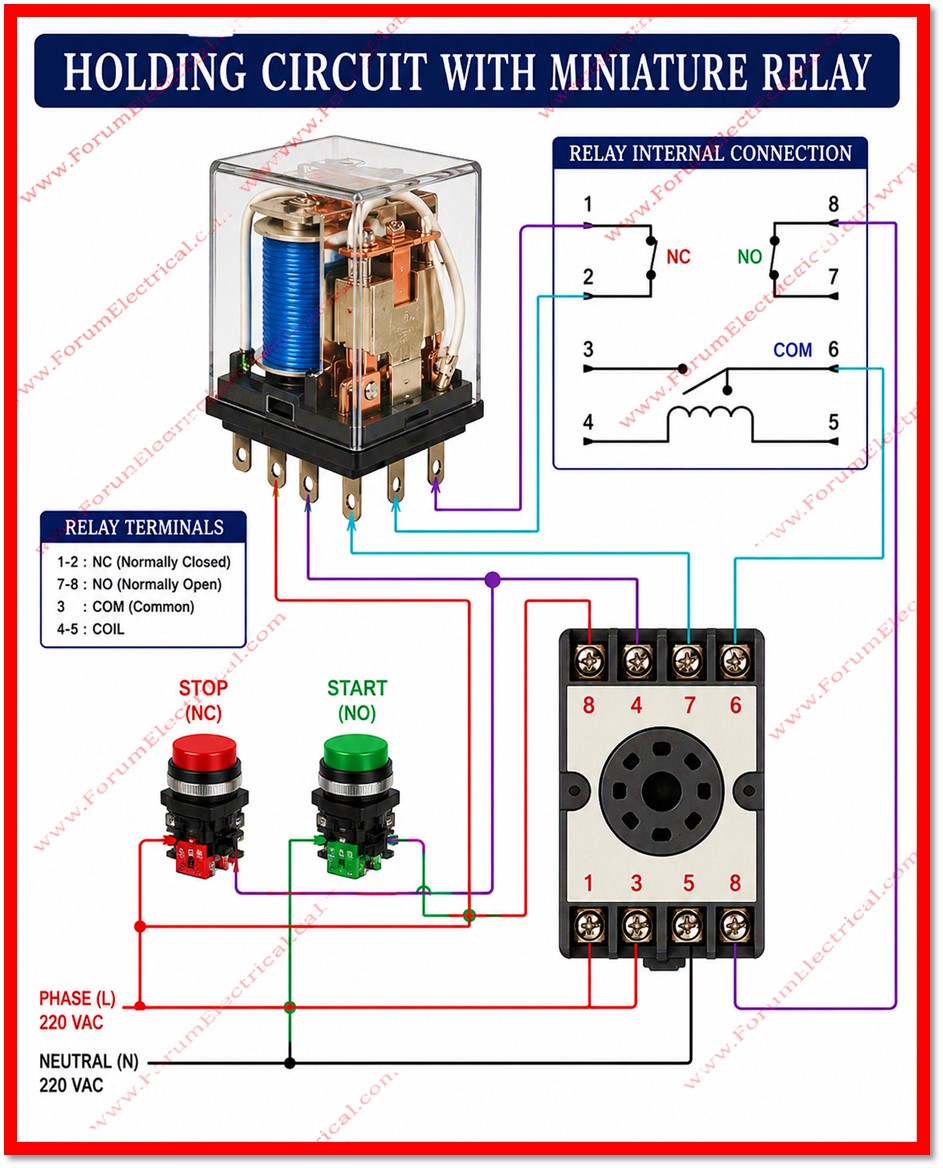
A miniature relay holding circuit, also called a self-holding or seal-in circuit, allows a relay to remain energized after the START push button is released. This is one of the most common control circuits used in industrial automation, motor starters, and control panels.
Working Principle
Initial State
- The STOP push button (NC) is closed.
- The START push button (NO) is open.
- The relay coil is de-energized, and the auxiliary NO holding contact is open.
- Press the START Button
- Pressing the START button completes the circuit to the relay coil.
- The relay coil energizes.
- The relay’s normally open (NO) auxiliary contact closes.
Relay Self-Holding
- The closed auxiliary contact provides an alternate current path around the START button.
- When the START button is released, current continues flowing through the auxiliary contact.
- The relay remains energized without holding the START button.
- Press the STOP Button
- Pressing the STOP button opens the control circuit.
- Current to the relay coil is interrupted.
- The relay de-energizes.
- The auxiliary holding contact opens, returning the circuit to its initial state.
Simple Circuit Sequence
STOP (NC) → START (NO) → Relay Coil (K1)
Holding Contact (K1 NO) is connected in parallel with the START push button.
Applications
- Motor starter circuits
- Industrial control panels
- PLC output interfacing
- Pump control systems
- Conveyor systems
- Machine automation
- Lighting control circuits
The holding circuit ensures that equipment continues operating after the START button is released and only stops when the STOP button is pressed or the power supply is interrupted. This simple yet reliable control logic forms the foundation of many electrical automation systems.
1 Like