How do you size a Transformer and Generator correctly?
Proper transformer and generator sizing is essential for ensuring reliable power supply, energy efficiency, and future load expansion. An undersized unit can lead to overheating, voltage drops, and frequent trips, while an oversized unit increases installation and operating costs. Correct sizing involves evaluating the total connected load, demand factor, power factor, starting currents, and expected future growth.
What is Transformer Sizing?
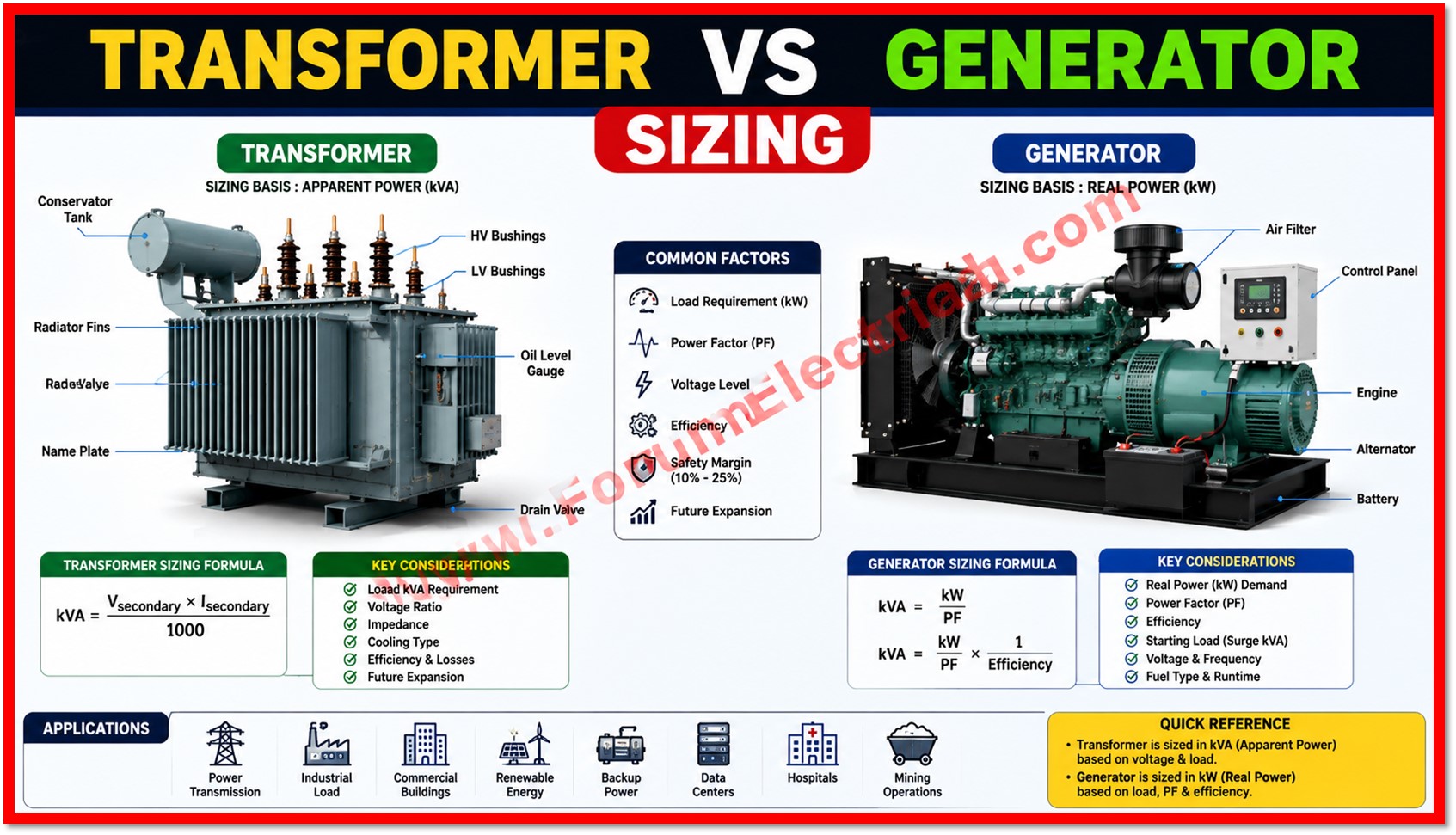
Transformer sizing determines the required kVA rating needed to safely supply electrical loads. The total load, diversity factor, and future expansion are considered before selecting the transformer.
Basic Formula:
Transformer Rating (kVA) = Total Load (kW) ÷ Power Factor
For three-phase systems:
kVA = (√3 × Voltage × Current) ÷ 1000
What is Generator Sizing?
Generator sizing determines the capacity required to supply electrical loads during power outages or off-grid operation. In addition to continuous load, generator sizing must account for motor starting currents, transient loads, and voltage regulation.
Basic Formula:
Generator Rating (kVA) = Total Load (kW) ÷ (Power Factor × Efficiency Margin)
Typically, an additional 10–30% safety margin is included for reliable operation.
Transformer vs Generator Sizing
| Parameter | Transformer Sizing | Generator Sizing |
|---|---|---|
| Primary Purpose | Step up or step down voltage | Supply electrical power |
| Rated In | kVA | kVA or kW |
| Main Consideration | Connected load and future expansion | Running load plus starting current |
| Motor Starting Impact | Generally not critical | Critical for voltage stability |
| Power Source | Utility or upstream supply | Diesel, gas, or alternate energy source |
| Safety Margin | 10–25% | 10–30% or more depending on load type |
| Load Type | Continuous electrical load | Continuous and transient loads |
| Design Focus | Voltage regulation and thermal capacity | Frequency, voltage regulation, and engine performance |
Key Factors
- Calculate the actual connected and demand loads.
- Consider power factor and load diversity.
- Account for motor starting current and inrush loads.
- Include future load expansion.
- Select equipment according to applicable IEC, IEEE, or local standards.
- Verify ambient temperature, cooling method, and installation conditions.
Correct transformer and generator sizing improves system reliability, minimizes energy losses, extends equipment life, and ensures uninterrupted power during normal operation and emergency conditions.