How do Protection Relays and Master Trip Relay (86) work together?
Protection relays continuously monitor electrical systems and detect abnormal operating conditions, while the Master Trip Relay (ANSI 86) provides lockout functionality to prevent unintended circuit breaker re-closure after a fault.
1. OCR (ANSI 50/51) detects phase overcurrent and short-circuit conditions. ANSI 50 provides instantaneous overcurrent protection, while ANSI 51 provides time-delayed overcurrent protection.
2. EFR (ANSI 50N/51N) detects earth faults using residual current measurement or a core-balance current transformer (CBCT).
3. OVR (ANSI 59) detects overvoltage conditions, while UVR (ANSI 27) detects undervoltage or supply failure.
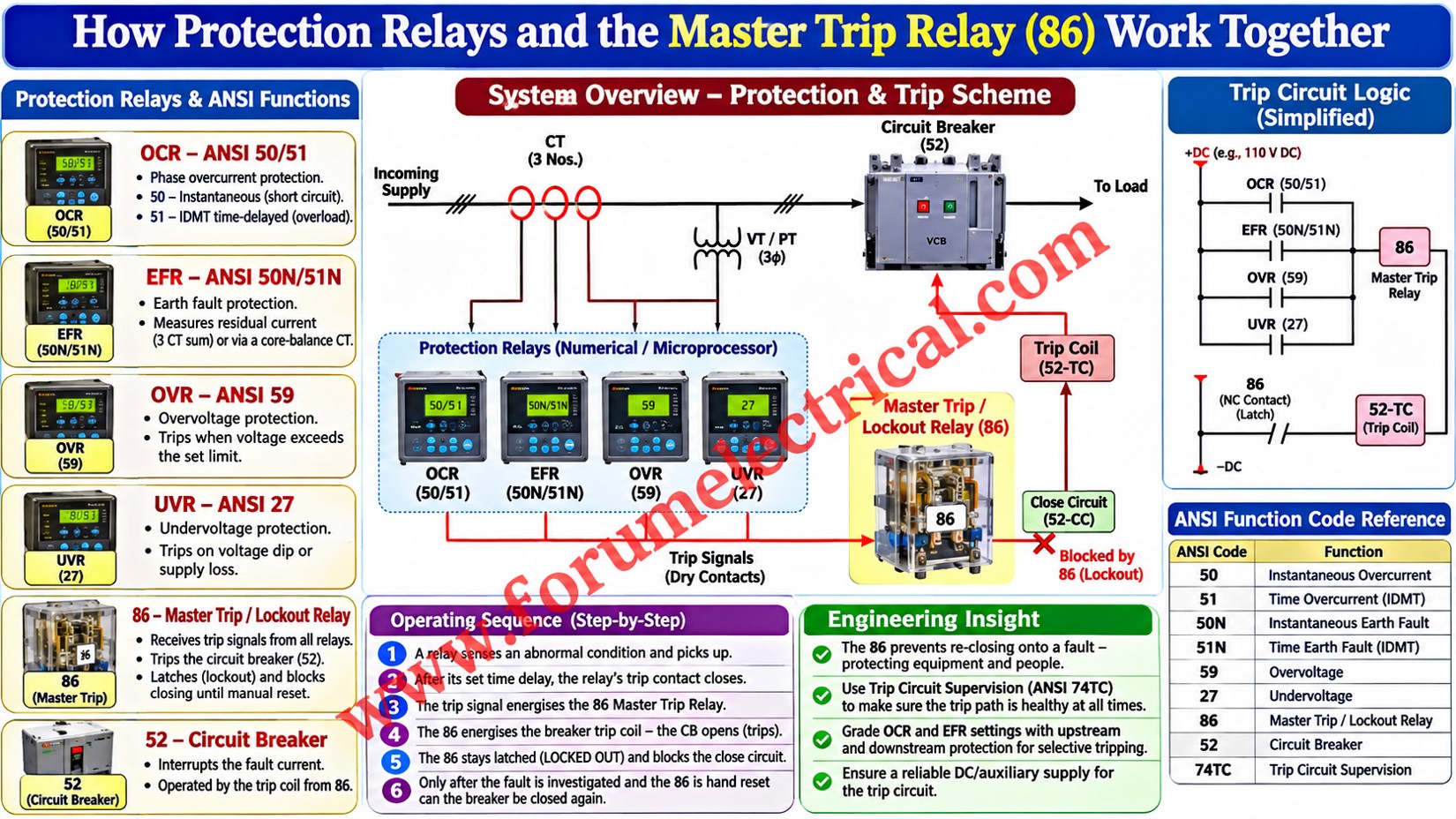
When a protection relay operates, its trip contact energises the Master Trip Relay (86). The 86 relay initiates circuit breaker tripping, typically through the trip coil, and remains latched to block the closing circuit until manually reset after fault investigation.
The circuit breaker (ANSI 52) interrupts the fault current and isolates the affected circuit.
Proper protection coordination, Trip Circuit Supervision (ANSI 74TC), and a reliable DC auxiliary supply are essential for dependable protection system operation.