How a Clamp Meter detects Leakage Current?
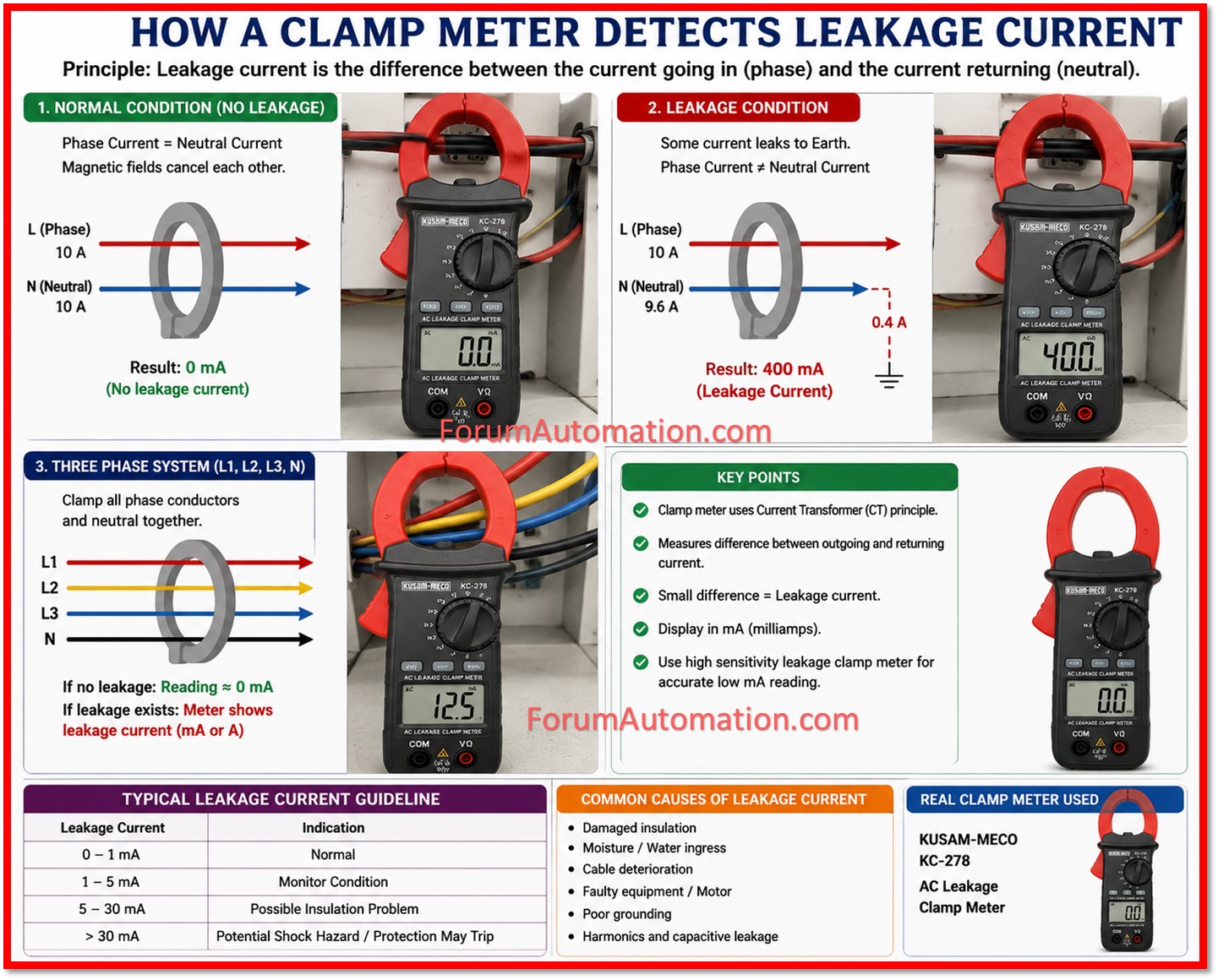
A clamp meter detects leakage current by measuring the imbalance of current flowing through conductors using the principle of electromagnetic induction .
How It Works?
In a normal electrical circuit, the current flowing through the phase (live) conductor should be equal to the current returning through the neutral conductor .
Normal Condition
If:
Phase Current = Neutral Current
then the magnetic fields generated by both conductors cancel each other inside the clamp jaw.
Result:
No residual current is detected (near zero leakage current).
Leakage Condition
When some current leaks to:
- Ground/Earth
- Equipment body
- Insulation fault path
- Moisture or damaged cable
The returning current in the neutral becomes less than the outgoing phase current .
This creates a difference (residual current) .
The clamp meter senses this imbalance as leakage current.
Working Principle
A leakage clamp meter contains a high-sensitivity current transformer (CT) inside the clamp jaw.
When phase and neutral are clamped together, the meter measures the vector sum of currents:
ILeakage=IPhase−INeutral
Normally:
IPhase=INeutral
Leakage current:
ILeakage ≠ 0
The detected imbalance is displayed in:
- mA (milliamps) for small leakage
- A (amps) for large leakage
Correct Method to Measure Leakage Current
Clamp both Phase and Neutral conductors together (single-phase system).
For a three-phase system , clamp:
- L1 + L2 + L3 + Neutral together
If there is no leakage:
Reading ≈ 0 mA
If leakage exists:
Meter shows the leakage current value.
Common Causes of Leakage Current
- Damaged insulation
- Moisture ingress
- Cable deterioration
- Faulty motors
- Heating elements
- Harmonics and capacitive leakage
- Poor grounding
Typical Leakage Current Values
- 0–1 mA → Normal
- 1–5 mA → Monitor condition
- 5–30 mA → Possible insulation issue
- >30 mA → Potential shock hazard / protection device may trip
Important Note
A standard clamp meter may not detect very small leakage currents accurately.
For precise measurement, use a:
Leakage Current Clamp Meter
which is designed to measure mA or µA leakage currents with high sensitivity.