Half-Wave vs Full-Wave Rectifier
A half-wave rectifier converts only one half-cycle of AC into pulsating DC, while a full-wave rectifier utilizes both halves of the AC waveform for improved DC output.
Half-Wave Rectifier
- Uses a single diode.
- Conducts during only one half-cycle.
- Lower average DC output.
- Higher ripple content.
- Simple and economical for low-power applications.
Full-Wave Rectifier
- Uses both positive and negative half-cycles.
- Can use a center-tapped transformer with two diodes or a bridge circuit with four diodes.
- Produces a higher average DC output.
- Lower ripple and better rectification efficiency.
- Widely used in DC power supplies and electronic circuits.
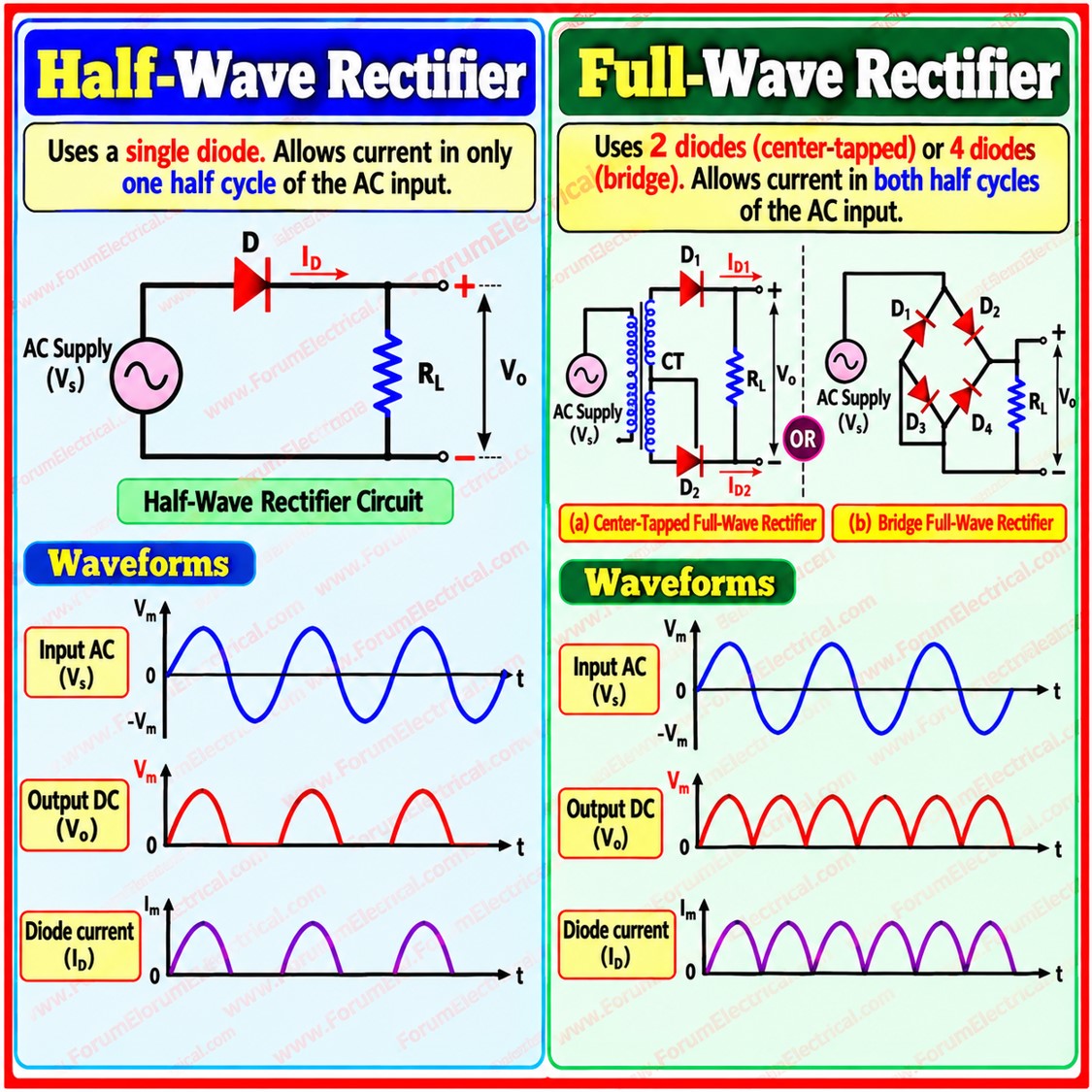
Difference between Half-Wave vs Full-Wave Rectifier
| Parameter | Half-Wave Rectifier | Full-Wave Rectifier |
|---|---|---|
| Basic operation | Converts only one half-cycle of AC into DC | Converts both half-cycles of AC into DC |
| Number of diodes | 1 diode | 2 diodes with center-tapped transformer or 4 diodes in bridge configuration |
| AC utilization | Uses only 50% of the input waveform | Uses both halves of the input waveform |
| DC output | Lower | Higher |
| Ripple | High | Lower |
| Ripple frequency | Same as supply frequency | Twice the supply frequency |
| Rectification efficiency | Lower | Higher |
| Filtering requirement | Requires larger filtering for smoother DC | Requires comparatively smaller filtering |
| Circuit complexity | Simple | More complex |
| Cost | Lower | Higher |
| Transformer utilization | Poorer | Better |
| Output quality | More pulsating DC | Smoother DC |
| Typical applications | Low-power and simple circuits | Power supplies, battery chargers and electronic equipment |